
While 91.5% of cold outreach emails are ignored, targeted link-building outreach can achieve a 13% response rate, and digital PR is now the top-performing tactic for 34% of SEOs. The practical answer is to stop treating outreach for SEO as a volume exercise and start treating it as an economics problem: invest effort where relevance, editorial fit, and likely link value justify the work.
Cold email still matters because backlinks remain a core part of SEO authority building. But the old “send more emails” advice breaks down in an inbox crowded with generic pitches, automated sequences, and poorly matched prospects. A smaller list of publishers who already care about your topic can produce more useful conversations than a large, unqualified database.
The distinction matters for forecasting. Generic cold email, targeted link-building outreach, relationship-based promotion, and digital PR all require different levels of preparation, produce different types of opportunities, and take different paths to a placement. A sustainable program measures those trade-offs instead of celebrating replies that never become editorial links.
Why Your SEO Outreach Gets Ignored
SEO outreach is rarely a volume problem. It is an economics problem, and the reply-rate gap makes that clear. One widely cited dataset found that only 8.5% of cold outreach emails received a response, leaving 91.5% ignored (Arvo's link-building statistics). A low response rate does not make outreach useless. It means a generic message sent to an uncertain prospect has little chance of starting a useful conversation.
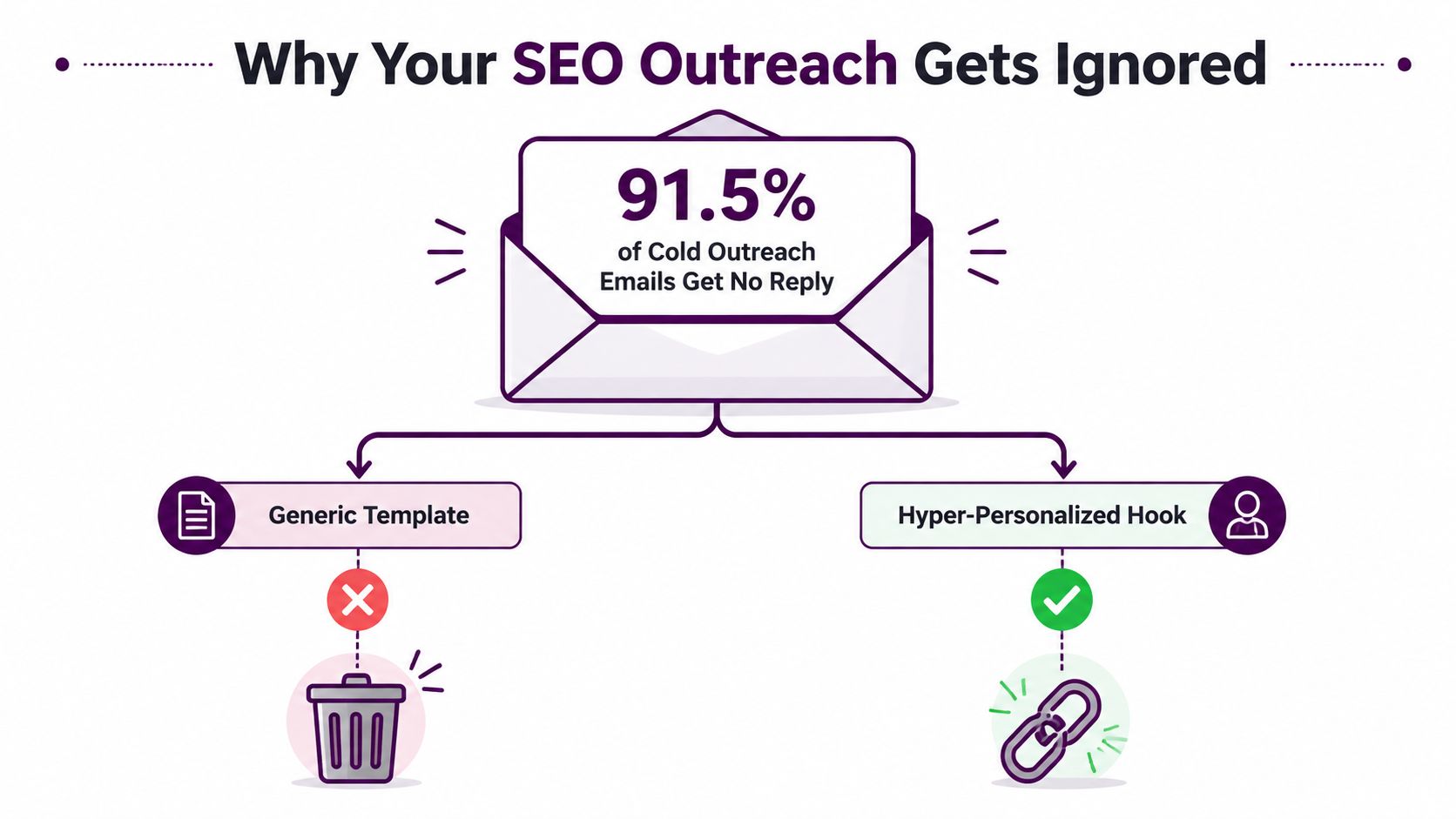
Start by checking the inputs before blaming the channel. If the recipient has no connection to your subject, does not publish the content you are promoting, or receives a message that could have gone to anyone, a polished template will not save the campaign. Relevance must exist before persuasion begins.
Inbox saturation makes poor targeting expensive. Editors and site owners can spot mass-produced requests quickly, and spam filters make delivery and attention harder to earn. Sending more emails may increase activity while producing fewer worthwhile opportunities. A smaller, better-matched prospect pool can therefore offer a stronger return than a large database.
Relevance beats activity
A useful outreach email answers three questions immediately:
Why this person: What did they publish, update, or curate that makes them a credible recipient?
Why this asset: What does your guide, data, tool, or commentary add to that specific page?
Why now: Is there a timely editorial gap, outdated reference, new development, or audience question?
Without those answers, the request transfers work to the recipient. They must inspect an unfamiliar page, judge its credibility, find a suitable placement, and accept editorial risk without seeing clear value.
Follow-ups can recover overlooked opportunities, but they cannot fix poor fit. The same reporting found that one follow-up increased replies by 65.8%, while personalized subject lines improved replies by 30.5%, as noted in the Arvo link-building dataset. Use persistence to revisit plausible opportunities, not to pressure an uninterested publisher.
Practical rule: Improve the prospect and the reason for contact before increasing the number of emails.
Treat the message as an offer of editorial assistance. That could mean replacing a broken reference, strengthening an explanation with a reliable source, giving a writer original evidence, or contributing expertise to a relevant story. The backlink becomes the result of a useful contribution, while targeted outreach and digital PR remain separate channels with different preparation costs and expected returns.
Prospecting and Qualifying the Right Targets
Outreach starts with a prospecting decision, not an email draft. Your first task is to identify publishers whose audience, subject matter, and editorial behavior make a link plausible. A site can look impressive in a spreadsheet and still be a poor target if it rarely links externally, publishes unrelated material, or has no page where your asset would improve the reader's experience.
Begin with the asset you want to promote. Define its audience, core topic, format, and strongest differentiator. A research report, a practical guide, a calculator, and a product comparison each create different outreach opportunities. Then search for publishers that have already covered adjacent subjects or linked to similar resources.
Build a fit-first shortlist
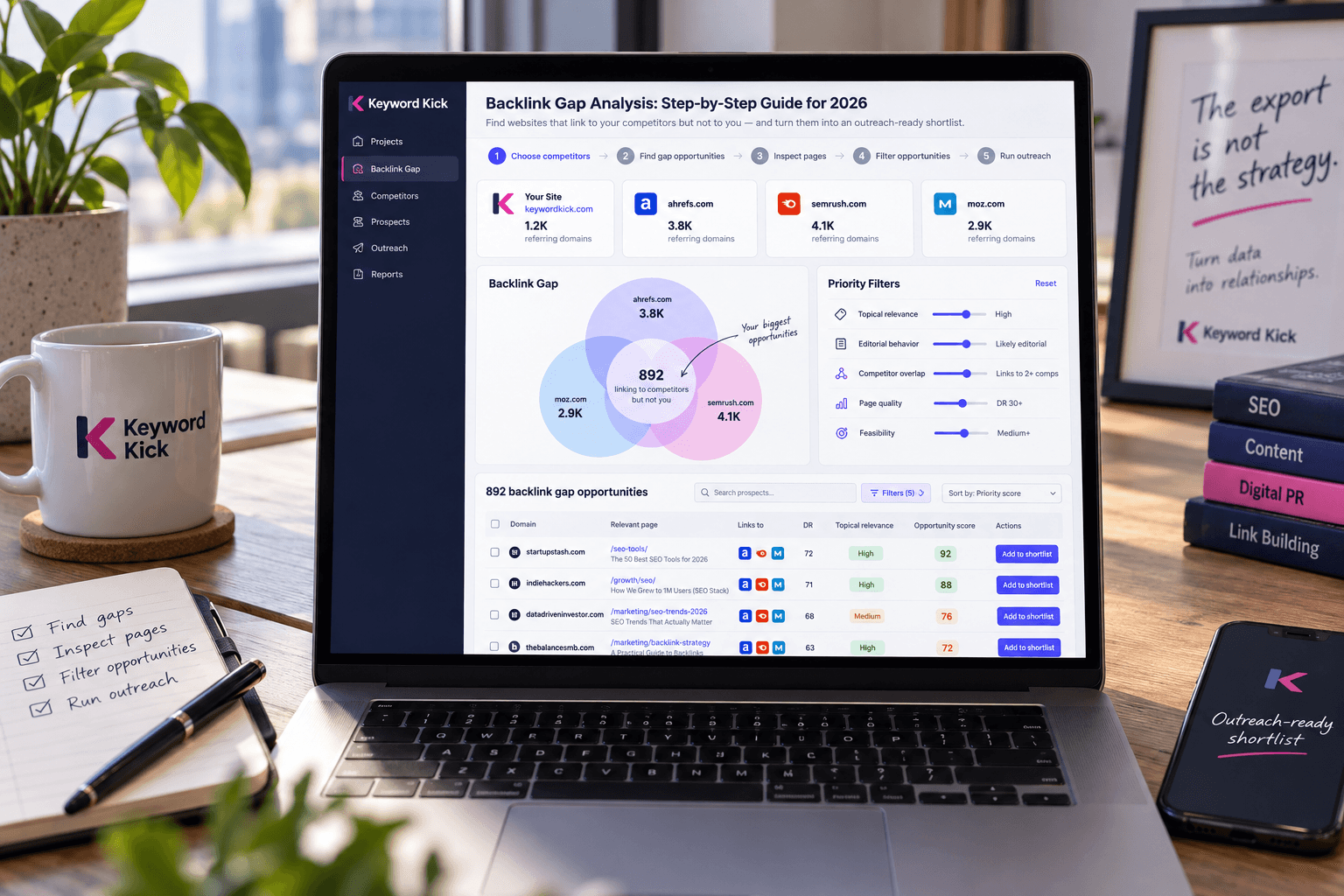
Use competitor backlink research to discover sites that have demonstrated linking behavior, but don't treat every referring domain as a lead. A practical workflow looks like this:
Find comparable pages. Identify competitor guides, tools, studies, or resource pages that attract relevant links.
Inspect the linking context. Record the exact page that links, the surrounding topic, and whether the link supports the reader or appears in a low-value directory.
Check editorial consistency. Review recent content, author information, update patterns, and the site's subject focus.
Look for a specific opening. An outdated statistic, missing explanation, weak resource, or unaddressed subtopic gives you a reason to write.
Remove weak fits. Exclude sites with no topical connection, unclear editorial standards, or patterns that suggest they publish links without meaningful review.
The competitor backlink analysis workflow helps turn competitor referring domains into a research source rather than a bulk contact list. The important judgment still happens manually. Tools can expose patterns, but they can't determine whether your page improves a publisher's article.
Identify the person who can act
A relevant editor, content manager, founder, or subject-matter writer is usually a better contact than a generic inbox. Confirm the person's role through the publication, author page, or professional profile, and note what they write about. Don't pretend you've read the entire site if you only reviewed one article. Specificity builds trust, but false familiarity destroys it.
Keep a research record for every prospect. Capture the page you're referencing, the proposed contribution, the contact's name, and the reason the fit is credible. This turns personalization from a last-minute flourish into a repeatable operating process.
For teams learning how to structure outreach conversations, A Founder's Guide to the B2B Sales offers useful context on qualification and buyer-focused communication. The same principle applies here: understand the recipient's priorities before presenting your request.
Qualification test: If you can't describe the exact reader benefit in one sentence, don't send the pitch yet.
Crafting Outreach That Earns a Reply
The strongest outreach messages reduce the editor's evaluation work. They identify a relevant page, explain the gap, present a credible resource, and make the next step easy. Personalization isn't inserting a first name into a template. It's showing that the message could only have been written for that recipient.
Consider a publisher who recently updated a guide about onboarding software. A weak pitch says:
“Hi, I love your site. We've published an amazing SEO guide and would love a backlink.”
That message creates no editorial reason to respond. It asks for a favor while forcing the recipient to investigate the sender's relevance.
A stronger version starts with the page itself:
“Hi Maya, I noticed your onboarding guide explains product tours and checklist adoption, but it doesn't cover how teams can measure which onboarding pages attract qualified search traffic. We've published a practical framework on mapping search intent to onboarding content, and the section on measurement could give readers a useful next step after the product-tour discussion.”
The second message still might be declined. No ethical outreach process guarantees acceptance. But it gives the editor a clear basis for evaluation and frames the asset as a possible improvement to an existing resource.

Structure the message around evidence
Use a compact sequence:
Subject line: Name the topic or editorial opportunity, not a vague promise.
Opening sentence: Reference a real page, section, update, or point of view.
Value sentence: Explain what your asset contributes to that specific audience.
Low-friction suggestion: Offer a possible use without dictating the placement.
Useful link: Make the resource easy to inspect.
Respectful close: Give the recipient permission to decline.
A subject line such as “Source for your onboarding measurement section” gives context without pretending the recipient already wants a backlink. Avoid exaggerated language, manufactured urgency, and claims that your asset is “the ultimate” resource. Editors have seen those phrases before, and they signal automation.
The first two sentences carry most of the burden. Don't spend them praising the publication. Spend them proving relevance. “I saw your article” is weak; “Your section on replacing outdated product screenshots links to a resource that no longer loads” creates a concrete editorial prompt.
Make the request editorial, not transactional
Different opportunities need different framing:
Broken link replacement: Identify the dead reference and explain why your page covers the same reader need.
Unlinked brand mention: Point out the existing mention and suggest a relevant destination, using a process such as converting unlinked brand mentions into backlinks.
Resource inclusion: Explain why the asset belongs alongside the resources already listed.
Expert contribution: Offer a focused perspective or answer, not a generic biography.
Guest contribution: Lead with a specific article idea that matches the publication's existing coverage.
Follow-ups should add clarity rather than repeat “just checking in.” You might clarify the section you're referring to, share a more relevant asset, or close the loop politely. If the recipient says no, thank them and record the reason. A respectful decline can preserve a future relationship, while an aggressive sequence can eliminate one.
Editorial standard: Ask whether your message helps the publisher make a better content decision. If it only helps you acquire a link, rewrite it.
Comparing Outreach Models for Maximum Impact
Outreach models differ in more than reply rate. They also differ in the quality of the resulting placement, the amount of creative work required, the likelihood of earning referral attention, and the time your team must spend before a link appears.
The 2025 benchmark cited by Hunter.io reported an average cold email sequence reply rate of 4.5% across 31 million emails, or about 45 replies per 1,000 recipients. For link-building and digital PR specifically, the same benchmark cited a 13% average response rate, indicating that a tightly aligned niche pitch can outperform generic cold email (Cold email outreach benchmarks).
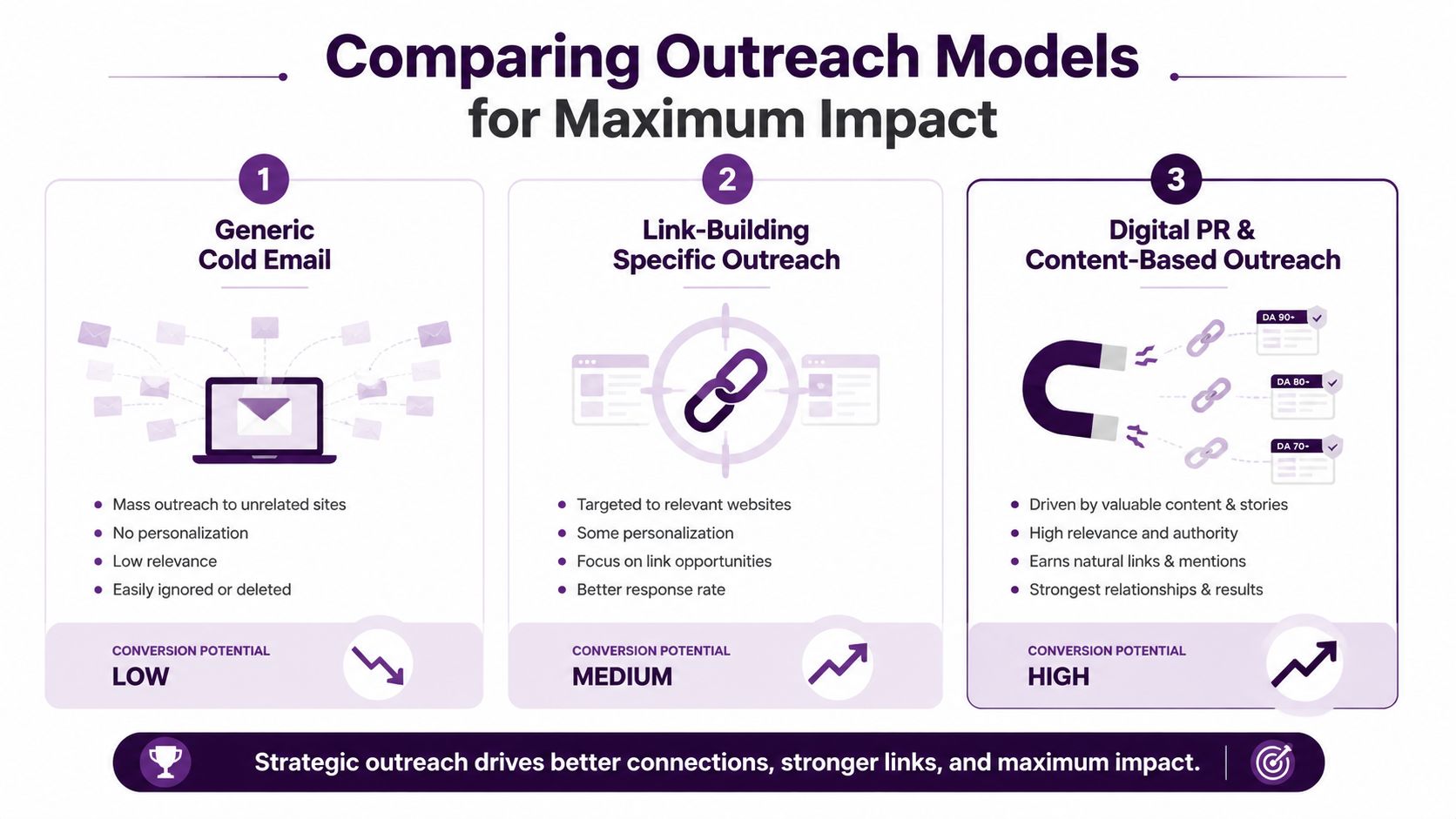
Generic cold email
Generic cold email is easy to launch and easy to misunderstand. It can work when the audience is narrowly defined and the offer has obvious relevance, but broad lists create substantial waste. The message often asks for a link, guest post, or partnership without demonstrating why that recipient is a logical match.
Its main advantage is speed. Its main weakness is poor qualification. If your team can't explain the editorial destination before sending, this model is usually economically weak even when the software makes sending inexpensive.
Targeted link-building outreach
Targeted outreach starts with a page, resource gap, mention, or linking pattern. The email may still be cold, but the underlying research is warm because the publisher has already shown interest in the subject.
This model generally produces fewer contacts per research hour, yet each contact has a clearer path to a placement. Use it for evergreen assets, resource replacement, competitor-link opportunities, and content that improves a specific page. The economics become attractive when one relevant placement can support rankings, referral discovery, or future editorial relationships.
Teams that want broader founder-focused communication ideas can also review these outreach techniques for founders, then adapt the principles to publisher-specific conversations rather than treating founders and editors as interchangeable audiences.
Digital PR and content-based outreach
Digital PR leads with a story, insight, data asset, expert perspective, or timely editorial angle. The publisher's incentive is coverage or a useful source for a story, while the SEO benefit comes from the authority and relevance of earned mentions.
A 2026 survey of 500 SEO professionals found digital PR was the top-performing tactic for 34% of respondents, ahead of guest posts at 18% and HARO at 21% (State of link building survey). Those figures describe respondents' reported tactic performance, not a guaranteed outcome for every campaign. Digital PR can require stronger research, faster response, better media judgment, and more coordination than a standard resource pitch.
Model | Best fit | Main cost | Editorial upside |
|---|---|---|---|
Generic cold email | Narrow offers with simple qualification | List waste and weak relevance | Limited unless the audience fit is unusually clear |
Targeted link-building outreach | Existing pages, content gaps, and relevant resources | Manual research and tailored copy | Strong contextual fit |
Digital PR | Newsworthy assets, original insight, and expert commentary | Creative development and campaign coordination | Potentially broader authority and media visibility |
Choose the model based on the asset and the business objective. If you need a contextual link to a defined page, targeted outreach may be more rational. If you have an interesting story, digital PR can justify the heavier preparation. If neither is true, improve the asset before contacting anyone.
Measuring Impact and Scaling Responsibly
Reply rate is an early diagnostic, not the final business metric. A campaign can generate polite responses without producing relevant placements, and it can earn a valuable link from a conversation that never looked promising in the inbox. Track the full path from prospect quality to durable outcome.
Start with a simple measurement chain:
Qualified prospects: How many contacts meet your topical, editorial, and audience criteria?
Delivered messages: How many valid emails reached the intended contact?
Positive responses: How many replies indicate genuine interest rather than an automated rejection or unrelated offer?
Editorial opportunities: How many conversations identify a possible page, contribution, mention, or story?
Placements earned: How many links or mentions went live?
Placement quality: Does each result fit the topic, provide reader value, and remain editorially credible?
Business contribution: Does the linked page gain relevant referral attention, stronger visibility, assisted conversions, or useful relationships?
This prevents a common reporting error: celebrating top-of-funnel activity while ignoring whether the campaign produced assets the business needed.
Use automation for operations, not judgment
Sequencing tools can manage reminders, suppress contacts after a reply, and keep records consistent. They shouldn't decide which prospects deserve a message or generate every personalization line without review. A human should verify the page reference, proposed angle, and recipient before launch.
Use a shared sheet or CRM with fields for:
Prospect fit: Topic, audience, publication type, and editorial relevance.
Contact context: Name, role, author pages, and prior communication.
Pitch angle: Broken reference, resource gap, mention, expert response, or story.
Status: Not contacted, sent, replied, negotiating, placed, declined, or archived.
Outcome notes: Placement URL, anchor context, editorial conditions, and follow-up date.
For backlink monitoring, this operational playbook for monitoring backlinks provides a useful structure for connecting outreach activity to what appears on the web.
Decide whether to scale or fix
Use campaign evidence to choose the next move:
Low engagement across a well-qualified list: Rework the opening, subject line, or offer. Don't immediately expand volume.
Positive conversations but few placements: Improve the asset, clarify editorial terms, and reduce friction in the handoff.
Placements from weak-fit sites: Tighten qualification and reject opportunities that don't serve the audience.
Strong results from one segment: Expand within that segment carefully, preserving the same relevance signals.
No credible asset to promote: Switch from link solicitation to asset development or a digital PR concept.
A follow-up sequence should have a clear stopping point. Persistent contact can recover missed messages, but repeated nudges to an uninterested editor damage trust and waste research time. Sustainable outreach protects sender reputation and leaves room for future collaboration.
Putting It All Together Your Outreach Action Plan
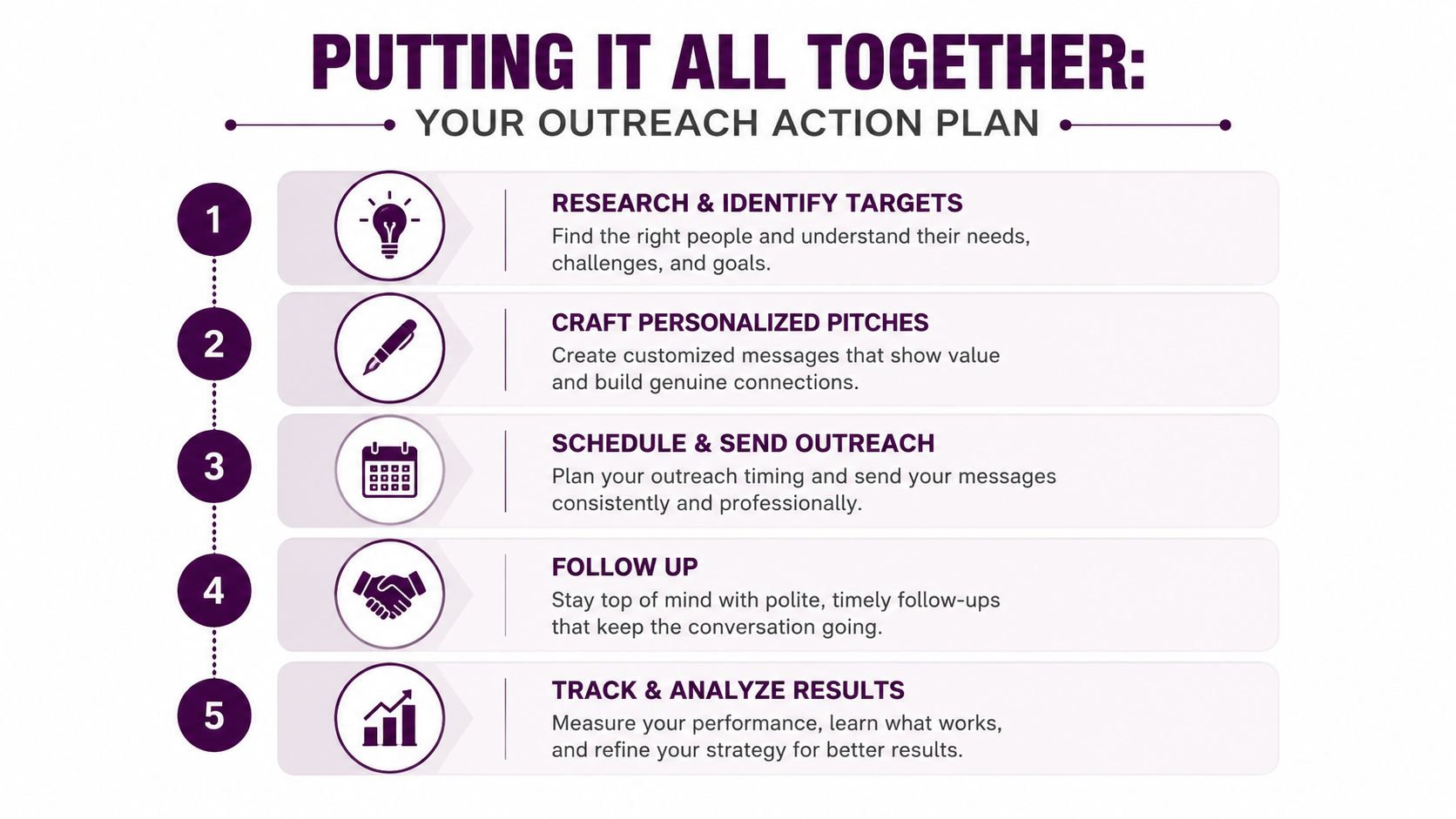
A practical outreach for SEO program starts with a page that deserves attention and ends with a placement record you can inspect. The process below keeps those two points connected.
Research and identify targets. Start with competitors, relevant publications, resource pages, and recent coverage. Keep prospects only when you can name the audience benefit and a realistic editorial opening.
Craft personalized pitches. Mention the exact page or section, explain the contribution, and use a subject line that reflects the opportunity. Remove generic praise and unsupported claims.
Schedule and send carefully. Segment by opportunity type and review every personalization field before launch. Automation can handle timing, but it shouldn't replace editorial judgment.
Follow up with purpose. Add context, answer a likely question, or close the loop. Don't send repetitive nudges that make the recipient work harder.
Track and analyze results. Record qualified prospects, replies, conversations, placements, and live URLs. Compare outcomes by segment and angle, then refine the weakest stage.
Avoid the familiar traps: buying unqualified lists, pitching irrelevant publications, relying on the same template for every editor, and judging success by sent volume. When replies fall, inspect relevance, asset quality, and contact accuracy before changing the sending cadence.
The economic question is simple: does the likely value of the opportunity justify the research and relationship work? Generic cold email often fails that test. Targeted link-building outreach and digital PR can pass it when the content, publisher, and audience align closely.
Keyword Kick helps agencies and in-house teams connect backlink data with rankings, technical signals, competitor analysis, and search performance in one workspace. Use Keyword Kick to audit your prospecting assumptions, monitor earned links, and turn outreach results into prioritized SEO actions.