
SEO growth hacking isn't publishing more articles and hoping traffic follows. It isn't stuffing a target phrase into every heading, buying random links, or chasing a new shortcut whenever rankings move. Google's Florida update in November 2003 began a series of major shifts that weakened keyword stuffing, cloaking, and doorway pages. Panda, released on February 23, 2011, and Penguin, released on April 24, 2012, pushed thin content and manipulative links further out of the reliable SEO playbook. Later changes, including RankBrain in 2015, mobile-first indexing in 2018, BERT in 2019, and Core Web Vitals becoming a ranking signal in 2021, made technical quality, intent matching, and user experience central to sustainable growth (historical SEO timeline).
The fastest gains often sit inside assets you already own: pages hovering near page one, competing pages splitting authority, technical blockers, overlooked commercial queries, and SERP features that change how users discover answers. Treat each opportunity as an experiment. Establish a baseline, state a hypothesis, make a bounded change, measure rankings, clicks, technical health, and conversions, then keep, revise, or roll back the change.
The ten tactics below follow that sequence. First, find problems and high-impact opportunities. Then execute focused improvements. Finally, protect visibility as search results become more crowded and AI-generated answers take a larger role.
1. Traffic Anomaly Detection and Rapid Response Optimization
Traffic anomalies deserve investigation before optimization. A sudden drop can reflect a crawlability problem, indexation change, Core Web Vitals regression, competitor movement, or an algorithm adjustment. A spike can reveal a topic, page, or audience segment worth expanding while demand is active.
Start by defining normal performance for each important page and channel. Compare current data with historical patterns in GA4, then check Google Search Console for query, click, impression, coverage, and manual-action changes. A publisher that sees impressions fall for a major article should inspect indexing and internal links before rewriting the copy. An e-commerce team that sees organic revenue decline after a template release should test page rendering and speed before changing product descriptions.
Practical rule: Treat an anomaly as a diagnostic trigger, not as proof that rankings caused the change.
Create an alert system around meaningful movement rather than every fluctuation. Track priority queries, landing pages, crawl errors, indexation, and page experience in one operating view. Keyword Kick can help connect rank tracking with analytics, Search Console, technical audits, and historical trends, so the team can ask whether the same pages lost rankings, clicks, and conversions.
Document the incident, suspected cause, fix, and outcome. Over time, those records reveal recurring failure patterns, such as releases that add accidental noindex tags or scripts that slow key templates. The experiment ends with a decision: restore the affected asset, capitalize on a new demand pattern, or continue monitoring because the evidence remains inconclusive.

2. Technical SEO Quick-Win Fixes and CWV Optimization
Technical fixes are useful only when they remove a real constraint. A page that search engines can't crawl, index, render, or use comfortably won't benefit fully from better copy or stronger promotion. Start with the pages that already attract impressions or support commercial journeys, then trace the issue from discovery to conversion.
Review Search Console coverage and crawl reports, inspect XML sitemaps, and check important templates for accidental noindex directives, canonical errors, broken internal links, and mobile usability problems. Use PageSpeed Insights and the Web Vitals report to isolate performance regressions. Largest Contentful Paint deserves early attention when the main content takes too long to appear, but teams should diagnose the underlying cause rather than apply the same fix everywhere.
A practical sequence looks like this:
Remove blocking resources: Defer non-critical JavaScript and reduce scripts that delay rendering.
Improve media delivery: Compress images, use appropriate dimensions, and lazy-load assets outside the initial viewport.
Stabilize delivery: Review hosting and CDN configuration when server response or geographic delivery creates friction.
Repair discovery paths: Keep sitemaps accurate and make sure important pages receive clear internal links.
Set a monitoring baseline: Recheck page experience after deployments and record which templates changed.
For a focused explanation of the metric framework, use this guide to Core Web Vitals for SEOs. If budget constraints affect tooling, group buying for SEO tools may be one option to evaluate, but access to a tool doesn't replace technical judgment.
3. Cannibalization Elimination and Keyword Consolidation
Two pages can rank for similar queries without causing a problem. The issue is competing pages that satisfy the same intent, overlap heavily, and divide internal links, backlinks, and editorial attention. Consolidation should follow evidence, not a blanket rule that every repeated phrase requires a redirect.
Find queries where multiple pages from the same domain appear in meaningful ranking positions. Then compare intent, content purpose, impressions, clicks, backlinks, conversions, and update history. An older guide and a newer guide may both rank because they serve distinct audiences. A product category and a buying guide may also deserve separate pages if one targets discovery and the other supports evaluation.
When the overlap is genuine, choose a primary page using the strongest combination of relevance, performance, authority, and business value. Rewrite or expand that page so it can satisfy the shared intent. Redirect a redundant page with a permanent redirect when its useful signals and user value can be transferred, and remove or redirect internal links that still point to the secondary URL.
Make the consolidation testable
Record the original URLs, target query set, chosen primary page, redirect decision, internal-link changes, and expected outcome. After deployment, watch Search Console for impressions and clicks across the affected query group, not just one keyword. Also check for redirect chains, broken references, and user journeys that previously depended on the retired page.
A successful consolidation should produce a clearer architecture and a stronger primary result. If visibility declines or intent coverage becomes weaker, restore the necessary distinction rather than forcing every similar page into one destination.
4. Rank Tracking Pattern Analysis and Opportunity Prediction
Rank tracking becomes valuable when it changes what the team does next. A list of positions tells you what happened. A historical view can show whether a page is gaining momentum, losing ground, responding to an update, or moving because demand is seasonal.
Group tracked queries by page, content pillar, funnel stage, product line, and market. Then review changes alongside impressions and clicks. A page ranking just outside the first page may need clearer intent alignment, stronger internal links, better snippet formatting, or a small content refresh. A page losing rankings while impressions remain stable may have a relevance problem. A page losing both impressions and rankings may require a broader demand or technical investigation.
The useful forecast isn't “this keyword will rank.” It's “this page has evidence of momentum, and this bounded intervention could improve its probability of reaching the next meaningful result set.”
Use weekly reviews for operational decisions and longer historical exports for seasonality and content decay. Track newly published pages separately from established assets, because early volatility can look like decline even when the page is still being discovered. Create alerts for priority queries entering prominent positions, but don't let alerts become the KPI. Clicks, qualified sessions, leads, revenue, and assisted conversions determine whether a ranking movement matters.
A SaaS team might notice that comparison content is gaining impressions while feature explainers are flat. That pattern can justify shifting editorial effort toward evaluation-stage pages, provided conversion data supports the move. The experiment is to optimize a selected group, leave a comparable group unchanged where practical, and review the difference rather than crediting every improvement to the latest edit.
5. High-Intent Keyword Priority Sequencing
Search volume alone creates weak priorities. A broad educational query may attract attention, while a product comparison, pricing, review, or implementation query may sit much closer to a buying decision. SEO growth hacking starts by connecting query intent to business value, then allocating effort where the path from search to conversion is credible.
Classify opportunities by the action implied by the query. “What is” and problem-led searches often need education. “Best,” “versus,” “review,” “pricing,” and product-specific searches may support consideration or decision-making, although the SERP must confirm the interpretation. A SaaS company might prioritize a comparison page over another general feature explainer if visitors from comparison queries progress further into the trial or sales journey.
Sequence the work by evidence
Begin with queries where the site already receives impressions but has weak click capture or an unsuitable landing page. Check whether competitors occupy positions that appear realistically contestable, then inspect the result page for shopping units, local results, ads, videos, and answer features. A query dominated by features may require a different visibility strategy from a conventional organic listing.
Create or refine a dedicated landing page when a generic category page can't answer the intent. Align the title, opening value proposition, proof, specifications, objections, and call to action with the searcher's decision stage. In GA4, connect the landing page and query group to conversion events or conversion value where available.
The hypothesis should be narrow: matching a defined high-intent query group to a purpose-built page will improve qualified engagement or conversion efficiency. If rankings rise but conversion quality doesn't, the page may be attracting the wrong audience, or the commercial promise may not match the product.
6. Content Gap Analysis and Competitive Intelligence
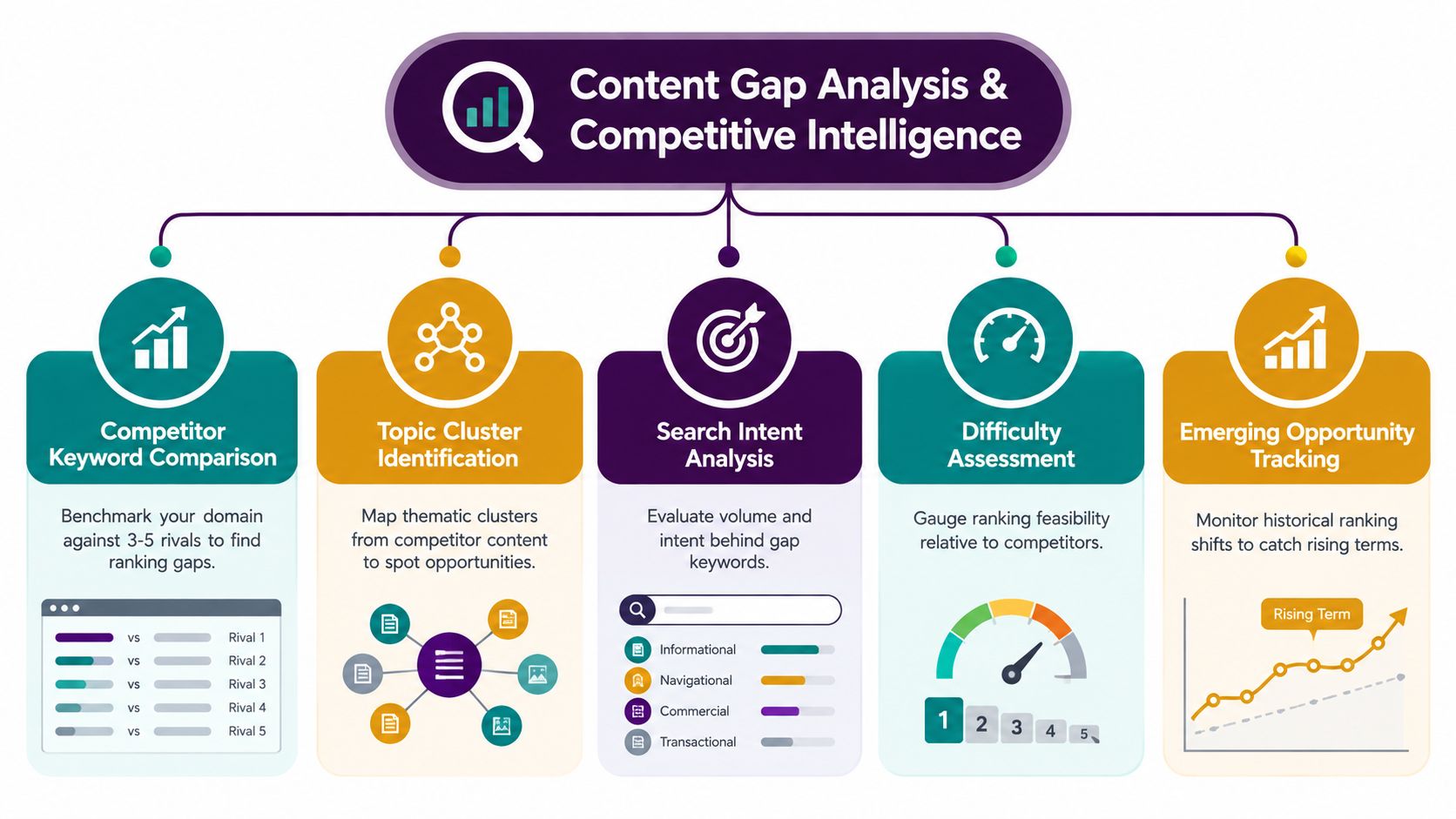
A competitor gap is not automatically an opportunity. Competitors may rank for topics outside your expertise, queries with poor commercial value, or pages that succeed because of authority you can't reproduce quickly. The useful gap combines unmet demand, a credible right to compete, and a clear role in your customer journey.
Compare your domain with a small set of direct competitors, then separate gaps into content, keyword, and backlink categories. Look for repeated themes rather than isolated terms. If several relevant competitors rank for integration questions and your product supports those integrations, the gap may justify a content cluster. If they rank for unrelated informational topics, publishing a copycat page may dilute your topical focus.
Cross-reference competitor gaps with Search Console. Queries where your pages already receive impressions are especially useful because they reveal latent relevance. Improve an existing page when the gap is a missing subsection or unclear intent. Create a new page when the query deserves a distinct answer, audience, or conversion path.
Use competitive intelligence for SEO to structure the comparison, but validate every recommendation against your own data and expertise.
Turn gaps into a bounded publishing test
Choose a coherent cluster, assign one primary page and supporting pages, and define the internal-link relationships before production. Set a baseline for impressions, clicks, ranking distribution, assisted conversions, and indexed status. Publish the smallest useful set that can test whether the theme earns visibility, then expand only when search demand and user behavior support it.
A market gap becomes strategically valuable when it reveals a missing customer answer, not merely a missing URL. That distinction protects teams from producing large volumes of low-fit content.
7. Intent-Matched Content Optimization and User Journey Mapping
A page can rank and still fail because it answers the wrong question. Search intent changes the required format, depth, proof, and call to action. A reader searching for a definition needs orientation. Someone comparing tools needs trade-offs. A buyer evaluating a product needs specifications, trust signals, and a clear next step.
Map query groups to awareness, consideration, and decision stages, then inspect the pages currently earning visibility. Review their structure, vocabulary, media, evidence, navigation, and conversion paths. Don't copy them mechanically. Use the result page to understand what users and search engines appear to consider a satisfactory answer, then make your page more useful and more specific.
A finance publisher might separate learning content from action-focused product reviews. A SaaS company may use problem pages for early-stage discovery, comparison pages for evaluation, and pricing or implementation pages for decision-making. Each page should make its purpose obvious within the opening section.
Measure the journey, not just the page
Connect the page to GA4 engagement and conversion events. Review scroll behavior, interaction with comparison elements, clicks to pricing, form starts, product views, and assisted conversions. A high engagement rate can be misleading if visitors can't move toward a relevant next step. A low time on page may be positive for a direct answer, so interpret the metric against intent rather than applying a universal benchmark.
Test one structural change at a time where possible, such as moving proof closer to the decision point or replacing a generic introduction with a direct answer. The decision should depend on qualified actions and search visibility, not on word count or keyword repetition.
8. Semantic Keyword Clustering and Topic Authority Building
A keyword list becomes more useful when it reflects how customers describe one problem from different angles. Group related queries by shared intent, entity, use case, audience, and stage. The cluster then informs the information architecture instead of dictating a separate page for every wording variation.
Start with priority queries and inspect their shared subtopics. A marketing software site might group queries around campaign planning, automation, reporting, and integrations, while an e-commerce site might organize content by product use case, maintenance, compatibility, and comparison. The exact structure should come from the SERP, customer language, product knowledge, and existing site performance.
Build a broad pillar page only when it can provide a useful overview. Supporting pages should answer narrower questions that deserve their own treatment, not repeat the pillar with minor wording changes. Link the pages deliberately, using anchors that describe the destination and adding links where the reader needs the next layer of detail.
A cluster is an operating model, not a publishing quota. Add a supporting page only when it resolves a distinct information need or strengthens a real journey.
Track the cluster as a unit. Review total impressions, clicks, assisted conversions, internal-link flow, and the performance of the pillar and supporting pages together. If several pages remain weak because they overlap, consolidate them. If users move from informational pages to commercial pages, preserve that path and improve the handoff.
Authority grows through coherent coverage and useful connections. It doesn't come from producing pages that share a few related phrases.
9. SERP Feature Optimization and Rich Snippet Capture
The search result page is part of the product experience. Featured snippets, People Also Ask results, local packs, shopping results, news features, and knowledge panels can change which listings receive attention. A page may gain visibility through a feature even when it isn't the conventional top result, but the feature must fit the query and the content must support it accurately.
Inspect the SERP for target queries before editing the page. Note whether the result favors a paragraph, ordered steps, table, definition, comparison, local information, product data, or video. Then format the answer so users can extract the key point quickly, while retaining enough surrounding context to make the page useful.
Structure question-led sections with direct responses, descriptive headings, clear lists, and appropriately marked-up data. Use schema only when it accurately describes visible page content and complies with search-engine guidelines. FAQ markup doesn't guarantee a People Also Ask placement, and structured data can't compensate for weak content or mismatched intent.
Optimize for visibility and click value
Track feature ownership and click changes in Search Console. AI Overviews make this measurement more important. Tracked keywords with AI Overviews rose from 6.49% in January 2025 to 24.61% in July, then settled at 15.69% in November, according to Semrush's AI Overviews study. Other research summarized in the same source found AI Overviews on 30% of U.S. desktop keywords, while organic click-through rates can fall sharply when those summaries appear.
That creates a new question: how do you grow when the result page takes the click? Prioritize queries where a cited source, brand preference, product evaluation, or deeper explanation still gives users a reason to visit. Improve concise answer blocks, strengthen brand demand, and measure qualified clicks rather than treating every impression as an equal opportunity.
10. Backlink Velocity and Authority Stacking
Link acquisition works best as a relevance and credibility program, not a race for the largest possible count. A link from a publication that serves your audience and discusses your subject can support discovery and authority more naturally than an unrelated high-authority placement. The target page, surrounding context, and editorial reason for the link all matter.
Begin with competitor backlink analysis. Identify recurring sources, resource pages, review sites, industry publications, associations, podcasts, partner ecosystems, and original research opportunities. Then classify each prospect by topical relevance, editorial fit, audience value, and the likelihood that the link will remain useful. A SaaS company may pursue legitimate software directories and comparison sites, while an e-commerce brand may create product expertise that earns inclusion in specialist guides.
Build authority in coordinated layers
Support a priority commercial page with useful informational assets, partnerships, digital PR, expert contributions, and internal links. The supporting assets should deserve references independently. Avoid campaigns built around exact-match anchors, irrelevant placements, or sudden bursts of low-quality links, because those patterns can create risk without improving user value.
Track newly discovered links, lost links, referring domains, target pages, anchor distribution, and referral engagement. Search Console can help identify unnatural patterns, but third-party backlink data can provide broader competitive context. If a link brings qualified referral visits or strengthens a page's reputation within its niche, it has value beyond a ranking metric.
The experiment is straightforward: choose a target page, define a relevant acquisition theme, earn editorially defensible mentions, and compare visibility and conversions against the baseline. Retain sources that contribute value. Stop outreach that produces placements without relevance, trust, or measurable assistance.
10-Point SEO Growth-Hacking Comparison
Strategy | Implementation Complexity 🔄 | Resource Requirements ⚡ | Expected Outcomes ⭐📊 | Ideal Use Cases | Key Advantages 💡 |
|---|---|---|---|---|---|
Traffic Anomaly Detection & Rapid Response Optimization | High, continuous monitoring + rapid diagnostics | Monitoring stack, real-time alerts, analysts/dev time | ⭐ Prevents revenue loss; 📊 rapid detection and recovery of drops/spikes | Revenue-dependent sites, e‑commerce, agencies managing many clients | Fast detection of issues; capitalize on spikes; protects peak-period revenue |
Technical SEO Quick-Win Fixes & CWV Optimization | Medium, targeted audits and dev fixes | Developer time, audit tools, PageSpeed/CWV monitoring | ⭐ Quick ranking gains within days–weeks; 📊 improved UX and stability | In‑house teams with devs, agencies, high‑traffic e‑commerce | Fast ROI from fixes; foundational for other tactics; improves user experience |
Cannibalization Elimination & Keyword Consolidation | Medium, analysis + coordinated content moves | SEO analysts, content owners, devs for redirects | ⭐ Significant rank boosts (2–3 positions common); 📊 better crawl efficiency | Mature content sites, large catalogs, publishers | Quick wins by consolidating existing pages; reduces wasted crawl and competition |
Rank Tracking Pattern Analysis & Opportunity Prediction | High, data modeling and trend analysis | Long-term rank dataset, analytics/ML tools, analyst time | ⭐ Predictive insights to prioritize keywords; 📊 proactive optimization before drops | Data-driven SEO teams, agencies with large keyword sets, brands planning strategy | Identifies near-win keywords; improves planning and reduces firefighting |
High-Intent Keyword Priority Sequencing | Low–Medium, prioritization workflow | Keyword intent data, conversion tracking (GA4), copy/landing resources | ⭐ Faster path to revenue; 📊 higher conversion from targeted traffic | E‑commerce, SaaS, performance-focused agencies | Focuses resources on revenue-driving queries; measurable ROI |
Content Gap Analysis & Competitive Intelligence | Medium, competitor research + content creation | Competitive tools, content production capacity, analyst time | ⭐ Targets achievable opportunities; 📊 faster wins vs. blind keyword research | Agencies, in‑house teams in competitive niches, growth teams | Reveals market blind spots; reduces guesswork in content planning |
Intent-Matched Content Optimization & User Journey Mapping | Medium–High, content mapping & testing | Content strategists, UX, analytics, A/B testing resources | ⭐ Improved relevance and engagement; 📊 better conversions and lower bounce | Content teams, SaaS companies, e‑commerce focused on funnel optimization | Aligns content to user intent; increases engagement and conversion quality |
Semantic Keyword Clustering & Topic Authority Building | High, strategic planning and content network | Large content production, SEO tooling, editorial coordination | ⭐ Builds durable topical authority; 📊 defensible rankings across related terms | Established brands, SEO agencies, startups aiming for authority | Creates comprehensive resources; reduces cannibalization and improves depth |
SERP Feature Optimization & Rich Snippet Capture | Medium, formatting + structured data | Schema/markup implementation, SERP tracking tools, content edits | ⭐ Higher CTR and visibility without #1 rank; 📊 incremental traffic gains | Content marketing teams, e‑commerce, local businesses | Fast visibility wins via snippets/PAA/local pack; improved CTR |
Backlink Velocity & Authority Stacking | High, sustained outreach and relationship building | Outreach teams/agencies, content assets, budget and time | ⭐ Strong ranking lifts for competitive terms; 📊 durable authority gains over time | Agencies running link campaigns, enterprises, competitive niches | Builds defensible rankings; compounds value of future links |
Turn the Tactics Into a Repeatable Growth Loop
SEO growth hacking becomes reliable when the team treats it as a portfolio of controlled decisions. Start by establishing baselines in GA4, Google Search Console, rank tracking, backlink monitoring, and technical audits. Record organic sessions, landing-page clicks, impressions, conversions, conversion value where available, ranking distribution, indexation status, crawl issues, page experience, and relevant referral activity.
Then select one opportunity using expected impact and effort. A page losing clicks after an indexation change may outrank a new content idea. A commercial page already receiving impressions may deserve attention before a broad awareness topic. A cluster with clear intent and existing expertise may be safer to test than a competitor gap that requires authority you don't yet have.
Write the hypothesis in operational terms. For example, a team might state that consolidating two overlapping comparison pages into one stronger destination will clarify intent and improve qualified clicks. Another hypothesis might predict that correcting a template-level rendering problem will restore discovery for affected pages. Define the change, the pages or queries included, the owner, the launch date, the expected observation window, and the decision rule before implementation.
Ship the smallest useful change. Don't rewrite an entire site when a title, internal-link path, rendering fix, or focused section can test the assumption. Keep a record of what changed so later analysis doesn't confuse multiple interventions. Where practical, maintain an untreated comparison set or compare the affected segment with its own historical baseline.
Review results on a defined cadence. Daily monitoring helps catch severe technical failures. Weekly reviews support ranking and anomaly response. Longer-term reviews reveal content decay, seasonality, cluster performance, and conversion quality. Separate correlation from proof. A ranking improvement after an edit is encouraging, but the team should still check whether clicks, qualified sessions, leads, sales, or assisted conversions improved.
Keyword Kick can serve as one workspace for fragmented signals from GA4, Search Console, rank tracking, backlinks, technical audits, competitor analysis, keyword research, and SERP features. Its K² AI Agent can turn those connected signals into prioritized recommendations, such as investigating a traffic decline or choosing pages for optimization. Use any platform as decision support, then validate recommendations against the underlying data and business context.
Retain tactics that create durable visibility or commercial value. Revise changes that improve rankings but attract the wrong intent. Roll back changes that damage discoverability, usability, or conversion paths. Sustainable SEO growth hacking isn't a collection of unsupported shortcuts. It's disciplined iteration, clear ownership, bounded experiments, and decisions based on what users and the business do.
Keyword Kick connects GA4, Google Search Console, rank tracking, backlinks, technical audits, keyword research, competitor analysis, and SERP feature data in one workspace for prioritized SEO action. Use it to identify anomalies, content gaps, cannibalization, and high-intent opportunities, then visit Keyword Kick to turn your next SEO experiment into a measurable workflow.