You publish a page around a keyword that looked promising in the tool. A few weeks later, impressions are up, clicks are decent, and the ranking report looks healthy.
Then you check pipeline, trials, or sales. Nothing moved.
That disconnect is why so much keyword research work feels busy rather than useful. Teams chase terms that can bring visitors, but they don't stop long enough to ask whether those visitors are likely to become customers. If you're trying to learn how to choose keywords, that's the mistake to avoid first. Good keyword selection doesn't start with volume. It starts with what the business needs the page to do.
The Real Goal of Choosing Keywords
A lot of keyword advice still treats the job like a filtering exercise. Find a term with enough searches, acceptable competition, and publish something around it. That approach can produce traffic, but traffic by itself doesn't pay for content, SEO tools, or the hours your team spends building pages.
A more useful standard is simpler. Choose keywords that bring the right visitor to the right page at the right stage of the buying process.
Carnegie Higher Ed makes this gap explicit in its guidance on keyword research. It notes that many keyword guides still overemphasize volume and competition, while stronger approaches tie keyword selection to business goals and funnel stage. It also makes the key point that the best keyword often isn't the highest-volume term, but the one that maps cleanly to a page's job in the buyer journey, as explained in Carnegie Higher Ed's keyword research guidance.
Why traffic can fail
The failure usually comes from intent mismatch.
You rank for an informational term, but the page asks for a demo too early. Or you rank for a broad term that attracts students, job seekers, and casual researchers when your company sells to procurement teams. Or you target a phrase that sounds relevant on paper, but the search results are dominated by definitions, directories, or comparison pages that don't fit what you're selling.
Practical rule: If the visitor's next logical action doesn't match the page's call to action, the keyword is wrong for that page.
This is why "more traffic" is a weak SEO goal. A page can perform well in Search Console and still fail the business. The stronger question is: what kind of visit would create value here?
A better north star
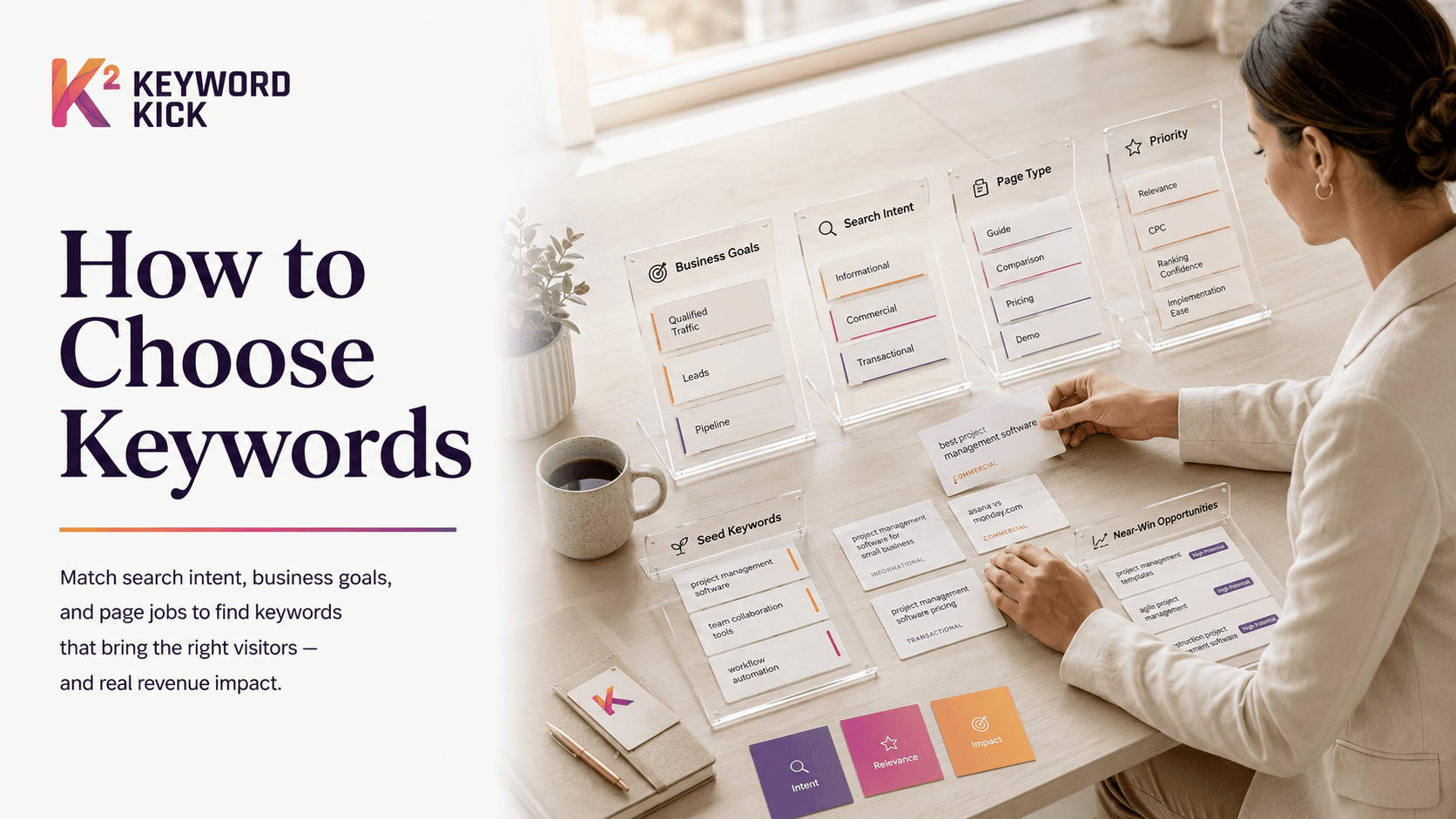
When I train teams on how to choose keywords, I ask them to stop thinking in isolated terms and start thinking in page jobs.
A pricing page needs visitors with buying intent. A comparison page needs evaluators. A guide at the top of the funnel needs searchers who are still framing the problem. Once you define the page's job, keyword selection gets easier because many options drop out immediately.
That shift changes the workflow from "What can we rank for?" to "What can we rank for that helps revenue?" That is the difference between an SEO content calendar and an SEO growth system.
Align Keywords with Goals and Search Intent
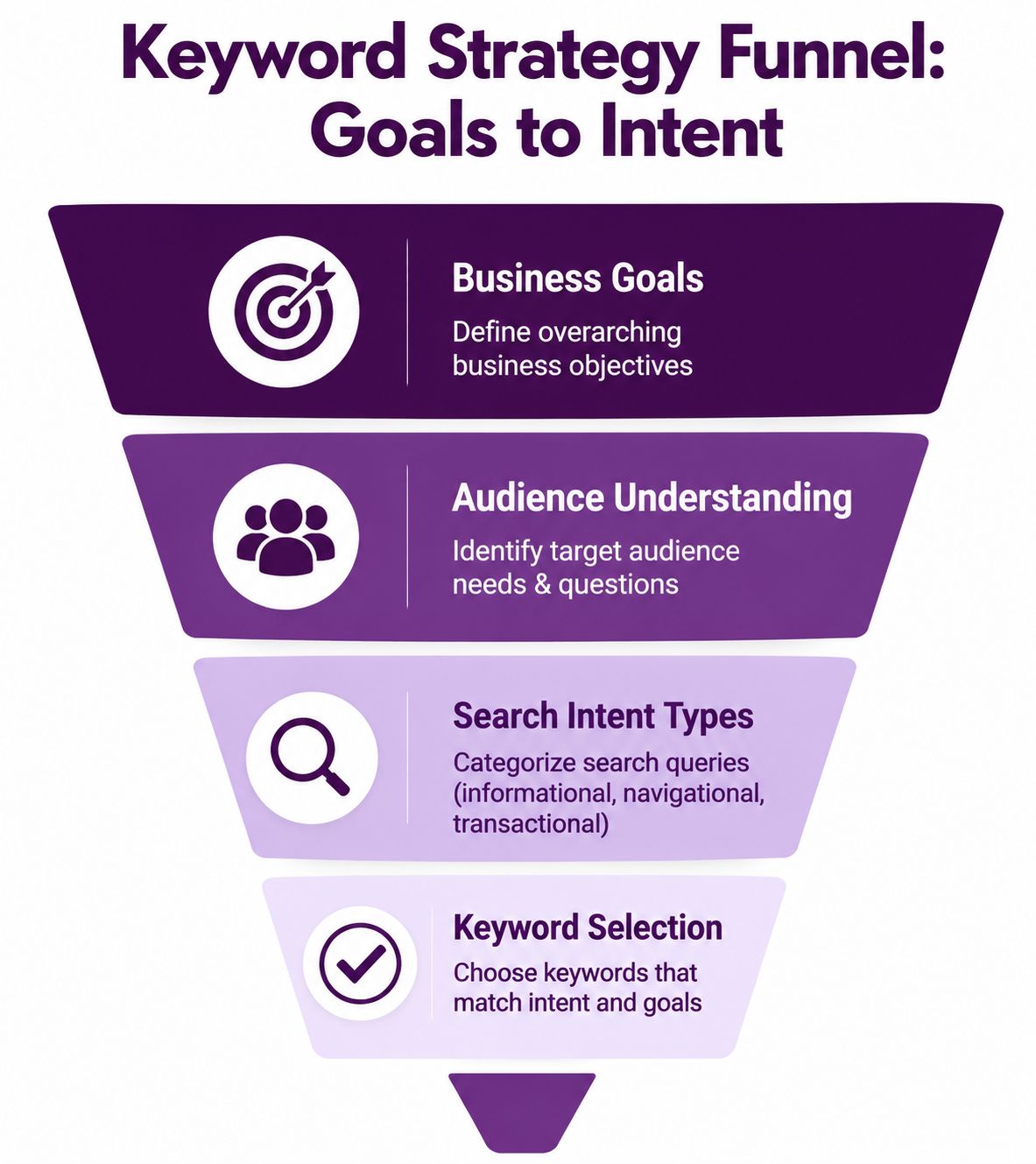
Before you open Ahrefs, Semrush, Google Search Console, or anything else, get clear on one thing. What business outcome should this page support? Lead generation, product sales, qualified signups, branded demand, or assisted conversions are very different goals, and each one points to different keyword types.
Start from the page outcome
Keyword selection gets sloppy when teams jump straight into keyword lists without deciding what success looks like. A blog post that's supposed to build awareness shouldn't be judged like a product page. A comparison page shouldn't target the same language as a help article.
Use this basic mapping:
Intent type | What the searcher wants | Best page types |
|---|---|---|
Informational | Learn or understand | Guides, explainers, tutorials |
Navigational | Reach a specific brand or destination | Homepage, login, brand pages |
Commercial | Compare options or evaluate solutions | Comparison pages, category pages, use-case pages |
Transactional | Take action now | Product pages, pricing pages, demo pages |
If your team needs a deeper framework for reading intent from the SERP, search intent optimization patterns are worth reviewing before you shortlist terms.
Match intent to funnel stage
Intent categories only become useful when you connect them to the buyer journey.
For a SaaS company selling team software, an informational phrase might suit a guide that introduces the problem. A commercial phrase fits a comparison page or use-case page. A transactional phrase belongs on a product, pricing, or demo page.
For an ecommerce brand selling running shoes, the split is different. "How to choose running shoes" belongs higher up the funnel. "Best running shoes for flat feet" suggests active evaluation. "Buy trail running shoes" points to category or product-level intent.
Here's the practical difference:
Awareness content brings in people naming a problem.
Consideration content helps people compare approaches.
Decision content captures visitors ready to choose a product, service, or vendor.
A keyword isn't valuable in isolation. It's valuable when it sends the right searcher to the page built for that moment.
Filter with business fit
Some keywords are relevant to your topic but irrelevant to your business model. That's where teams lose time.
A few examples:
Broad educational terms can build audience, but may not support short-term pipeline.
High-volume definitions often attract low-commitment visitors.
Comparison terms usually matter more when your brand can credibly compete.
Bottom-funnel phrases matter most when the landing page and offer are strong enough to convert.
A useful screen is to ask these three questions before adding any term to the target list:
Does this query match a real buyer stage?
Do we have a page type that can satisfy that intent?
If this page ranks, what business outcome could realistically happen next?
If you can't answer the third question, don't target the term yet.
Two teams, two different choices
A B2B SaaS brand trying to grow demo requests should bias toward commercial and transactional language. An online retailer with strong category pages can often profit from a broader mix, including informational content that nudges visitors toward product discovery.
Neither is wrong. The keyword choice depends on the revenue path.
That sounds obvious, but it's where keyword research usually breaks. Teams pick what tools surface fastest, not what the business can turn into value. Learning how to choose keywords well means treating intent as a revenue filter, not just an SEO concept.
Build Your Initial List of Seed Keywords
Once the business goal and intent are clear, start building a seed list. This part shouldn't begin in a keyword tool. It should begin in the language your customers already use.

Start with the phrases buyers actually say
The best seed keywords rarely come from a blank search bar. They come from support tickets, sales calls, onboarding questions, product reviews, Reddit threads, Quora discussions, and competitor copy. Those sources reveal pain points in the words people naturally choose, which is exactly what you want before expanding into variants.
A solid seed phrase is usually short and specific. One academic library guide recommends choosing the most important 2 to 4 words or phrases, and the same guidance notes that short, specific phrases work better than broad single terms, as outlined in the APUS library guide on keyword selection.
That matters in practice. "Keyword research" is a usable seed phrase. "Keywords" is too broad. "Project management software pricing" is a usable seed phrase. "Software" is useless.
Good sources for seed ideas
Don't rely on one input. Pull language from several places and you'll notice patterns fast.
Sales conversations bring out objections, desired outcomes, and comparison language.
Customer support logs show the exact friction points people care enough to ask about.
Competitor pages reveal how other brands frame use cases, alternatives, and solution categories.
Community spaces like Reddit and Quora surface problem language that marketing teams often miss.
Trend monitoring can help you spot emerging phrasing. If your audience reacts to timely topics or platform-driven conversations, XBurst's guide to X trends is a useful example of how to monitor fast-moving discussion themes and turn them into seed ideas when they're relevant to your niche.
If you need a baseline definition before expanding terms, this glossary entry on seed keywords is a helpful reference.
Build clusters, not a random list
A long list of disconnected terms is hard to prioritize. Group seeds by topic cluster instead. That usually means one commercial theme, one supporting educational theme, and one set of adjacent use cases.
For example, a CRM brand might cluster around:
Core solution phrases such as CRM software, sales CRM, pipeline management
Use-case phrases such as CRM for agencies, CRM for consultants, CRM for remote teams
Problem phrases such as lead follow-up process, sales pipeline tracking, contact management workflow
Field note: When a seed phrase sounds like something a real buyer would type after a frustrating workday, it's usually stronger than a phrase invented in a meeting.
The goal isn't perfection. The goal is to gather enough structured inputs that your later analysis has real commercial context behind it.
Analyze Keywords with the Right Metrics
Now the list needs pressure testing. Teams usually narrow too fast based on only two fields: search volume and keyword difficulty. Both matter, but they don't tell you enough by themselves.
A stronger workflow starts broad, then gets selective. Salesforce recommends beginning with 5 to 10 broad seed keyword categories, expanding them, then prioritizing by intent, relevance, and difficulty before mapping one primary keyword to one page, as described in Salesforce's keyword research workflow.

What each metric actually tells you
Volume tells you there is demand. It doesn't tell you whether the demand is useful.
Difficulty tells you how competitive a term may be. It doesn't tell you whether the ranking is worth the effort.
That means every keyword should be read through several lenses at once:
Metric | What it helps answer | What it can miss |
|---|---|---|
Search volume | Is there meaningful demand? | Whether visitors are qualified |
Keyword difficulty | Is this realistic for us now? | Whether the term converts |
CPC | Do advertisers value this query? | Whether organic pages fit the SERP |
SERP features | Will organic listings actually get clicks? | Whether those clicks lead to action |
Relevance | Does this fit our offer? | Hard to score without business context |
Use CPC as a commercial signal
If you run paid search, CPC is familiar. If you don't, it's still useful.
High CPC often signals that advertisers see commercial value in the query. That doesn't mean every high-CPC keyword is worth targeting organically, but it does suggest there may be stronger purchase intent behind the search than a low-value informational query. When I'm deciding between two similarly relevant terms, CPC often helps reveal which one sits closer to revenue.
Treat it as a directional signal, not a final answer.
Read the SERP before trusting the keyword
Many teams skip this step and pay for it later. A keyword can look great in a tool and still be a poor target because the actual results page absorbs clicks or favors a content type you don't have.
Check for:
Ads at the top that push organic results lower
People Also Ask boxes that satisfy basic curiosity without a click
Video carousels that suggest Google prefers video for the query
Product grids or shopping results that indicate transactional intent
Forum-heavy SERPs that may reflect community trust or weak formal content
If the SERP is crowded with features, the keyword's click potential may be much lower than the reported demand suggests.
Useful test: Search the keyword manually and ask, "If we ranked here, would the result type and page format actually fit us?"
Relevance beats raw popularity
A broad, high-demand term often looks attractive to stakeholders because it feels strategic. In practice, it can be a trap if your page won't satisfy the dominant intent or if the searcher isn't close to buying.
I push teams to rank each term against business relevance before they discuss opportunity size. A medium-demand query that matches the offer, the page type, and the funnel stage is often a better target than a bigger query that pulls in the wrong audience.
Watch for cannibalization while you analyze
Metric analysis isn't just about choosing winners. It's also about avoiding overlap.
If several keywords express the same intent, they probably belong on one page rather than three. If you split them across multiple URLs, you risk creating internal competition and diluted relevance. That's why one primary keyword per page remains such a durable rule. It forces clarity.
The best analysis phase doesn't produce a giant spreadsheet of "interesting terms." It produces a shortlist of keywords with a clear reason to exist in your strategy.
Prioritize Your List with a Scoring Framework
After analysis, teams often encounter the same obstacle. The list is still too long, every keyword seems defensible, and nobody agrees on what to build first.
That's where a scoring model helps. Not because it makes prioritization perfect, but because it makes trade-offs visible.
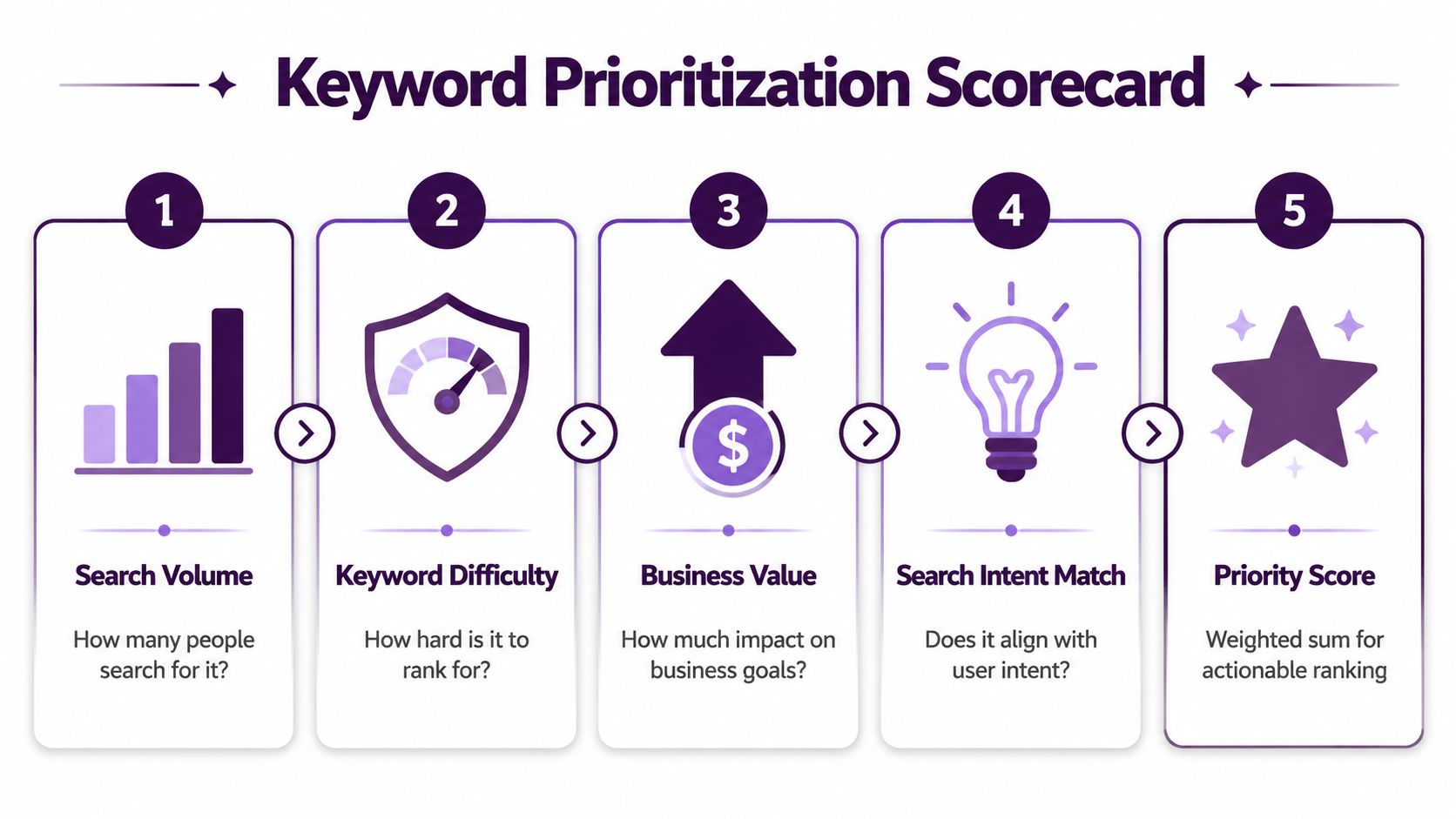
Use a simple score, not a complex formula
I like a practical scorecard with three inputs:
Business impact
Ranking confidence
Implementation ease
Score each one on a simple low-to-high scale within your team. The exact numbers matter less than consistent judgment.
Here is the thinking behind each factor:
Business impact asks whether ranking for this keyword could influence pipeline, sales, or qualified leads.
Ranking confidence asks whether your current site can realistically earn visibility for the term.
Implementation ease asks how much effort the page needs, including content depth, design, product input, and technical support.
A high-priority keyword usually isn't just valuable. It's valuable and realistically attainable without excessive delay.
What good prioritization looks like
This kind of scoring helps settle common debates.
A category keyword might have high business impact, but low ranking confidence because the SERP is dominated by entrenched players. A long-tail use-case phrase might have slightly lower upside, but much higher confidence and easier implementation. If your team needs traction, the second one may be the better first move.
That doesn't mean you ignore hard terms. It means you sequence them.
Factor | Low score means | High score means |
|---|---|---|
Business impact | Weak connection to revenue | Strong connection to qualified action |
Ranking confidence | Hard to compete right now | Good fit for current authority and SERP |
Implementation ease | Heavy lift across teams | Can publish or optimize efficiently |
Mine near-win keywords first
One of the fastest ways to prioritize intelligently is to look at queries where you already have some visibility. Mangools recommends using Google Search Console performance data, sorting by impressions and rank position to identify near-win opportunities, then improving those pages instead of starting from zero, as described in this guide to finding keyword opportunities.
That workflow matters because existing impressions mean Google already associates your page with the topic. If the page is getting seen but not clicked, or if it sits just outside stronger visibility, optimization can be more efficient than creating a new asset from scratch.
If you want a more tactical playbook for this process, review these quick-win page 2 keyword opportunities.
What to look for in Search Console
When you're reviewing live data, focus on patterns such as:
Queries with impressions but weak clicks. The page may have title, intent, or snippet issues.
Keywords where the current page is close but not strong enough. The content may need clearer alignment to the query.
Terms where one page ranks inconsistently. Internal competition or thin coverage may be holding it back.
This is one of the few areas in keyword work where "good enough" data can be more useful than perfect data. Real impression and click behavior often reveals better next actions than a fresh export from a third-party tool.
The easiest keyword to win is often the one Google already thinks you're relevant for.
Choose the order with discipline
A scorecard also protects teams from stakeholder bias.
Without one, people push for the biggest-looking terms or the phrases they personally like. With one, you can explain why a narrower query gets built first. It fits the funnel, your site can compete, and the page can ship quickly.
That's what prioritization is supposed to do. Not crown the most glamorous keyword, but identify the most sensible next move.
Map Keywords to Content and Iterate on Performance
A prioritized keyword list only becomes useful when every target has a clear content home. In this context, discipline matters most.
The operating rule is simple: one primary keyword, one page.
That doesn't mean a page can only rank for one phrase. It means one page should own one core intent. When teams ignore that rule, they create overlapping pages, split signals, and spend months wondering why rankings bounce between URLs.
Decide whether to optimize or create
Before assigning a new keyword, check whether a suitable page already exists.
Use this decision logic:
Existing page matches the intent. Optimize that page.
Existing page is adjacent but not aligned. Rewrite or reposition it.
No page can satisfy the searcher's need. Create a new one.
Several pages target the same intent. Consolidate before adding more.
Content operations and SEO must work together. The right answer isn't always "publish another article." Sometimes the better move is to merge, redirect, and strengthen what you already have.
Build a feedback loop
Keyword research isn't a one-time planning task. It only gets smarter when performance data comes back into the process.
Track the basics after implementation:
Rankings to see whether visibility is improving
Organic traffic to confirm the page is attracting visits
Conversions or qualified actions to verify business value
If rankings improve but conversions don't, revisit the intent match. If traffic rises but engagement is poor, the page may be satisfying the keyword but disappointing the visitor. If clicks stay weak despite impressions, the snippet or page positioning may need work.
That feedback loop is what turns keyword selection from a planning exercise into an operating system. You learn which themes attract buyers, which pages close the gap between search and action, and which keywords look good only on paper.
Bottom line: The best keyword strategy isn't the one with the biggest list. It's the one that keeps getting sharper after real performance data comes in.
When teams ask how to choose keywords, they're usually asking which terms to target. The better question is which terms deserve a page, fit a buyer stage, and have a believable path to business impact. That's the standard worth using.
If you want a faster way to turn scattered SEO data into a ranked action plan, Keyword Kick helps teams connect keyword research, Google Search Console, GA4, rank tracking, backlinks, and technical signals in one place. Instead of juggling reports, you can see which pages to optimize first, where cannibalization is creeping in, and which opportunities are most likely to move visibility and conversions.