Your store is probably already doing some SEO work. Product titles get tweaked. A few category pages rank. Someone checks Search Console when traffic dips. At the same time, paid search keeps absorbing budget because it's predictable, immediate, and easy to defend in a meeting.
That pattern is common, and it's expensive.
The problem isn't that ecommerce teams ignore SEO. It's that they treat ecommerce and SEO like a loose collection of tasks instead of a revenue system. They run audits, collect issues, and end up with a backlog full of low-impact fixes while the pages that make money stay under-optimized, under-crawled, or buried behind avoidable technical friction.
A better approach starts with prioritization. Fix the pages and systems that change revenue first. Ignore the vanity work. Treat crawl paths, category architecture, product data, and search intent like operating levers, not checklist items.
Why SEO Is Your Most Valuable Sales Channel
Paid acquisition is useful, but it rents attention. The moment you stop paying, the traffic stops. SEO works differently. It compounds, especially for stores with a broad catalog and category structure that can rank for hundreds or thousands of commercial queries.
The business case is hard to ignore. An analysis of over 20,000 ecommerce websites found that the average brand ranks for 1,783 keywords and drives an estimated 9,625 monthly organic visits. Buying that same traffic through paid search would cost about £11,790.58 per month, according to Reboot's ecommerce SEO statistics.
That number matters because it reframes SEO from “traffic channel” to margin channel.
Organic traffic usually reaches better buyers
Not all traffic is equal. Ecommerce teams often learn this the hard way after scaling social or display campaigns that bring sessions but weak purchasing intent. Organic search usually performs better because many users arrive with a clear task. They're comparing products, looking for a model, checking specs, or trying to solve a purchase problem.
When ecommerce and SEO are aligned properly, search doesn't just fill the top of the funnel. It captures buyers much closer to the transaction.
Practical rule: If a query suggests selection, comparison, compatibility, price, availability, or a known product need, SEO deserves direct commercial ownership, not leftover marketing attention.
A strong ecommerce SEO program also creates coverage that paid search rarely matches efficiently. Paid teams tend to concentrate budget on proven head terms and branded campaigns. SEO can capture the entire long tail. That includes modifier terms, product attributes, brand-plus-category combinations, and SKU-level searches that collectively drive substantial value.
The channel gets stronger as your catalog gets clearer
The best-performing stores rarely win because they “did more SEO.” They win because they made their catalog easier for search engines to understand and easier for buyers to use.
That usually means:
Clear category intent: Category pages target broad commercial demand and help users compare options.
Precise product coverage: Product pages satisfy exact-match searches for models, variants, and long-tail purchase terms.
Technical discipline: Search engines spend time on pages that matter instead of parameter junk and duplicate URLs.
Revenue focus: Teams judge success by commercial impact, not just impressions.
If your acquisition mix is too dependent on ads, SEO is usually the channel that restores control. It won't replace paid media overnight, and it shouldn't. But it gives your business an asset that keeps working after the campaign ends.
Building a Bulletproof Technical Foundation
A large ecommerce site without technical control is like a warehouse with great inventory and broken shelving. The products exist, but nobody can find them efficiently. Search engines have the same problem. If your architecture is messy, your strongest pages won't get crawled, indexed, or refreshed as often as they should.
Technical ecommerce SEO comes down to three operating priorities: architecture, crawlability, and speed.
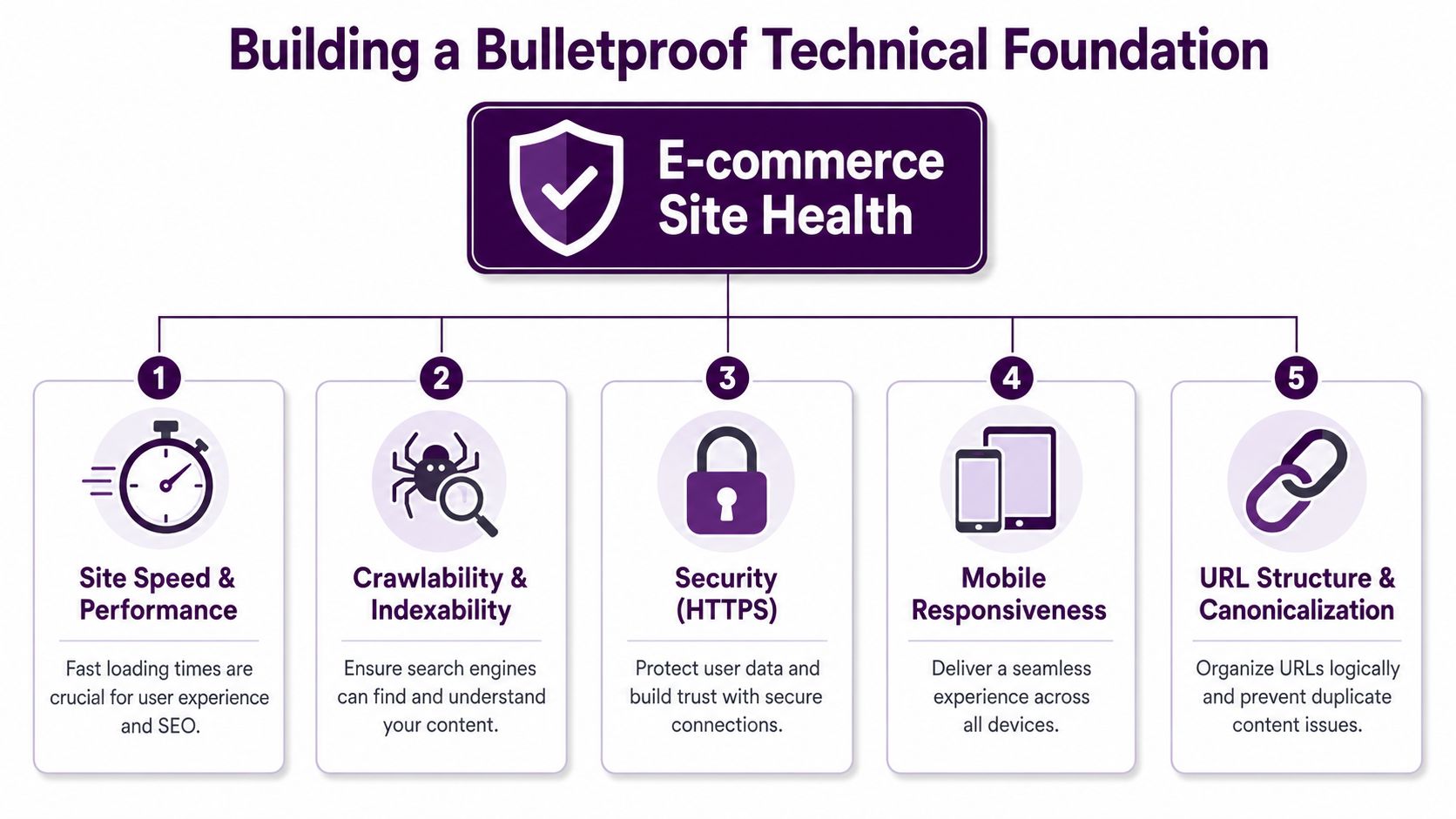
Architecture decides what matters
Your site structure tells Google which pages are primary, which are supporting, and which should barely exist. On stores with thousands of URLs, bad structure creates silent losses. Important categories sit too deep. Product pages compete with duplicate collection paths. Filters create endless crawl branches.
Faceted navigation is where this usually gets ugly. Filters are useful for shoppers, but they can become an indexation trap for SEO. Think of facets like aisles in a supermarket. A few signs help people find their way. A sign for every possible combination of color, size, price sort, material, and availability turns the store into a maze.
What works is intentionality:
Keep core categories indexable: Main category and subcategory pages should map to real search demand.
Control parameter sprawl: Sorting, session parameters, and low-value filter combinations usually shouldn't be crawl priorities.
Use canonical logic consistently: Canonicals should reinforce your preferred URLs, not contradict internal linking.
Teams that need a structured process for tackling technical debt on Shopify often find that many ranking issues are really architecture and implementation issues wearing an SEO label.
Crawl budget isn't abstract on large stores
On small sites, crawl budget talk is often overstated. On large ecommerce sites, it's operational reality. A typical large ecommerce store can waste 40 to 70% of its crawl budget on thin or filtered pages. When teams fix that index bloat, sites can see a 15 to 30% increase in indexed product pages within 3 to 6 months, according to this technical ecommerce SEO checklist.
That's why I don't start large-store audits with title tags. I start with URL inventory.
If Googlebot spends its time on filtered duplicates, your money pages wait in line.
Use a crawl tool and compare four sets of URLs:
Crawled URLs
Indexable URLs
Canonical URLs
Revenue-driving category and product URLs
The gap between those sets is where wasted effort lives.
A practical workflow helps. This SEO site audit checklist is a good reference for turning broad audit findings into fixable buckets rather than one giant technical to-do list.
Speed matters because intent is fragile
Retail search traffic is impatient. If the category page lags, filters jump, or product images stutter on mobile, buyers leave before your content gets a chance to do its job. Speed work should focus on templates that influence discovery and purchase, not vanity scores in isolation.
Start with:
Category templates: Product grids, filter rendering, lazy loading, and pagination behavior
Product templates: Image weight, app scripts, review widgets, and variant rendering
Mobile UX: Thumb-friendly filters, stable layout, and fast add-to-cart interaction
Good technical SEO isn't glamorous. It just makes everything else possible.
Optimizing Product and Category Pages That Convert
Category pages and product pages do different jobs. Many stores blur them together, then wonder why neither ranks as well as it should.
A category page should help a shopper choose among options. A product page should remove the final hesitation around a specific item. If you write both page types the same way, you weaken both.
Category pages should narrow choices fast
A strong category page targets broader commercial searches and supports comparison. It needs enough text to establish relevance, but not so much that it pushes the product grid below the fold or forces users through a wall of copy.
Good category optimization usually includes:
Focused titles and H1s: Use the main product type and the modifier that matches demand, such as brand, use case, material, or audience.
Short, useful intro copy: Clarify what the shopper will find and what differentiates the range.
Clean merchandising: Surface subcategories, bestsellers, or buying cues that help users refine quickly.
Supportive FAQ content: Answer sizing, compatibility, shipping, or selection questions that commonly block purchase.
The best category copy sounds like a merchandiser who understands search intent, not a copywriter stuffing synonyms into paragraphs.
Product pages win on clarity, not word count
Product pages don't need inflated copy. They need complete, trustworthy, decision-ready information.
That means your PDP should answer the questions a serious buyer asks before purchase:
What is it?
Who is it for?
What problem does it solve?
How is it different?
What are the key specs?
What happens if it doesn't fit or arrive on time?
For most stores, the page structure matters more than literary style. Put the essentials where users can act on them. Title, price, availability, variant clarity, images, delivery expectations, returns, reviews, and common objections all need to work together.
A lot of teams treat conversion and SEO as separate disciplines here. They're not. Better product information improves both ranking relevance and purchase confidence. If you're working through practical on-page friction, this guide on solving ecommerce conversion problems is useful because it focuses on the buying journey, not just traffic acquisition.
Product pages lose sales when they force shoppers to infer the answer.
A simple page-level standard
Use this as a working baseline for both templates:
Page type | Primary goal | Common mistake | Better approach |
|---|---|---|---|
Category page | Help users compare and refine | Long generic intro text | Lead with intent, merchandising, and useful filters |
Product page | Help users commit to one item | Thin manufacturer copy | Add original benefits, specs, trust elements, and objections handling |
Reviews and Q&A matter here too, but only if they're visible, relevant, and easy to scan. Hidden tabs, weak moderation, and duplicated manufacturer content don't help users or rankings. Unique detail does.
Winning SERP Real Estate with Structured Data
Ranking on page one isn't enough if your listing looks weaker than the results around it. In ecommerce, search visibility has two layers. First, your page has to rank. Then it has to earn the click.
Structured data improves the second layer by helping search engines present richer product information directly in the result.
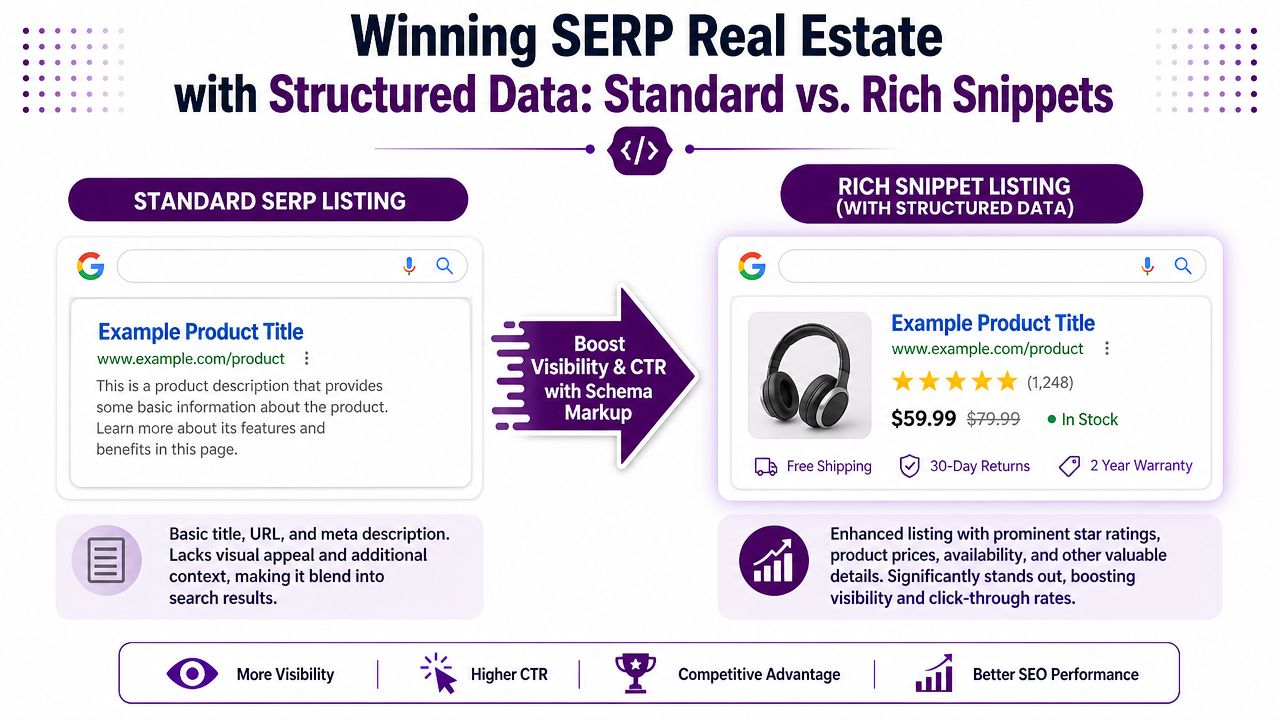
Rich results change how your listing competes
When full Product schema is implemented correctly, pages can achieve 1.6 to 2.4 times higher SERP real estate through rich snippets. In high-commercial-intent searches, price and availability badges can produce 15 to 35% CTR uplifts, according to this technical SEO checklist covering ecommerce schema.
That's why schema isn't a “nice extra” anymore. For product-led stores, it belongs in the same operational category as canonicalization, internal linking, and XML sitemaps.
Google's recent ecommerce requirements also raised the standard. Shipping details and return policy markup now play a more central role in rich result eligibility. If your page shows those details to users but your structured data omits them, you leave visibility on the table.
The minimum schema stack for modern stores
The exact implementation depends on platform and feed setup, but these are the properties that should be considered mandatory:
Schema Property | Type | Example Value |
|---|---|---|
name | Product | Trail Running Shoe Model X |
image | Product | Main product image URL |
sku | Product | TRX-001-BLK-42 |
offers.price | Product | 129.00 |
offers.priceCurrency | Product | USD |
offers.availability | Product | InStock |
aggregateRating | AggregateRating | 4.6 |
breadcrumb | BreadcrumbList | Home > Shoes > Trail Running Shoes |
shippingDetails | OfferShippingDetails | Standard delivery details |
hasMerchantReturnPolicy | MerchantReturnPolicy | 30-day returns policy |
If you need a primer before implementation, this guide to schema markup for SEO explains the foundations clearly.
Validation is where teams usually slip
Most schema mistakes aren't strategic. They're operational. Fields go stale. Variant data conflicts with visible content. Ratings get marked up inconsistently. Shipping policy exists in one template but not another.
Check three things every time:
Page-match accuracy: Structured data should match what users see.
Template coverage: Apply schema consistently across eligible product pages.
Validation workflow: Test at launch, and retest after theme, app, or feed changes.
Structured data is one of the few SEO tasks that can improve both search presentation and downstream discoverability across newer search surfaces. That makes it worth treating like infrastructure, not decoration.
Developing a Content Strategy Beyond Product Pages
Stores that only publish product and category pages usually hit a ceiling. They cover bottom-funnel demand, but they miss the earlier searches where buyers define the problem, compare approaches, and learn the vocabulary that eventually leads to a purchase.
That's why ecommerce and SEO need a content layer beyond the catalog.
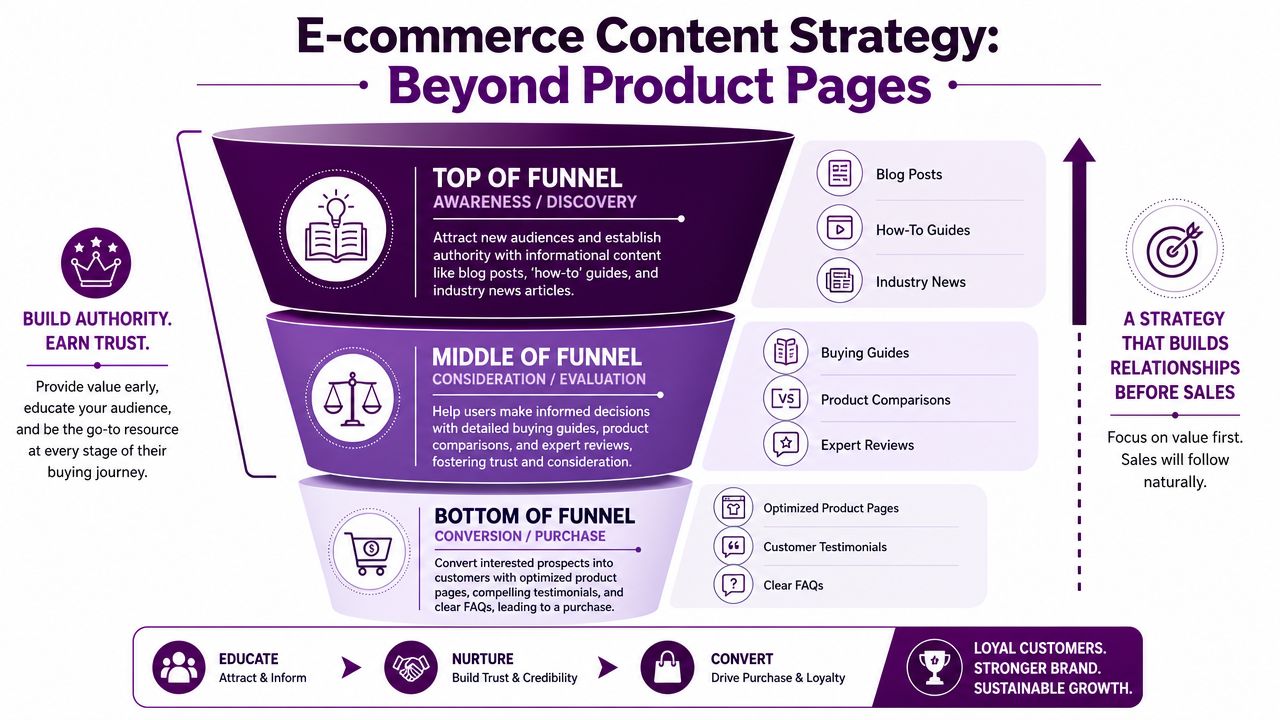
The catalog and the content engine should feed each other
Informational content works best when it supports commercial pages, not when it lives in a separate editorial universe. A buying guide should link to relevant categories. A comparison article should help users evaluate product types. A how-to post should remove friction that blocks conversion.
Three content roles matter most:
Awareness content: Educational posts, trend pieces, and how-to resources that attract new search demand
Consideration content: Comparison pages, gift guides, and buying guides that help users narrow choices
Conversion support content: FAQs, care guides, fit guides, and compatibility resources that strengthen product and category pages
This isn't about publishing more. It's about publishing content that gives your transactional pages more authority and better internal link support.
Internal site search is an underrated content brief
E-commerce businesses often ignore one of the best datasets they own: internal search logs. Those logs show exactly how real visitors describe products, what they expect to find, and where your catalog language fails them.
By exporting and clustering top internal site search queries, including zero-result terms, brands can systematically create new content and categories that directly address user intent, leading to sustained ranking improvements for informational and transactional keywords, as noted in Search Engine Land's guide to advanced ecommerce SEO tips.
That workflow is especially useful for seasonal catalogs, fast-moving inventory, and stores with confusing taxonomy.
A zero-result search term is often a taxonomy problem before it's a content problem.
A practical workflow for turning search logs into SEO actions
Start monthly, not quarterly. Internal search patterns shift faster than most content calendars.
Export query data: Pull top searches, zero-result searches, and abandoned searches from your site search tool.
Cluster by intent: Group queries into themes such as problem-based, category-based, compatibility-based, or brand-specific.
Map each cluster: Decide whether the right destination is a new category page, revised copy on an existing page, a guide, or synonym support in filters and onsite search.
Link to revenue pages: Every new content asset should route users toward relevant collections or products.
Review content gaps regularly: As your catalog changes, your informational layer should change with it.
This process pairs well with a structured SEO content gap analysis workflow, especially when you need to decide whether a missed query deserves a new page or a better existing one.
Building Authority with Ecommerce Link Building
Authority still matters, but ecommerce link building works best when it's tied to real commercial assets. Generic outreach for homepage links rarely moves the pages that need help most. Category pages, buying guides, tools, and launch assets usually give you a better path.
The easiest way to think about link building for stores is to split it into three lanes: foundational, commercial, and brand-led.
Start with links you should already have
Most stores overlook obvious sources of relevance. Suppliers, distributors, retail partners, trade associations, stockists, and complementary brands often already mention the business somewhere, but not always with a useful destination.
Good foundational work includes:
Supplier page links: Ask manufacturers to link to your brand page, authorized retailer page, or a relevant collection.
Partner mentions: If you bundle products, co-market, or sponsor niche events, secure a crawlable link to the most relevant commercial URL.
Brand profile cleanup: Reclaim outdated mentions that point to old pages, redirects, or generic homepage URLs.
This isn't glamorous work, but it often produces the cleanest relevance.
Product-led outreach works when the angle helps publishers
Review sites, gift guides, niche blogs, and expert roundups don't link because a store asks nicely. They link when the product, comparison, or expert input improves their content.
The outreach angle matters more than the template. A few patterns consistently work better than generic “please feature us” emails:
Offer a clear fit for a roundup or seasonal guide
Pitch a comparison asset that helps a publisher explain a category
Provide expert commentary from someone who understands the product space
Send people to the best landing page, not always the homepage
A category page can earn links if it's useful. A buying guide often earns them more easily. In practice, the best ecommerce link profiles usually come from both.
Digital PR should support search demand
For stores with new products, proprietary data, strong founders, or unusual stories, digital PR can do more than build awareness. It can create linkable assets that strengthen search visibility around priority themes.
Treat link building like merchandising. Put the strongest asset in front of the right audience.
The mistake is chasing links with disconnected campaigns. The better move is to align PR angles with category demand, launch moments, or customer questions you already know matter. When that happens, link acquisition stops being a side project and starts reinforcing the pages that drive revenue.
Scaling SEO for International and Multi-Domain Stores
International ecommerce SEO gets complicated fast because every growth decision affects architecture, operations, and content governance at the same time. The wrong setup creates duplicate content, reporting confusion, and localization debt that's painful to unwind later.
The first real decision is structural. Where should each market live?
Choosing between ccTLDs, subfolders, and subdomains
There isn't one right answer. The right model depends on your resources, operational maturity, and how independently each market needs to operate.
Option | Best fit | Main strength | Main trade-off |
|---|---|---|---|
ccTLDs | Country-specific brands with local teams | Strong local market signaling | Higher maintenance and fragmented authority |
Subfolders | Centralized global SEO program | Easier consolidation of authority and governance | Requires disciplined localization control |
Subdomains | Semi-independent regional teams or platforms | Operational separation | Can dilute SEO focus and complicate reporting |
If a brand has one central team and shared catalog logic, subfolders usually keep execution cleaner. If each market has separate legal, merchandising, and operational ownership, a country-specific setup may be worth the extra complexity.
Hreflang and localization need operational discipline
Hreflang doesn't fix weak localization. It helps search engines understand which regional or language version belongs to which audience. If the underlying content is barely adapted, you still get thin pages with weak user signals.
A useful checklist for international stores:
Localize category language: Don't just translate keywords literally. Match how local customers describe products.
Align currency and fulfillment signals: Shipping, returns, and pricing presentation should match the intended market.
Keep canonicals and hreflang consistent: Mixed signals create avoidable indexation problems.
Standardize templates, localize content: Shared technical templates help. Shared copy usually doesn't.
A lot of multi-market teams also overlook launch support. If you're entering a new region, visibility often depends on more than technical setup. Brand mentions, regional media coverage, and localized announcements can accelerate discovery. For teams evaluating that channel, this breakdown of the SEO benefits of press releases is useful because it explains where press releases fit and where they don't.
Governance matters more than architecture debates
Most international SEO failures don't come from choosing the “wrong” URL structure. They come from weak governance. Teams publish untranslated templates, duplicate collection logic, and disconnected metadata because nobody owns the cross-market standard.
The stores that scale cleanly usually document three things early:
Which content is global
Which content must be localized
Who approves technical and SEO changes across markets
Without that, expansion multiplies SEO problems faster than it multiplies growth.
Your Playbook from Audit to Action with Keyword Kick
Most ecommerce SEO programs don't suffer from a lack of data. They suffer from too much disconnected data. Search Console says one thing. GA4 says another. The crawler exports thousands of URLs. Ranking tools show movement, but nobody can tell which issue deserves attention first.
That's where teams stall.
A 2024 analysis highlighted that over 70% of ecommerce sites fail to adequately track product-level organic contribution to conversions, which creates a serious gap between SEO activity and revenue accountability, according to Lumar's analysis of common ecommerce SEO issues.

What a useful workflow looks like
A good SEO operating system doesn't just collect metrics. It helps a team answer practical questions:
Which templates are underperforming?
Which categories have strong impressions but weak clicks?
Which product groups are losing visibility because of crawl waste?
Which fixes are likely to affect revenue, not just scores?
That's the gap many audits never close. They identify issues, but they don't rank them in business terms.
A realistic scenario from a mid-sized store
Say an ecommerce team notices that organic revenue from a core product line has softened. Paid search is holding demand, but margins are getting squeezed. Search Console shows stable impressions on some URLs, declining clicks on others, and a handful of category pages slipping behind marketplace competitors.
A typical audit would produce a giant spreadsheet:
Duplicate titles
Missing alt text
Slow pages
Parameterized URLs
Thin content
Redirect chains
Weak internal links
Incomplete schema
All of those might be true. Few of them deserve equal priority.
The better process starts by tying visibility shifts to commercial templates. If the affected pages are category URLs with high purchase intent, the first questions should be operational:
Did crawlable filter URLs start competing with canonical categories?
Did product availability or merchandising weaken internal linking?
Did rich result eligibility drop because schema coverage broke?
Did the page lose CTR because the snippet got less competitive?
Did onsite engagement change because the mobile template got heavier?
That's how you move from “site has issues” to “this is the next fix.”
How prioritization should actually work
I'd rank ecommerce SEO tasks in this order:
Revenue blockers first
If an issue affects crawl access, indexation of money pages, snippet quality on commercial URLs, or internal links to priority categories, fix that before anything cosmetic.
Examples include:
Important product pages not being indexed
Canonical mistakes pushing authority to the wrong URL
Broken category pagination or faceted duplication
Product schema failing across a large portion of PDPs
Quick-win visibility gaps next
These are pages that already have some demand and don't need a full rebuild. They need a sharper title, stronger snippet, better copy alignment, better internal links, or improved page structure.
Good candidates often include:
Category pages with impressions but weak CTR
PDPs ranking for near-transactional queries without complete specs
Buying guides that attract traffic but don't route users to collections
Fixes with clear buyer intent beat broad “content improvements” almost every time.
Scalable growth after that
Once the blockers and quick wins are handled, then it makes sense to invest in larger initiatives such as taxonomy refinement, content expansion from internal search, and structured link acquisition around category themes.
That sequencing matters. Otherwise teams spend weeks polishing low-stakes pages while high-intent pages bleed opportunity.
What an action-oriented SEO stack should deliver
The strongest workflows bring the signals together in one place:
Input | What it reveals | Why it matters |
|---|---|---|
Search data | Queries, CTR, landing-page demand | Shows where visibility exists but performance is weak |
Analytics data | Engagement, cart starts, purchases | Connects rankings to commercial outcomes |
Crawl data | Indexability, canonicals, depth, duplicate paths | Exposes technical friction blocking growth |
Competitive data | SERP features, content gaps, authority gaps | Helps teams choose winnable moves |
That's the standard teams should aim for. Not more dashboards. Better prioritization.
If you're serious about ecommerce and SEO, the payoff comes from turning noisy audit data into a short list of fixes with obvious commercial logic. The teams that grow organic revenue consistently aren't the ones doing the most tasks. They're the ones fixing the right problems in the right order.
Keyword Kick helps you do exactly that. By connecting your search, analytics, ranking, backlink, and technical data into one workspace, it gives you a clearer answer to the questions that matter most: what changed, why it changed, and what to fix next. If you want a faster path from SEO audit to revenue action, explore Keyword Kick.