
You're probably looking at a travel site that already has strong visuals, decent destination pages, and a booking engine that cost real money to build. Yet organic visibility is inconsistent, the pages that should rank don't, and the pages that do rank often attract researchers instead of bookers.
That's normal in travel. It's also fixable.
Travel website SEO breaks when teams treat it like a blog calendar plus a few title tag updates. Winning brands treat it as infrastructure. They align technical SEO, content design, internal linking, international targeting, and SERP feature strategy around how travelers search. In this vertical, that means handling long research cycles, mobile-first discovery, complex listings, and now AI-generated answers that often intercept the click before a user even reaches your site.
Why Most Travel SEO Fails and How Yours Will Succeed
Most travel SEO programs fail for a simple reason. They're built like brochure websites, not search systems.
A common pattern looks like this: a brand launches destination pages, publishes a few “best things to do” articles, and assumes rankings will follow. Then the site encounters the constraints of travel search. Pages compete against OTAs, tourism boards, publishers, review sites, map results, and now AI-generated summaries. At the same time, the site itself is often slowed down by heavy imagery, booking widgets, filters, and disconnected templates across content and commerce.
The commercial stakes are too high to treat SEO as a side channel. According to Digital Flavour's travel agency SEO guide, organic search drives 40% of travel website revenue, first-page rankings capture 75% of all clicks, and 57% of travel bookings start on mobile. That changes the conversation. SEO isn't a brand-awareness tactic. It's part of revenue architecture.
What works is narrower and more disciplined than is generally assumed.
Build for real search intent: Travelers don't all want the same thing. Some need inspiration, some need comparison, some are ready to book.
Fix performance before scaling content: A beautiful destination page that loads poorly on mobile won't carry its weight.
Treat every page type differently: Guides, hotel pages, route pages, tour pages, and filtered listings each need their own SEO model.
Compete where users compare options: If you work in a segment like cruise ships, search visibility depends on covering decision-making detail, not just aspirational copy.
Most underperforming travel sites don't have one fatal flaw. They have ten medium-sized flaws spread across content, templates, and crawl control.
The sites that win usually aren't doing something mysterious. They've made SEO operational. Their pages load fast, render cleanly, cover topics in depth, and map tightly to the way travelers plan trips.
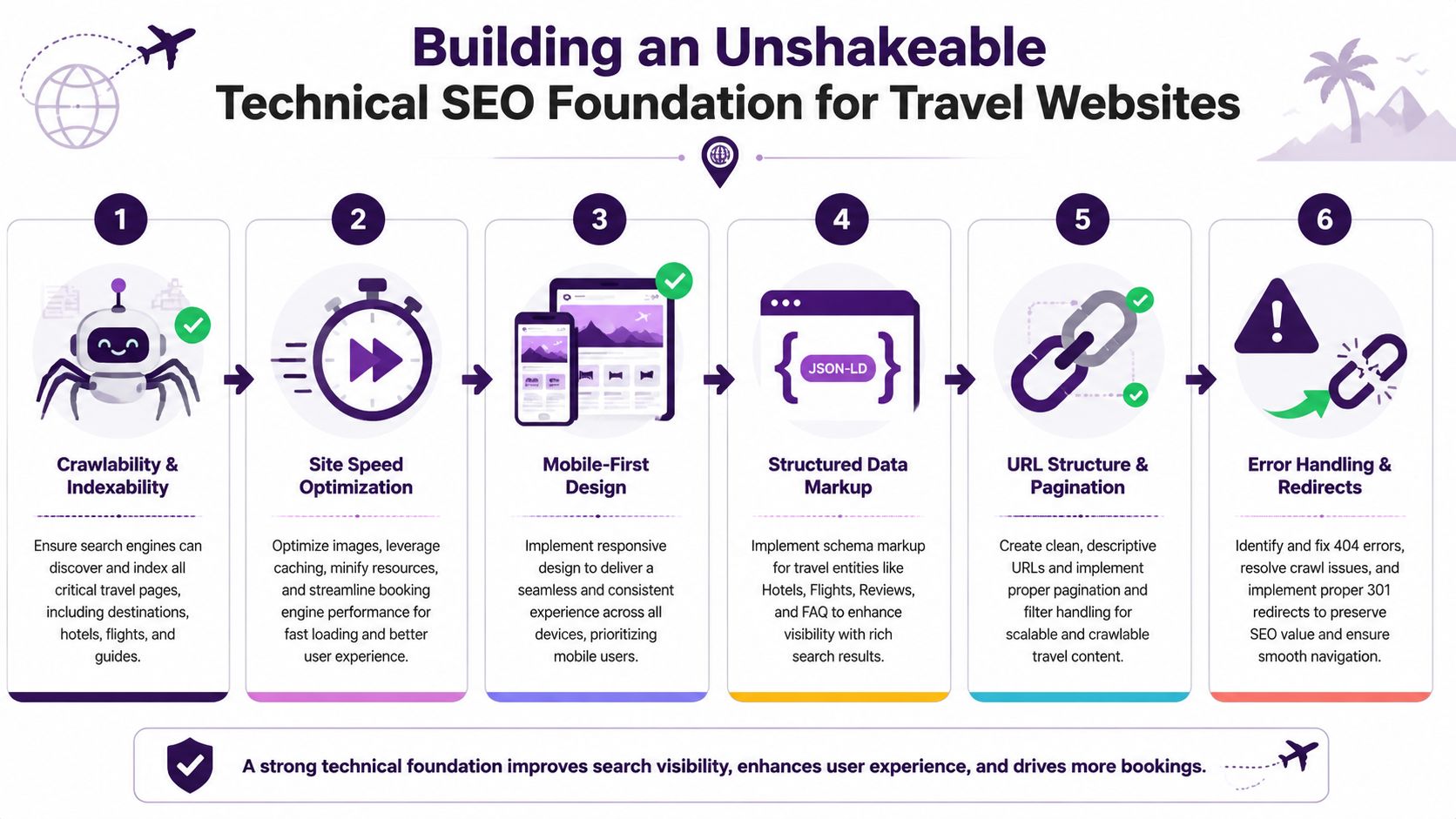
Building an Unshakeable Technical SEO Foundation
Technical SEO is where travel sites either become scalable or stay fragile. This category is unusually exposed to technical debt because travel platforms often combine CMS pages, booking engines, faceted search, maps, reviews, and third-party scripts inside the same user journey.
A practical audit order matters. One travel SEO checklist recommends checking Core Web Vitals first, then crawl and indexation, then rendering, and treating pages as problematic when more than 25% of URLs exceed the 2.5-second LCP threshold in Google Search Console, as outlined in this technical SEO checklist for travel sites.
Start with Core Web Vitals and mobile rendering
Don't begin with metadata. Begin with what users and crawlers experience.
Travel pages often fail LCP because of oversized hero images, autoplay media, or fare and availability widgets that sit above the fold. On many sites, the design team optimizes for visual impact while the SEO team is left dealing with pages that render late and shift during load.
Focus first on:
Hero media weight: Compress large visuals and replace unnecessarily heavy formats where possible.
Critical path scripts: Defer anything that isn't required for first paint.
Mobile interaction friction: Test booking forms, calendars, and sticky bars on real devices, not just responsive previews.
If your stack is complex, it helps to review implementation patterns from CMS-heavy environments. Kogifi's expert guide to Sitecore and SharePoint SEO is useful because it shows how enterprise content systems can inadvertently create crawl, metadata, and rendering issues at scale.
Then verify crawl and indexation
Once performance is under control, check whether search engines can consistently discover and index the pages that matter.
A lot of travel sites waste crawl attention on the wrong URLs. Search bots find sort orders, session-driven variants, expired availability states, internal search results, or parameter-heavy filter pages, while strategic pages stay weakly linked and undercrawled.
Use this sequence:
Identify indexable money pages: Destination hubs, hotel pages, route pages, category pages, and evergreen guides.
Review internal linking depth: Important pages shouldn't depend on five clicks from the homepage.
Separate useful filters from junk URLs: Some filtered states deserve indexation. Most don't.
Check canonical consistency: Canonicals should support the page's search role, not collapse valuable variants by accident.
A strong technical review usually surfaces structural issues faster than page-by-page edits. If you need a broader framework for the mechanics behind this process, Keyword Kick's guide to technical SEO fundamentals is a solid reference point.
Operational rule: If a page type can generate thousands of URLs, assume it can also generate thousands of SEO problems unless you explicitly control it.
Rendering is where many travel sites lose visibility
Rendering failures are common in travel because key content often depends on JavaScript. Booking widgets, room inventory blocks, pricing modules, and review components may appear fine in the browser while being delayed, incomplete, or inaccessible to crawlers.
Look closely at:
Area | Common problem | Better approach |
|---|---|---|
Booking widgets | Core content loads after scripts | Keep essential descriptive content server-rendered |
Reviews | Third-party embeds hide useful text | Expose summary content in crawlable HTML |
Availability modules | Empty states confuse indexing | Define stable fallback content |
Structured data | Injected late or inconsistently | Validate rendered output, not template intent |
Technical SEO for travel isn't about polishing edge cases. It's about making sure your site remains understandable when the stack gets messy.
A Modern Content Strategy for the Travel Customer Journey
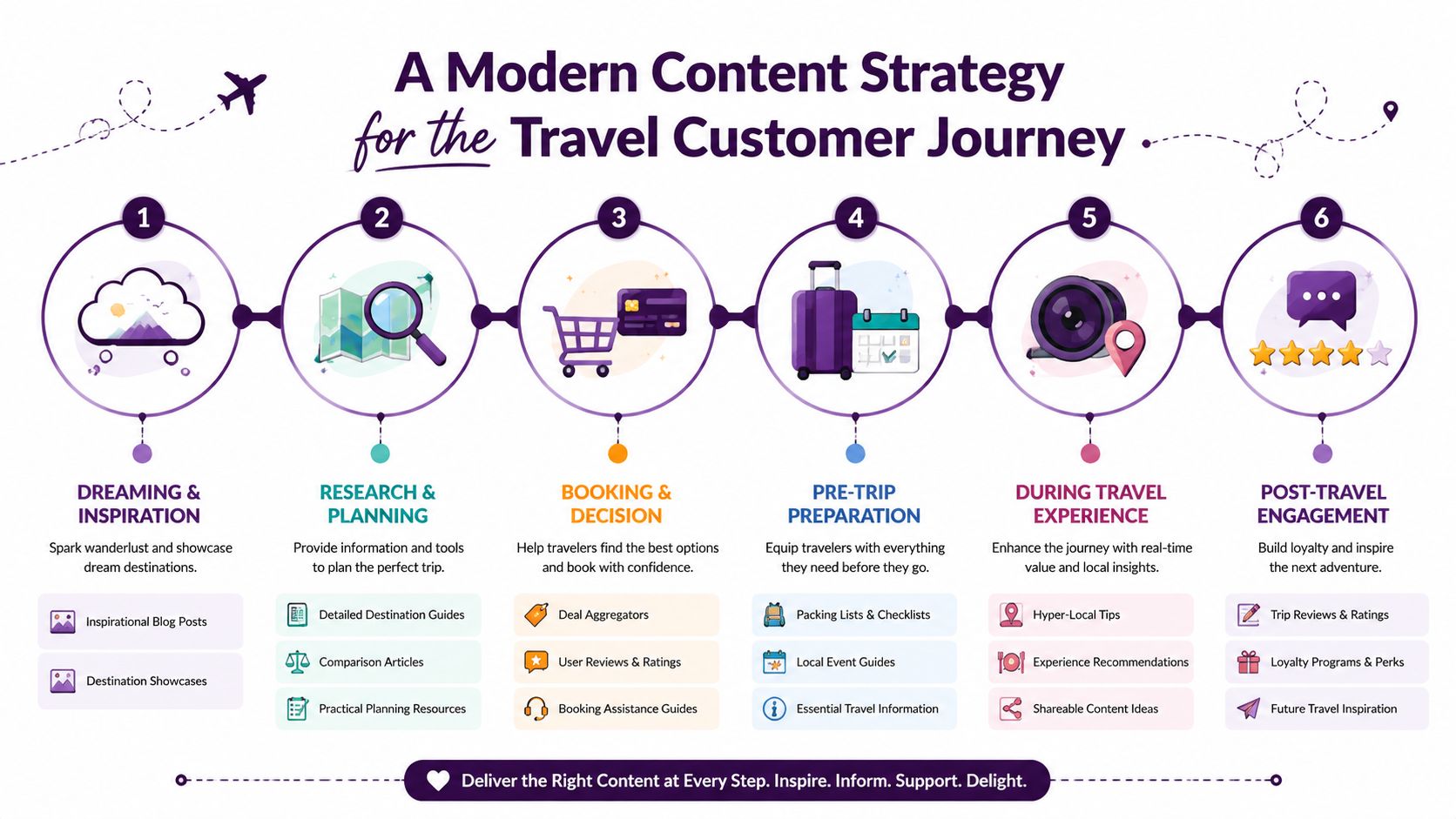
Travel content only works when it matches planning behavior. Too many sites publish isolated articles with no role in the customer journey. They get traffic, but they don't build topical authority or push users toward booking pages.
Travelers don't all arrive ready to transact. Industry guidance cited by Atlas Perk notes that flight research can begin up to 145 days before travel, while hotel searches often start around 80 days before a trip, and top-ranking travel pages average around 1,400 words in this category, as detailed in their travel SEO guide. That's the key planning constraint. You need content for the long consideration window, not just the final booking moment.
Build content by decision stage, not by keyword list
A content strategy for travel should look more like a journey map than a publishing calendar.
Here's the model that consistently works.
Early research content
At this point, travelers are still choosing destination, trip style, budget range, or season.
Useful page types include:
Destination guides: Broad but structured pages that answer where to stay, when to go, how long to spend, and what kind of traveler the destination suits.
Itinerary pages: Multi-day plans by audience, such as couples, families, solo travelers, or luxury travelers.
Seasonal planning pages: Content tied to weather patterns, events, and trip timing.
This stage is where shallow content fails fastest. Generic listicles don't hold up because users are comparing multiple sources. Richer pages with clear subtopics, internal links, maps, examples, and practical planning context tend to perform better.
Mid-funnel comparison content
This is the layer most travel brands underinvest in, even though it often bridges inspiration and booking.
Users here ask practical questions:
Which area should I stay in?
Resort or apartment?
Direct flight or stopover?
Guided tour or self-planned itinerary?
Create pages that help users reduce uncertainty, such as:
neighborhood comparisons
hotel type comparisons
route comparisons
package comparisons
“best for” destination breakdowns
These pages often produce better commercial outcomes than broad inspiration content because they sit closer to the decision point. They also create strong internal linking paths into booking and listing pages.
A useful way to organize this work is through a structured editorial workflow. A checklist like this content SEO framework helps teams keep briefs, intent mapping, internal links, and on-page depth aligned instead of publishing disconnected assets.
The best travel content doesn't just describe a destination. It helps a traveler choose.
Bottom-funnel booking support content
Low-funnel SEO in travel isn't limited to hotel or tour pages. It also includes the support content that removes booking friction.
Strong examples include:
visa and entry guidance
transfer and airport logistics
cancellation policy explainers
baggage or packing expectation pages
local transport guidance tied to where the user will stay
This content won't always carry the highest volume, but it improves conversion paths because it answers the last questions users have before they book.
Cluster destinations like a publisher, route users like a merchant
Most major travel sites need a cluster model around each strategic destination or trip type. That usually means one authoritative hub supported by related subpages that target narrower intents.
A simple structure might look like this:
Cluster level | Role in SEO | Typical page type |
|---|---|---|
Core hub | Establish destination authority | “Guide to Kyoto” |
Supporting planning pages | Capture practical variants | “Best time to visit Kyoto” |
Comparison pages | Help users narrow options | “Where to stay in Kyoto” |
Commercial pages | Convert interest into action | hotel, tour, or package pages |
The trap is overproducing content that doesn't connect to revenue pages. If a guide attracts traffic but doesn't lead users into relevant listings, tours, itineraries, or lead forms, it's acting like a media page on a commerce site.
Depth beats volume when pages are meant to rank
The fact that top-ranking travel pages average around 1,400 words in the guidance above doesn't mean every page needs to hit a word target. It means thin coverage won't compete in a category where users need detail before they commit.
Depth should show up as:
complete answers to planning questions
destination specificity
meaningful internal links
unique local context
clear progression to the next decision
That's what separates content that ranks from content that sits in the archive.
Mastering Local and International SEO for Travel
Geographic targeting in travel isn't one problem. It's two.
The first is local SEO for operators, agencies, hotels, and attractions that need to win visibility in a specific place. The second is international SEO for brands serving demand across multiple countries and languages. Teams often mix these up, then end up with weak local signals and bloated multilingual sections.
Local SEO for operators and place-based brands
If you run a hotel group, tour business, destination management company, or physical agency, local SEO should support your organic strategy, not sit apart from it.
The basics still matter:
complete Google Business Profile data
consistent NAP details across the site and listings
location-specific landing pages
review acquisition tied to real locations and services
strong local intent copy on service pages
But the practical difference-maker is alignment. Your location page, business profile, and supporting content need to reinforce the same entity and service area. If your site says “private food tours in Rome” while your profile and on-page content stay generic, Google gets a weaker local signal.
Field note: Local travel pages perform better when they read like operational pages with real service detail, not recycled city copy with a booking widget attached.
International SEO needs prioritization, not ambition
Many travel brands often overspend.
Digitaloft highlights a core gap in travel SEO guidance: most advice on multilingual SEO stays broad and doesn't give teams a real framework for choosing which languages, countries, and page types to prioritize first, which creates a high risk of thin, translated content on travel sites, as discussed in their analysis of SEO for travel websites.
That's exactly the issue. Brands launch multiple languages too early, translate everything, and discover that none of the new sections have enough local relevance, authority, or demand coverage to rank well.
A better prioritization model looks like this:
Start with market fit
Choose the countries and languages where you already have one or more of these:
strong booking demand
operational capability
localized inventory or offers
native-language support
enough content depth to avoid template-only pages
Then choose page types
Don't translate the entire site at once. Start with the page types most likely to earn visibility and support revenue, such as:
top destination hubs
highest-demand commercial pages
local practical guides
branded comparison pages
Protect quality with localization, not literal translation
A translated page that keeps the same examples, terminology, and user assumptions often underperforms because it doesn't reflect how people in that market search. Localization changes the framing, not just the language.
The structural trade-off
Travel brands usually debate subdirectories versus subdomains. In practice, the right answer depends on internal resources, CMS flexibility, and governance. What matters more is consistency.
Whichever structure you choose, keep these principles in place:
Decision area | What to avoid | What good looks like |
|---|---|---|
Hreflang | Incomplete return tags | Market-specific pairs that map cleanly |
URL logic | Mixed structures by market | Consistent patterns by language or country |
Content rollout | Bulk translation | Prioritized launch by market value |
Templates | One-size-fits-all copy | Localized messaging and entities |
Travel SEO expands internationally when teams say no to unnecessary scale. That restraint usually produces better rankings than launching ten weak market versions at once.
Advanced SEO for Travel Listings and Aggregators
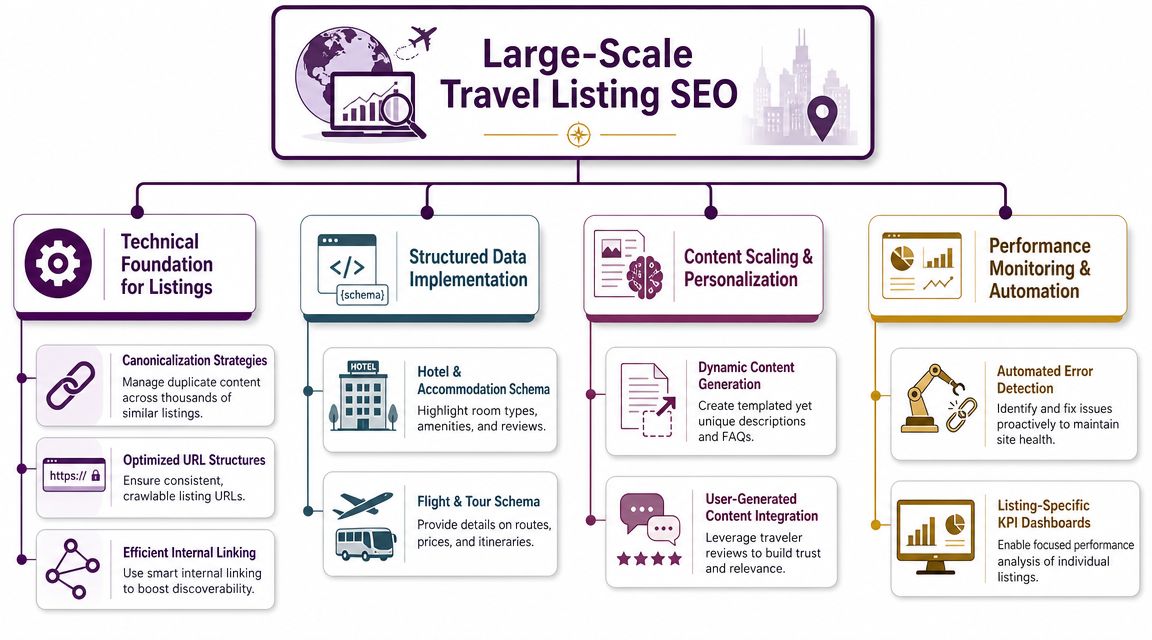
Large travel sites live or die by template quality and crawl control. If you manage hotel listings, route pages, tours, packages, or marketplace inventory, the challenge isn't publishing more pages. It's making large sets of similar pages both useful and searchable.
Classic SEO advice becomes too vague. Aggregators need rules, not slogans.
Make listing templates carry real information
A listing page can't rely on a property name, a gallery, and a thin amenity block. Search engines need enough unique, crawlable context to understand why one page deserves visibility over thousands of near peers.
Good listing templates usually include:
unique descriptive text tied to location and audience
structured headings around key attributes
summarized reviews or traveler context
availability-adjacent content that doesn't disappear when inventory changes
links to nearby alternatives, related categories, or destination hubs
The key is stable value. If the page only becomes useful once a booking widget loads live inventory, it's too dependent on a dynamic component.
Use structured data to clarify page meaning
Structured data helps search engines interpret entities and relationships on travel pages. On large sites, it also forces discipline. You have to define what the page is.
For travel listings and aggregators, the practical question isn't “should we use schema?” It's “which page types deserve which markup, and is that markup present in the rendered output?”
A working model:
Hotel or accommodation pages: Mark up the lodging entity, amenities, reviews where appropriate, and core business details.
Flight or route pages: Clarify route intent and transport-specific details when the page meaning supports it.
Tour and activity pages: Mark up the experience as an organized offering, not as a generic article.
Breadcrumb markup: Reinforce hierarchy across destination, category, and listing depth.
Schema won't rescue a weak page, but it can improve interpretation and strengthen eligibility for richer search presentation.
If your template says one thing in the HTML, another thing in the visible UI, and a third thing in schema, search engines won't trust the page as much as you think.
Faceted navigation is the real scalability test
Faceted navigation is where many large travel sites lose control. Users need filters for dates, budget, amenities, trip style, departure airport, duration, neighborhood, and board basis. SEO teams need to stop those combinations from exploding into a mess of low-value URLs.
The mistake is treating all filtered pages the same. Some deserve indexation because they represent stable, meaningful demand. Most are just user-interface states.
A practical decision model:
Index when the filtered state reflects stable search demand
Examples might include a major destination plus a meaningful category or traveler type, assuming the page has enough content and internal links to stand on its own.
Keep crawlable but non-indexed when the filter helps users but adds little standalone value
This often applies to sort states, narrow amenity combinations, or temporary refinements.
Block or suppress when the URL creates duplicate or near-duplicate page sets
Parameter-heavy URLs, session variants, and endless combinations usually belong here.
Canonicals, internal links, and page intent have to agree
A lot of travel platforms send mixed signals. They internally link to a filtered page, allow it to self-canonicalize, but also treat it as disposable in the broader architecture. That inconsistency weakens discovery and makes indexing unpredictable.
Use a clear matrix like this:
Page type | Index goal | Canonical approach | Internal linking |
|---|---|---|---|
Core category page | Strong | Self-canonical | Linked globally and contextually |
High-value filtered page | Selective | Usually self-canonical if strategic | Linked from hubs and guides |
Sort order page | Low | Canonical to parent category | Avoid index-oriented links |
Session or parameter variant | None | Canonical to clean URL | No strategic links |
Automation helps, but governance matters more
Large travel sites often automate title tags, meta descriptions, FAQs, internal links, and descriptive copy blocks. That's fine. The risk starts when automation produces pages that look unique structurally but say almost nothing new.
The right pattern is controlled scale:
define which variables can be templated
define which sections require editorial input
define which page states are eligible for indexation
validate rendered output regularly
Travel aggregators don't need every page indexed. They need the right pages indexed, and the rest managed tightly.
Winning in the New Era of AI Overviews
AI Overviews change the travel SEO target. Ranking in blue links still matters, but it's no longer the only visibility layer that counts.
OpenMoves notes an important gap in current travel SEO advice: success in AI Overviews depends on citing statistics, reliable sources, and location-specific terminology so tourism-site information is easier for answer engines to use, as explained in their guide to tourism SEO strategy.
That has direct implications for how travel teams should build pages.
Pages need answer-ready sections
A destination guide can't just be immersive and broad. It also needs clean, scannable answers to questions travelers ask, such as:
best area to stay for families
when to visit for a specific experience
how many days to plan
transport options from airport to city
what to book in advance
This doesn't mean writing robotic FAQ pages for everything. It means structuring key answers so search engines can identify them without guessing.
Specificity now does double duty
The same details that help a traveler make a decision also help AI systems trust your page. Generic travel copy is weak input. Precise local language is stronger input.
Useful signals include:
named neighborhoods
local transport terms
seasonal distinctions
attraction names
traveler-type context
cited facts where facts matter
The trade-off is real. If you answer everything too completely on-page, some users won't click. If you stay vague, you lower your chances of being surfaced at all. The best middle path is to answer the question clearly, then make the click worthwhile with planning tools, comparison depth, inventory access, maps, reviews, or bookable options.
AI visibility still depends on classic SEO discipline
This isn't a separate channel. It sits on top of the same foundations.
Pages that are easier to render, easier to interpret, and clearer in structure are better candidates for AI-driven visibility. So are pages with schema, strong headings, and direct answer blocks tied to real entities and locations.
AI Overviews reward pages that are both machine-readable and decision-useful.
Travel brands that adapt fastest won't abandon SEO fundamentals. They'll package them in a way that answer engines can consume without stripping the page of commercial value.
Tracking KPIs and Prioritizing Your Next Move
The biggest mistake in travel SEO reporting is measuring activity instead of business impact. Rank changes matter, but they're not the decision layer. You need a system that tells you which page types, destinations, and technical issues deserve attention first.
Track performance at the page-set level:
destination hubs
commercial listing pages
filtered category pages
local landing pages
multilingual market sections
Then watch the signals that change outcomes:
organic-driven bookings or qualified leads
impressions versus clicks on strategic pages
indexation health for core templates
visibility share across priority destinations
pages losing traction after template or rendering changes

A useful reporting habit is to split opportunities into three buckets: pages with high impressions but weak clicks, pages with strong engagement but poor rankings, and pages that should rank but aren't reliably indexed. That turns SEO from a backlog of ideas into an action list.
If you want a stronger measurement framework for that process, this guide to rank tracking for modern SEO teams is worth reviewing. The point isn't to stare at ranking charts. It's to connect ranking movement to revenue pages, SERP features, and template decisions.
Travel website SEO rewards the teams that prioritize well. Fix the technical constraints that suppress visibility. Build content around real planning behavior. Scale international expansion carefully. Control listing sprawl. Adapt pages for AI-driven discovery. Then measure what moves bookings.
Keyword Kick helps teams do that without stitching together five separate tools. If you need one place to connect search data, spot priority issues, and turn them into clear next actions, take a look at Keyword Kick.