
You can usually spot the problem before the report proves it. A campaign launches, search terms start drifting in from everywhere, and the account is suddenly paying for traffic that never had a shot at converting. That's what happens when sem keyword research starts with a tool instead of a business goal, because the list gets bigger while the intent gets blurrier.
The market context matters here too. One industry summary estimates the global SEM market at $210.8 billion in 2025, up from $147 billion in 2022, and projects it to exceed $250 billion by 2027, while Google Ads accounts for 56.2% of global digital ad spend in 2024 (SEM market statistics). In a market that large, keyword choices aren't housekeeping, they're budget allocation decisions.
Defining Campaign Goals Before Touching a Keyword Tool
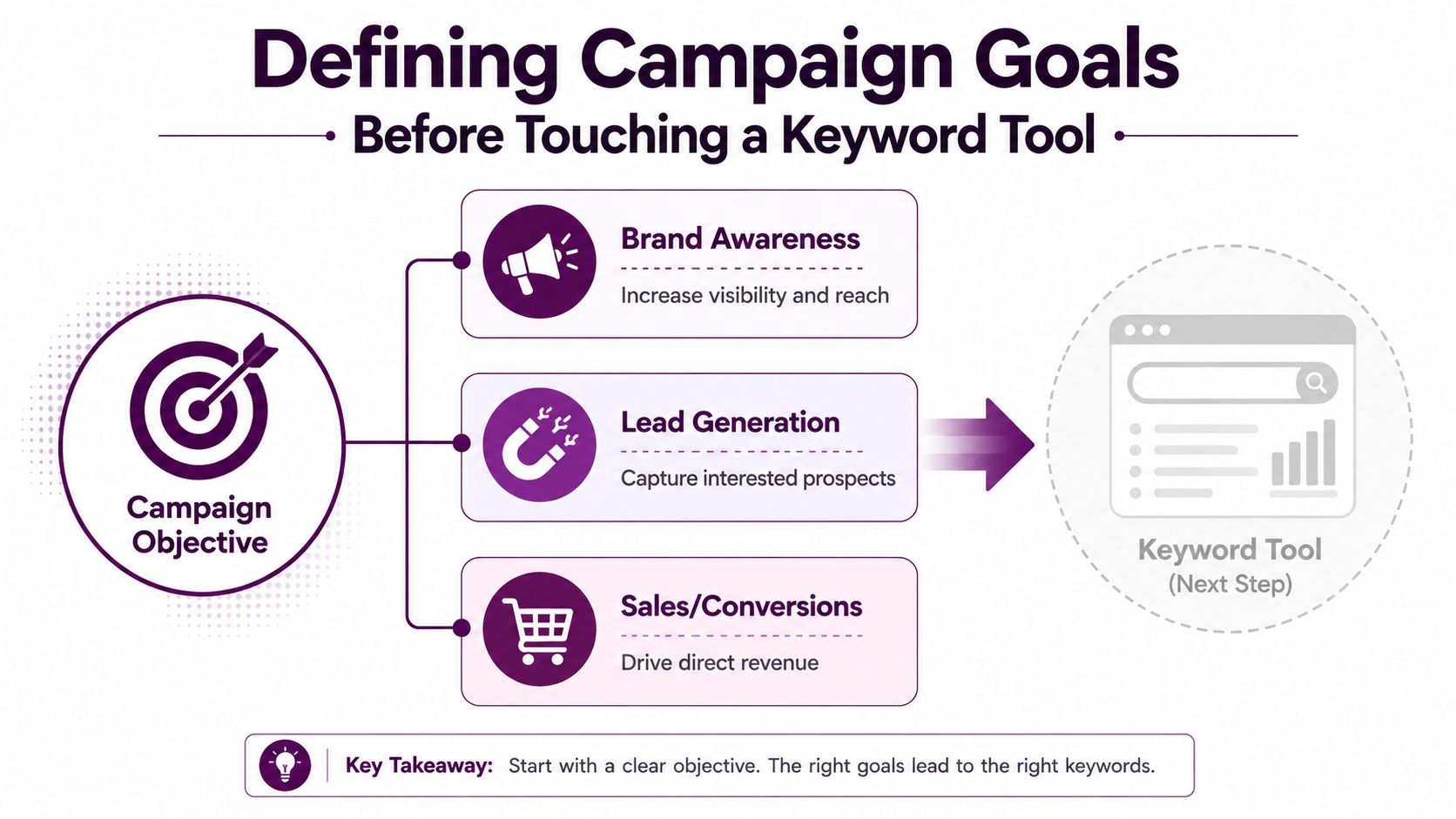
Bad keyword research wastes money in a very predictable way. A lead gen team chases broad informational terms, sales gets curious clicks instead of pipeline, and the landing page ends up trying to do three jobs at once. If the objective isn't defined first, every later decision, match type, ad copy, negatives, and page selection, gets negotiated in the wrong order.
Start with the outcome, not the seed term
Write the campaign goal in plain language before you open a keyword tool. Brand awareness wants reach and visibility, so informational clusters and broader problem language matter more than direct-response terms. Lead generation needs queries that signal active evaluation, while sales and conversion campaigns should focus on high-intent commercial terms, comparison phrases, and branded demand capture.
The practical move is to translate the business goal into a keyword brief. For awareness, ask whether a term can introduce the brand to a relevant audience without blowing up cost. For lead gen, ask whether the query suggests a problem worth solving. For revenue campaigns, ask whether the page can satisfy someone ready to act right now.
Practical rule: if you can't explain what action the searcher should take after the click, the keyword probably belongs in another campaign.
Use a decision matrix before expansion
A simple planning matrix keeps scope tight. It doesn't need to be fancy, it just needs to stop teams from mixing intent buckets in the same build. Use this as a working brief:
Goal type | Keyword characteristics | Match type bias | Landing-page requirement |
|---|---|---|---|
Brand awareness | Informational clusters, problem language, broad educational intent | Phrase and broad, with close monitoring | Educational page or guide |
Lead generation | Service terms, comparison queries, solution-seeking phrases | Phrase first, exact for proven terms | Service page, demo page, or lead magnet |
Sales and conversions | Commercial and branded terms, pricing, vendor, and comparison intent | Exact for core winners, phrase for expansion | Direct conversion page with clear CTA |
Conquesting | Competitor brand terms and “alternative” queries | Tight control, frequent review | Dedicated comparison or switch page |
A written brief helps most here. If the goal is revenue, the brief should say which intent bucket wins, what page will receive the traffic, and what would count as a bad query. That one page of notes prevents the classic failure mode where every stakeholder adds “just one more keyword.”
Use the brief as your guardrail and keep it attached to the build. If the campaign's purpose changes, rewrite the brief before you expand the list. For a deeper framework on aligning keyword choice with business value, this revenue-focused keyword guide is a useful reference.
Discovering Keywords Beyond Tool-Generated Suggestions
Keyword tools are useful, but they hand everyone the same starting list. That's why the best-performing accounts usually pick up terms that never show up in generic exports, because the language came from buyers instead of software. In complex B2B, ecommerce, and service businesses, that difference matters more than many acknowledge.
Mine first-party language before you mine the SERP
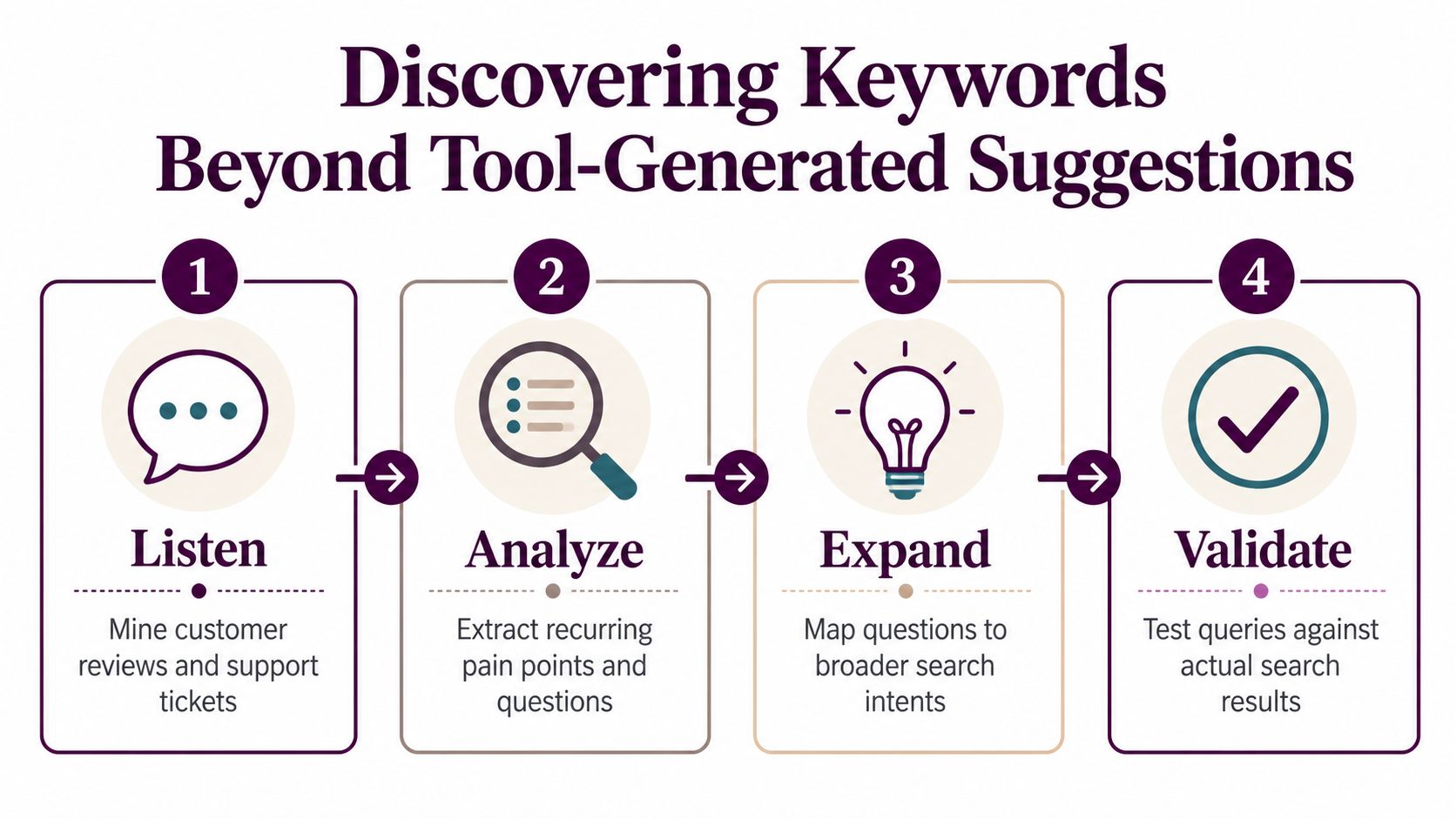
Sales calls are the cleanest source of real demand language. The questions prospects ask, the objections they raise, and the way they describe the problem often sound nothing like a keyword database. Support tickets and onboarding calls do the same thing on the post-sale side, they expose confusion, feature names, and pain points that buyers are already trying to solve.
Don't summarize the language too early. Capture the exact phrases customers use, then sort them into themes like objections, comparisons, pricing pressure, setup confusion, or competitor references. That's where low-volume, high-intent terms often live. The point isn't to build a giant transcript archive, it's to create a repeatable feed of phrases that can become ad groups, negatives, or landing-page angles.
“Use the words the buyer used, not the words the brand team prefers.”
Let the SERP fill in the missing pieces
Once the first-party language is captured, validate it against search results. People Also Ask boxes, related searches, and headings on top-ranking pages are where long-tail variants and supporting questions usually surface. Those signals help you see whether a phrase belongs in a comparison page, a problem-solution page, or a deeper educational cluster.
Competitor ad copy is another high-value clue. Look at the terms rivals repeat in their headlines, which ad extensions they favor, and which landing pages they send traffic to. If a competitor keeps sending traffic to one page for multiple terms, that page is telling you how they grouped the intent. If their copy leans on a specific objection or use case, that's a cue to test the same language, not to imitate the whole campaign.
For teams that need a deeper workflow, Prescott SEO keyword tactics is a solid example of how local and service keywords can be mined from real-world demand signals. The structure matters more than the channel, because the same language-mining logic applies whether you're building local, B2B, or ecommerce campaigns.
Pull everything into one master sheet. Keep columns for source, intent, estimated value, and notes on whether the phrase came from a customer, a competitor, or the SERP. If you want a more granular process for this kind of expansion, the long-tail workflow guide fits neatly beside it.
Filtering and Grouping Keywords Into Themed Ad Groups
A huge keyword list looks productive right until the campaign structure starts leaking money. The fix is to filter hard, group by intent, and keep each ad group tied to one clear page purpose. That's how you avoid self-competition and stop your account from bidding against itself.
Apply three filters before you group anything
The first filter is meaningful demand. A keyword doesn't deserve a slot just because it exists in a report, it needs enough real search interest to justify the build for that business. The second filter is manageable competition, which means the economics have to fit the target acquisition model, not just the keyword tool. The third filter is clear intent, because transactional, informational, and navigational searches need different treatment even when they share the same root term.
Practical rule: if a keyword can't be mapped to a page and an intent bucket, it isn't ready for launch.
Grouping comes next. Put terms with the same search intent, page type, and ad angle into the same theme. If one ad group needs different headlines, different proof points, or a different CTA, the group is probably too broad. The tighter the theme, the easier it is to write ads that match what the searcher wants.
Match types should follow confidence, not habit
Exact match is for the terms you already trust. Phrase match gives controlled expansion while keeping the core meaning intact. Broad match should only be used with strong bidding discipline, clean conversion tracking, and a serious negative keyword system.
Match Type | Best For | Risk Level | Bid Strategy Pairing |
|---|---|---|---|
Exact Match | Proven high-intent terms and branded winners | Lower | Manual control or smart bidding with tight guardrails |
Phrase Match | Controlled expansion around a strong intent theme | Medium | Smart bidding or disciplined manual bidding |
Broad Match | Discovery when negatives and conversion signals are mature | Higher | Smart bidding with active search term review |
The mistake that keeps showing up in accounts is isolated keyword targeting. Teams launch individual terms without deciding which page owns the intent, then wonder why performance fragments across multiple ad groups. One primary intent cluster should map to one page, and supporting content should internally reinforce the pillar instead of competing with it.
That structure matters before launch, not after damage control starts. If two pages can plausibly answer the same query, choose one owner and make the rest support it. The goal is cleaner signals, fewer cannibalized impressions, and faster learning once the campaign goes live.
Adapting Keyword Strategy for AI Search and AI Overviews
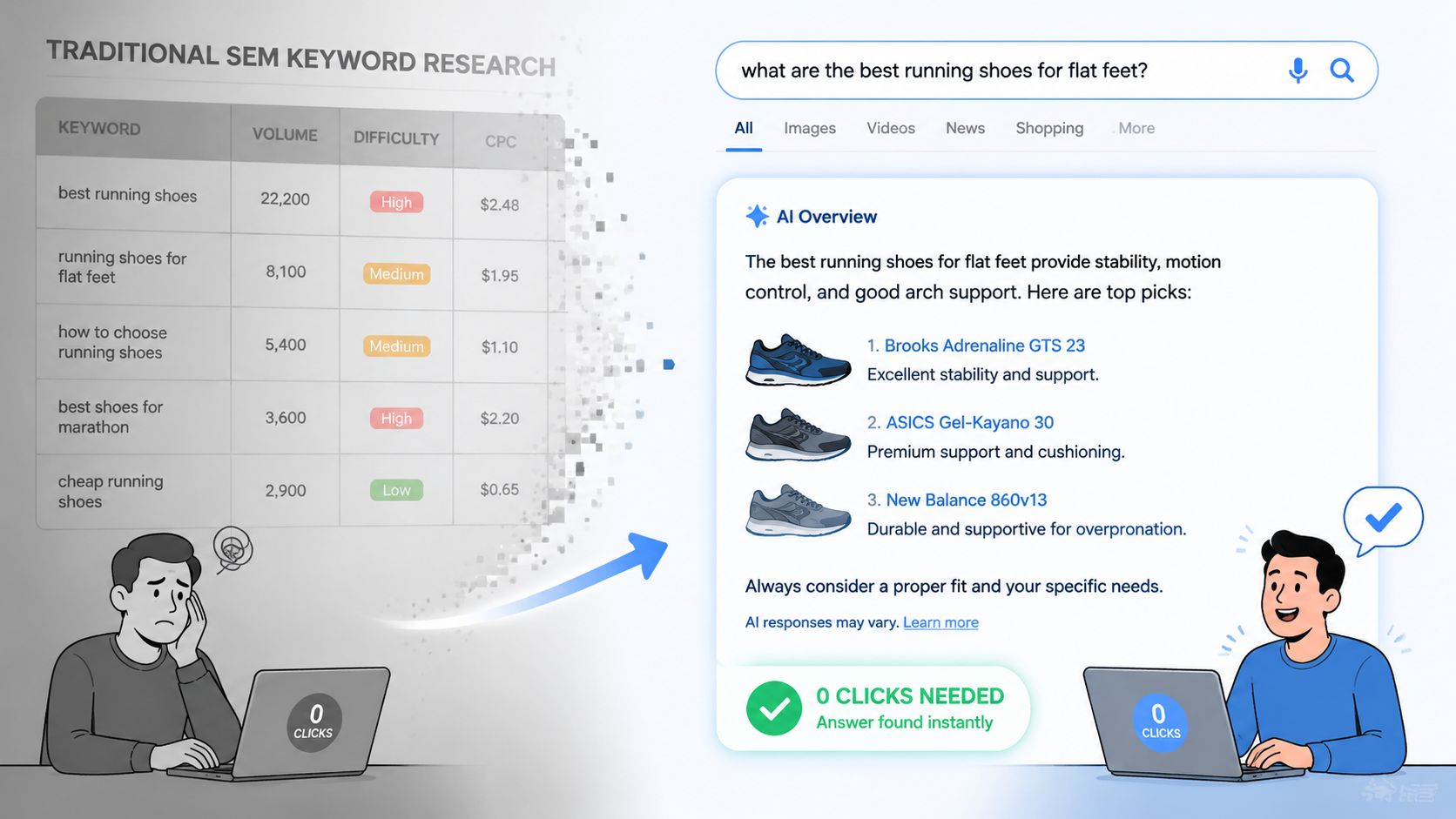
Legacy keyword research still leans too hard on volume, CPC, and difficulty. That framework misses a growing share of how people now encounter answers, especially when the search result itself compresses the research journey. In that environment, some keywords deserve more budget than their raw volume suggests, while others deserve less.
Evaluate queries on conversion intent and AI-search visibility, not just raw keyword volume
A keyword with modest traditional volume can still matter if it shows strong conversion intent or gives your brand a chance to appear in AI-driven results. The opposite is also true. A keyword can look attractive in a spreadsheet and still be a poor PPC bet if an AI Overview answers the question completely and leaves little reason to click.
Semrush's 2026 guidance frames keyword research around search intent, page type, and AI-search visibility, and its competitor workflows now include “topics & prompts” and “missing” opportunities in AI-driven results (Semrush keyword research in 2026, Semrush Keyword Magic Tool). That is the right direction. The shift is to score a query against both conversion intent and the likelihood that the SERP still produces a click.
Watch which SERPs still pay off
Some SERPs compress the funnel, which can make ad placement more valuable if your offer sits above the AI content. Others are fully satisfied by the answer box, which means the keyword may be better suited to organic visibility, retargeting, or a different content format altogether. The question is whether the searcher still has a reason to click after the AI summary appears.
That guidance also pushes teams to use sales calls and demo questions as keyword inputs. That is useful because AI visibility and real customer language belong in the same research loop. The words prospects use in calls often expose intent that keyword tools miss, especially for queries that sound broad but signal readiness to buy.
The working model is simple. If AI search compresses the top of funnel, treat the keyword as a blended opportunity and look at where your ad would sit relative to the AI content. If AI answers fully satisfy the query, move on unless the term has strong conversion intent or a strategic brand reason to stay in it. That is a better use of budget than chasing every term with a visible SERP panel.
Building Negative Keywords and Forecasting Bids
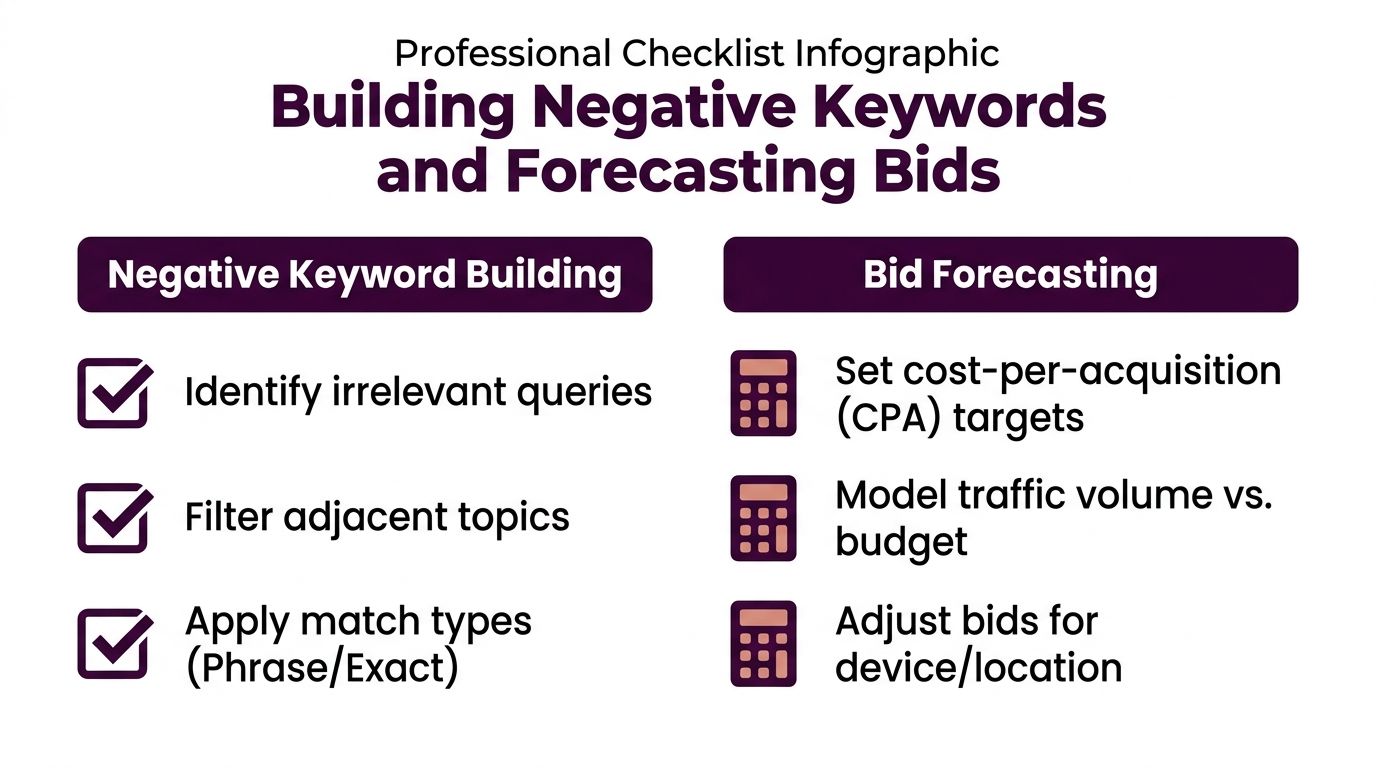
Negative keywords protect the account before waste starts. If you wait until the search terms report shows bad traffic, you've already paid for the lesson. The stronger move is to build the exclusions list from the beginning and forecast spend with enough realism to keep stakeholders grounded.
Build negatives from likely waste, not just past waste
Start by listing the irrelevant categories that can siphon clicks from your core theme. Adjacent industries, job seekers, DIY intent, price shoppers, and research-only modifiers often show up before you notice them in the reports. Phrase and exact negatives can help contain the account, but the primary win is knowing which terms should never have been eligible in the first place.
A good negatives list is operational, not decorative. Keep it tied to campaign intent, landing-page scope, and known adjacent topics. If the ad group is built for commercial evaluation, then informational modifiers and unrelated use cases shouldn't be allowed to roam in it.
Forecast with assumptions you can defend
Bid forecasting doesn't need false precision. It needs a clear set of assumptions about CPC, expected traffic, and budget range so leadership knows what the launch can realistically support. If you've got historical data, use it. If you don't, start with a conservative model and make the uncertainty explicit.
Landing-page alignment belongs in the same conversation. The ad promise, the keyword theme, and the page headline should point to the same intent. If the page asks for a demo but the query is clearly research-led, you're forcing friction into the funnel before the user has agreed to convert.
Before launch, verify the tracking stack too. Confirm the conversion action is firing, check the audience layers, and make sure the page can support the query set you're about to buy. For teams that want a platform layer tying keyword research to the rest of the SEO stack, Keyword Kick is one option that combines keyword research, rank tracking, site audits, backlink analysis, and competitor analysis in one workspace.
Measuring Performance and Iterating Keyword Strategy
Launch data gets useful fast if you know what to look for. The trap is chasing visible metrics that feel active but don't change return on spend. Good SEM keyword research shows up in the search terms report, the match type mix, and the quality of traffic by theme, not just in click counts.
Read the right signals first
Search term relevance is the first check. If the query set doesn't match the page intent, the campaign isn't learning cleanly. Quality score trends matter because they often reflect the alignment between keyword, ad, and landing page, while conversion rate by match type tells you whether exact, phrase, or broad is pulling its weight.
The search terms report should be reviewed with a purpose. Add new negatives when irrelevant intent appears. Promote converting search terms into exact match when they prove their value. Pause the queries that keep spending without producing useful behavior.
Practical rule: the search terms report is a build tool, not a reporting vanity sheet.
Use a simple cadence and document what changes
The first week is for tracking issues, disapprovals, and obvious mismatches. The first month is for keyword-level CPA and ROAS patterns, plus the first real negative keyword cleanup. The first quarter is where structural decisions start to make sense, whether that means expanding a winning theme, tightening a weak one, or retiring terms that never found traction.
For a measurement framework that keeps keyword work tied to business outcomes, this practical performance guide is a useful companion. The key habit is to document what changed and why, because future campaigns should start with inherited knowledge instead of a blank sheet.
Keep a campaign journal with three columns, what changed, what happened, and what to do next. That tiny habit prevents teams from relearning the same lesson six months later. It also makes it easier to spot which keyword themes deserve more budget, and which ones should be cut before they become sunk cost.
If you're building SEM campaigns and want a cleaner way to turn messy search data into decisions, Keyword Kick gives you a single workspace for keyword research, rank tracking, site audits, backlink analysis, and competitor signals. Use it to spot intent gaps, surface cannibalization, and decide which pages deserve attention before the budget gets spread too thin.