You've published the pages. You've waited for indexing. You've told yourself SEO takes time, which is true, but that doesn't help when your reporting window is this month and the graphs are flat.
That's where SEO quick wins matter. Not as a replacement for strategy, but as the fastest way to realize value from work you've already done. The reason this works is simple. Search clicks are concentrated near the top of the results page. A Backlinko analysis of 4 million Google results found the top organic result gets an average click-through rate of 27.6%, while position two gets 15.8% and position three gets 11.0%, as summarized in Re:signal's write-up on SEO quick wins. If you already rank close to page one, small improvements can change traffic fast.
Most SEO advice gets this wrong. It gives you a bag of tactics with no order, no validation method, and no connection to business impact. That's why teams stay busy without moving anything meaningful.
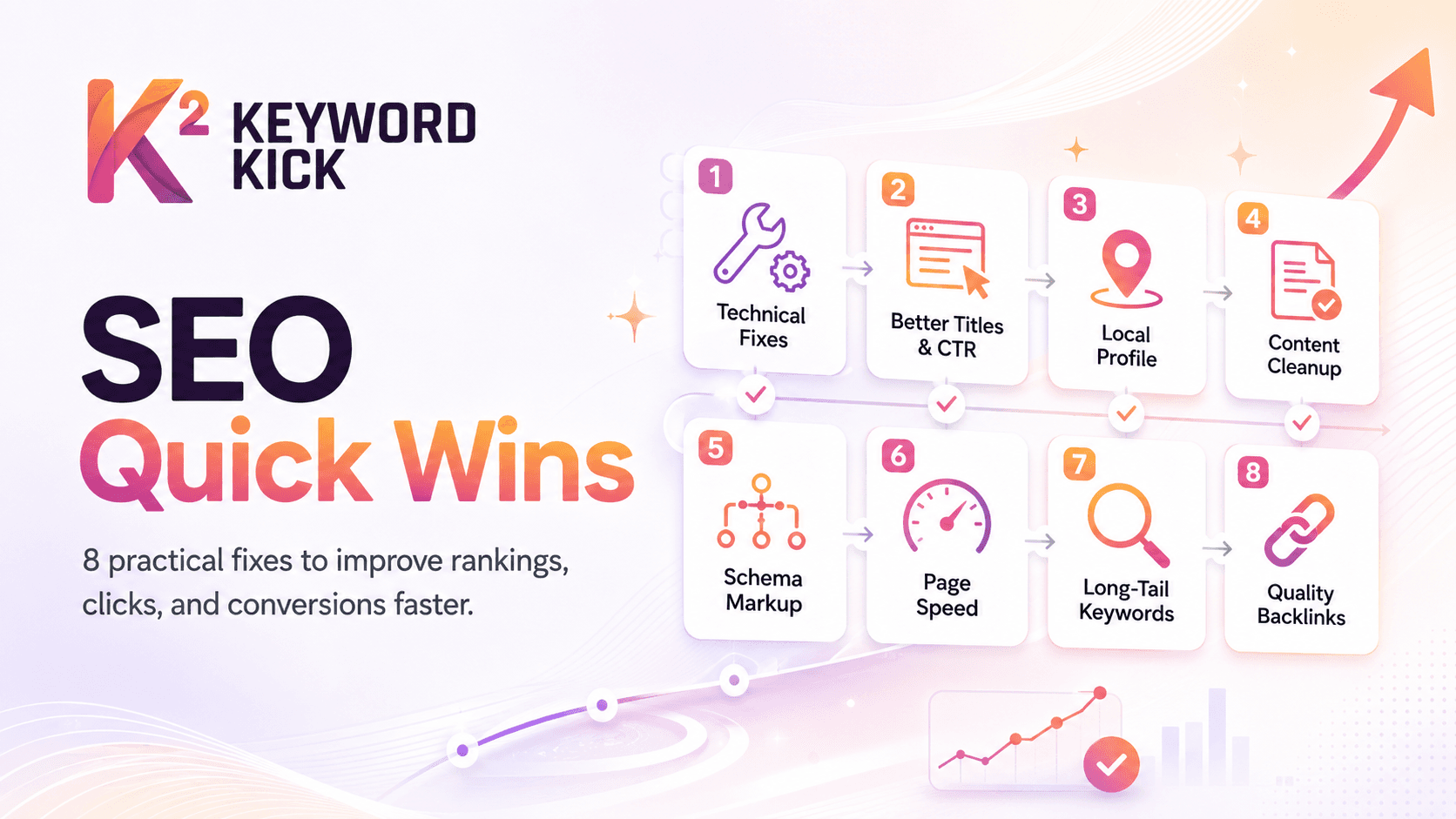
The better approach is to treat each quick win like a mini-project. Find the right page in Google Search Console. Make a focused change. Measure the result against clicks, rankings, qualified traffic, and conversions where possible. That's what this guide does. These are the eight SEO quick wins I'd prioritize when you need traction in days or weeks, not another vague six-month roadmap.
1. Fix Low-Hanging Fruit Technical SEO Issues
Technical quick wins aren't glamorous, but they often remove the exact blockers keeping good pages from performing. I'm not talking about a full rebuild. I mean fixing obvious crawl, indexation, and internal linking issues that waste authority or send users into dead ends.
Start with Google Search Console and your crawler of choice. Look at Pages, Excluded, and Crawl reports. Then compare that against a domain crawl so you can separate harmless noise from problems that affect pages people visit.
What to look for first
Broken internal links on valuable pages: If category pages, core service pages, or frequently visited blog posts point to 404s, fix those first. They hurt user experience and interrupt crawl paths.
Redirect chains: If old URLs hop through multiple redirects before landing on the final page, update internal links to the final destination directly.
Duplicate versions of the same page: This shows up on blogs, faceted ecommerce pages, and sites with messy parameter handling. Consolidate where needed and tighten canonicals.
Weak sitemap hygiene: Make sure your XML sitemap includes indexable URLs only, then resubmit after major cleanup.
A common scenario is an ecommerce site that discontinued products but left old internal links in category copy, breadcrumbs, and blog guides. Search Console will often surface the fallout faster than teams expect.
Practical rule: Fix the issues tied to high-traffic or high-intent pages first. A sitewide cleanup feels productive, but a targeted cleanup usually pays back faster.
How to validate the win
Track three things for the affected URLs over the next few weeks:
Indexation status: Are blocked or excluded pages now eligible and indexed?
Internal click paths: Are users landing on working pages instead of error states?
Ranking stability: Do cleaned-up pages stop drifting or start improving?
If you need a process to work through before publishing or refreshing pages, use this SEO site audit checklist. It's a practical framework for catching the issues that are easiest to miss when teams move fast.
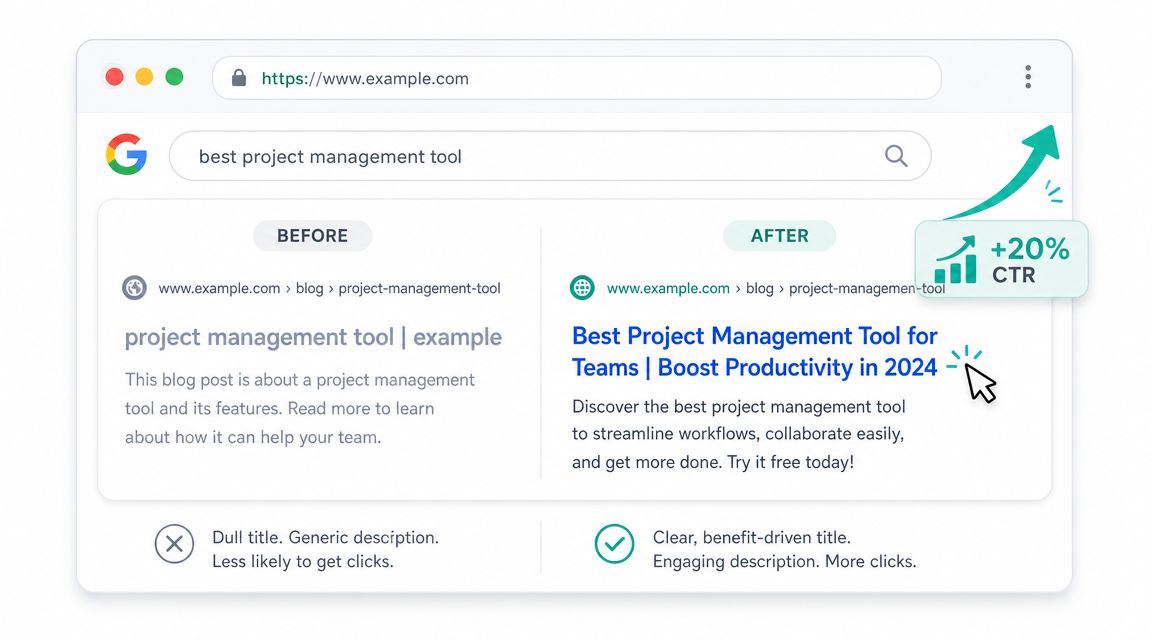
2. Optimize Title Tags and Meta Descriptions for Click-Through Rate
This is one of the fastest SEO quick wins because you're not asking Google to trust a brand-new page. You're improving how an existing page competes in the search results.
The highest-value targets are pages that already get impressions but underperform on clicks. Google Search Console gives you the shortlist. Filter for queries and pages with strong impressions, then sort for weak CTR and average positions just outside the top spots.
Where this pays off fastest
Google still holds about 89.85% of global search engine market share, which is why Google-first snippet improvements still deserve priority. That figure is cited in SEOProfy's SEO statistics roundup. If you want quick gains, focus where the demand already is.
Good title work isn't about clever copywriting. It's about matching intent better than the other result options. On a commercial page, that could mean surfacing product type, use case, brand trust, or a specific differentiator. On an informational page, it often means making the outcome clearer.
How to run it like a test
Pull candidates from GSC: Prioritize pages with high impressions and disappointing CTR.
Review the live SERP: Don't rewrite in isolation. Compare your title against what ranks.
Tighten the promise: Lead with the main topic, then add the benefit or differentiator.
Keep the snippet honest: Better clicks that bounce immediately aren't a win.
For example, a page titled “Project Management Software” is often too generic. If the query pattern suggests buyers want team size fit, pricing clarity, or industry relevance, the title should reflect that. The meta description then supports the click by reducing uncertainty.
Don't optimize titles for approval in a spreadsheet. Optimize them for the person scanning ten blue links in five seconds.
Measure before and after in Search Console at the page level. Keep annotations so you know when edits went live. If you want a repeatable process for this, this CTR improvement playbook is the right kind of framework because it starts with data, not headline formulas.
3. Claim and Optimize Google Business Profile with Rich Data
If you serve a local area, this is one of the few quick wins that can improve visibility without touching your website first. Too many businesses claim the profile, fill in the basics once, and never come back. That leaves money on the table.
A properly managed Google Business Profile helps you show up more credibly in branded searches, local intent searches, and map results. For service businesses, dental clinics, law firms, restaurants, retailers, and multi-location brands, it often influences the first click or call before the user ever reaches the site.
What a complete profile actually includes
Your profile should be fully filled out and actively maintained. That means core business data, categories, services, attributes, hours, booking or appointment options where relevant, fresh photos, and review responses.
A lot of local profiles fail because the data is technically present but strategically weak. The category is too broad. The services are thin. The photos are old. Holiday hours are wrong. Posts are ignored. Review responses read like canned copy.
Primary category accuracy: Pick the closest core service, not the broadest label.
Photo coverage: Add exterior, interior, team, product, and service images that make the business feel current and real.
Review management: Reply consistently and use natural language that reinforces what you do.
Operational trust signals: Keep hours, phone, service area, and appointment paths accurate.
For a practical walkthrough, this guide to optimizing Google Business Profile covers the fundamentals well.
How to validate local impact
Use your profile insights and your website analytics together. Look for changes in branded search behavior, direction requests, calls, bookings, and landing-page traffic from local queries.
A common real-world pattern is that the website traffic bump looks modest at first, while call or direction intent improves faster. That's still a win. Local SEO isn't just about sessions. It's about making it easier for nearby buyers to choose you.
4. Repair Content Cannibalization Issues
Cannibalization is one of the easiest problems to miss because it doesn't look like a technical error. The site appears healthy. You have multiple relevant pages. But Google keeps rotating which URL should rank, and none of them performs as well as the best one could.
This usually happens after years of publishing similar posts, near-duplicate service pages, overlapping category pages, or slight keyword variations that never needed separate URLs in the first place.
Pick a winner, then support it
The fix isn't always a 301 redirect. That's where people get sloppy. Sometimes two pages deserve to exist because they satisfy different intent. Other times, one page is clearly stronger and the rest are just splitting signals.
Look for cases where several URLs attract impressions for the same query family. Then assess which page should lead based on relevance, internal authority, backlinks, and business value.
Merge when pages overlap heavily: Fold the weaker page into the stronger one and redirect if the intent is effectively the same.
Differentiate when intent is distinct: Tighten headings, copy, internal links, and on-page targeting so each page owns a clearer topic.
Update internal links: Point contextual links and navigation toward the page you want to win.
A common example is a SaaS site with separate posts for “CRM for agencies,” “agency CRM software,” and “best CRM for marketing agencies,” all saying almost the same thing. One strong page usually beats three middling ones.
If two pages are competing for the same visit, the problem isn't a lack of content. It's a lack of editorial discipline.
How to measure whether the fix worked
Watch the target keyword set and the chosen URL in Search Console. You want less URL switching, stronger average position stability, and clearer impression concentration around the winner.
If your team needs a methodical process, this guide on keyword cannibalization and how to fix it fast is useful because it forces the decision often avoided, which is choosing the page that deserves support.
5. Add Schema Markup and Structured Data for Rich Snippets
Schema is worth doing when it clarifies the page and supports richer search presentation. It isn't a ranking shortcut by itself, and it isn't worth stuffing with fields just because a plugin makes that easy.
Use it where it aligns with the page type. Product pages, articles, breadcrumbs, organization details, and some FAQ or support content are usually the most practical places to start. Keep it accurate, current, and limited to what the page genuinely contains.
Where schema earns its keep
On ecommerce pages, Product schema can help search engines better understand product details. On editorial pages, Article schema and breadcrumb markup often improve clarity. On service and support content, structured data can reinforce the page's purpose if the content already supports it.
The trap is over-markup. Teams add every available property, forget to maintain it, and end up with stale details or misleading signals. That creates cleanup work later.
Use JSON-LD: It's easier to maintain than hard-coded microdata on most sites.
Validate before release: Use Google's Rich Results Test and check Search Console enhancement reports.
Match page reality: If the page doesn't show it clearly to users, don't mark it up for bots.
How to validate the result
Start with eligibility and error-free implementation. Then watch CTR and appearance changes for marked-up pages. In some cases, the visible gain is richer snippet treatment. In others, the benefit is cleaner interpretation and more stable presentation.
This works best on pages that already rank reasonably well. Schema on a buried page usually stays buried. Schema on a page already in the mix can help it earn more attention.
6. Improve Page Load Speed and Core Web Vitals
Page speed projects go wrong when teams try to fix everything at once. The quicker path is to identify the small set of issues affecting your most important templates, then remove the bottlenecks users feel.
Start with your revenue pages, top landing pages, and your most linked informational assets. Run PageSpeed Insights and compare findings across templates. You're looking for repeated problems, not one-off lab quirks.
Focus on what users notice first
Largest Contentful Paint often points to heavy hero images, oversized sliders, render-blocking CSS, or slow server response. Layout shift usually comes from banners, delayed font rendering, embeds, or ad placements that push the page around after load.
You don't need a theoretical perfect score. You need pages that load cleanly and predictably on real devices.
Compress and resize images: Use properly sized files and modern formats where your stack supports them.
Remove script bloat: Audit tag managers, chat widgets, heatmaps, and A/B testing tools that aren't pulling their weight.
Stabilize layout: Reserve space for media, banners, and embeds so content doesn't jump.
Defer what isn't critical: If a script doesn't affect the first screen, load it later.
Long-form content upgrades often pair well with speed work. That matters because long-form pages of 2,000 words or more are reported to outrank shorter pages by 56%, according to SQ Magazine's SEO statistics roundup. But richer pages need better performance discipline, or the extra depth becomes a usability problem.
How to prove the improvement mattered
Use a mix of Search Console Core Web Vitals data, page-level engagement, and organic landing performance. If rankings don't jump immediately, that doesn't mean the work failed. Faster pages often improve user flow and conversion quality first, then search performance follows.
7. Target Low-Competition Keyword Opportunities and Long-Tail Variations
Quick wins from new content don't come from chasing giant head terms. They come from finding specific queries where your site can plausibly satisfy intent better than the current results.
That usually means long-tail searches, niche modifiers, use-case terms, comparison phrases, and problem-driven queries already hinted at in Search Console. I like to start with the pages that already rank for adjacent terms, because that shows Google has some topical trust in the area.
Find opportunities the right way
Search Console is excellent for discovering untapped query variants. Look at pages that generate impressions for related terms you never directly targeted. Those are often the easiest content expansion opportunities because the relevance signal already exists.
Then cross-check with keyword research tools. The point isn't to find “easy” phrases in the abstract. The point is to find commercially useful phrases your site can credibly answer.
A good example is a B2B software company that targets broad “best CRM” terms while ignoring industry-specific searches like “best CRM for recruiting firms” or “CRM for field sales teams.” The broad term is glamorous. The niche term is often easier to win and easier to monetize.
Validate before you scale
Write one or two focused pages first. Don't spin up a hundred variations. The page should have a clear angle, internal links from relevant existing content, and a destination in your funnel.
A major gap in most SEO quick wins advice is prioritization by business impact rather than ease. That point is highlighted in LowFruits' analysis of quick SEO wins, which argues that pages close to winning, especially those with high impressions, weak CTR, or positions near page one, are often a better investment than publishing more generic content.
The best low-competition keyword isn't the one with the lowest difficulty score. It's the one that brings the right visitor to a page built to convert.
Measure impressions, ranking entry speed, and assisted conversions where applicable. If the first few pages gain traction, expand the cluster around the same topic family.
8. Build High-Quality Backlinks from Relevant Authority Sources
Backlinks are still powerful, but they're easy to waste time on. Most outreach fails because the target page isn't worth linking to or the prospect list is built on vanity metrics instead of relevance.
The fastest useful link wins usually come from assets you already have, not from random guest post pitches. Think original guides, category resources, comparison pages, tools, templates, local resource pages, supplier relationships, and unlinked brand mentions.
What works better than mass outreach
Start by reviewing which competitors earn links to pages similar to yours. Not to copy every domain, but to understand what type of page attracts references in your niche. Then improve the asset or the angle before you pitch it.
A few examples that consistently have a chance:
Resource inclusion: Industry directories, partner pages, association listings, and curated resource hubs.
Guest contributions with topical fit: Only when the publication reaches the audience you want.
Unlinked mention reclamation: If someone cites your brand, ask for the link politely and specifically.
Linkable assets: Original tools, calculators, glossary hubs, or sharply useful guides.
The trade-off is simple. High-quality links take more judgment and more patience. Cheap links are easier to buy and easier to regret.
How to judge success
Don't measure this only by link count. Look at whether the linked page improves in ranking competitiveness, whether referral traffic is relevant, and whether the links reinforce the topics you want to own.
For a local business, one trusted chamber, association, or niche industry mention can matter more than a pile of unrelated blog placements. For a SaaS company, a mention from a respected software review, integration partner, or specialist publication is usually worth more than broad lifestyle coverage.
SEO Quick Wins: 8-Tactic Comparison
Item | 🔄 Implementation Complexity | ⚡ Resource Requirements | 📊 Expected Outcomes | 💡 Ideal Use Cases | ⭐ Key Advantages |
|---|---|---|---|---|---|
Fix Low-Hanging Fruit Technical SEO Issues | Low, hours to days; minimal dev | Low, audit tool + small dev fixes | Quick crawl/index gains; ~5–15% recovered indexed pages | Sites with crawl/indexation errors (e‑commerce, blogs) | High ROI; fast, trackable wins via GSC |
Optimize Title Tags and Meta Descriptions for CTR | Very Low, content edits only | Low, editor time; A/B testing | CTR lift (often 20–50% on targeted pages) within weeks | Pages ranking #5–30 with low CTR | Fastest ROI; scalable; no dev required |
Claim and Optimize Google Business Profile with Rich Data | Low–Medium, verification + ongoing management | Low, time to complete profile, photos, review responses | Improved local pack visibility; more calls/visits within days | Local services, retail, multi‑location businesses | Strong local trust signal; free and mobile‑focused |
Repair Content Cannibalization Issues | Medium, analysis, merges, redirects | Medium, editorial effort; some dev for redirects | Rank consolidation; often 20–30% ranking improvements in weeks | Sites with overlapping topics or many similar pages | Improves rankings without new content; measurable gains |
Add Schema Markup and Structured Data for Rich Snippets | Medium, JSON‑LD coding and validation | Low–Medium, developer or plugin + QA | Eligibility for rich snippets; CTR lift ~20–30% when shown | E‑commerce (Product), FAQ/support, recipe/article sites | Enhances SERP appearance; helps search engines understand content |
Improve Page Load Speed and Core Web Vitals | Medium–High, front‑end and server work | Medium–High, dev time, hosting/CDN, testing | Better UX, conversions, reduced bounce; ranking support | High‑traffic e‑commerce, SaaS, mobile‑heavy sites | Official ranking factor; tangible UX and conversion improvements |
Target Low‑Competition Keyword Opportunities and Long‑Tail Variations | Low–Medium, research + content creation | Medium, writers, keyword tools, content production | Faster rankings (4–8 weeks); steady conversion‑focused traffic | Niche brands, new domains, intent‑specific campaigns | Easier to rank; higher intent; scalable cumulative traffic |
Build High‑Quality Backlinks from Relevant Authority Sources | High, outreach, relationship building, content assets | High, time, outreach/PR effort, content creation | Domain authority gains; ranking improvements over months | Competitive niches needing authority and referral traffic | Strong, sustainable ranking impact; referral traffic benefits |
From Quick Wins to Sustainable Growth
SEO quick wins work best when you stop treating them like a random to-do list. The right move isn't “fix everything.” It's “fix the pages and signals most likely to change outcomes soon.”
That usually means starting with one of three buckets. Pages that already have impressions but weak CTR. Pages that rank close enough to improve with better alignment and stronger internal support. Pages with technical friction that blocks performance they should already be earning. If you work from those buckets, your effort stays tied to evidence instead of hope.
There's also a trade-off that needs to be accepted. The easiest task isn't always the most valuable one. Changing ten title tags is easy. Choosing the ten pages that could influence qualified traffic or revenue is the actual skill. Publishing more content feels like progress. Consolidating two overlapping pages, cleaning internal links, or improving a local profile often produces the faster business result.
That's why validation matters as much as implementation. Every quick win should have a before state, a change log, and a review window. In practice, that means pulling baseline clicks, impressions, average position, and conversion behavior where available before you touch the page. Then check the same page or page set after the change. If the result is positive, scale the tactic. If nothing moves, don't turn a weak idea into a bigger project.
The importance of a unified workflow becomes clear. If your rank tracking sits in one tool, Search Console in another, technical issues in a crawl export, and backlinks in a separate dashboard, prioritization gets slow and political. Teams start choosing tasks based on who's loudest, not what's most likely to move. The better setup pulls those signals together so you can decide faster and defend the decision with data.
Use these eight SEO quick wins as operating plays, not one-time hacks. Run them in small batches. Document what changed. Keep the pages that matter under active review. Then build from those wins into a system that compounds.
And don't ignore the bigger context around search visibility. Quick fixes can create momentum, but sustainable growth still depends on consistency, sharper intent matching, and better decisions over time. If you want a broader perspective on building momentum across channels, ClipCreator.ai's marketing guide is a useful companion read.
If you want a faster way to spot the next best SEO move, try Keyword Kick. It pulls together Google Search Console, GA4, rank tracking, backlinks, keyword research, competitor data, and technical SEO signals so you can stop guessing which fix matters most. Instead of juggling exports and dashboards, you get prioritized actions you can implement, whether you're cleaning up cannibalization, finding low-CTR pages, diagnosing traffic drops, or deciding which pages deserve attention first.