
Your team's content calendar is full, the next brief is due, and someone has just dropped “LSI keywords” into the Slack thread like it's a shortcut to better rankings. The problem is that many content optimizers chase the phrase without understanding the method behind it, so they end up adding awkward synonyms, repeating terms unnaturally, and calling it optimization. Latent Semantic Indexing is older, more technical, and much more interesting than that.
What is latent semantic indexing is a question about how machines can understand meaning from patterns in language, not just exact word matches. That distinction matters because it separates real information retrieval theory from the marketing myth that LSI is a keyword stuffing tactic. If you've ever had to explain to writers why “just add more related words” isn't a strategy, this guide is for you.
Introduction to Semantic Indexing
A content team often notices the same pattern. A page ranks poorly, someone reviews the competitor pages, and the room decides the answer must be “more LSI keywords.” A draft comes back packed with loosely related phrases, but the copy feels off and the page still doesn't solve the reader's problem.
That frustration usually starts with a misunderstanding. Latent Semantic Indexing was introduced as a way to reduce lexical mismatch in information retrieval, using statistically derived concept indices instead of individual-word matching, and it does that through truncated SVD on a term-document matrix LSI paper. In academic terms, it's about uncovering hidden patterns across a whole corpus, not about sprinkling synonyms into a blog post.
For marketers, that distinction is the key takeaway. The value of LSI isn't in a magical ranking trick, it's in the idea that meaning can be inferred from context, co-occurrence, and topic structure. That's the mindset shift teams need before they can do semantic SEO well.
Understanding Latent Semantic Indexing
How the method works
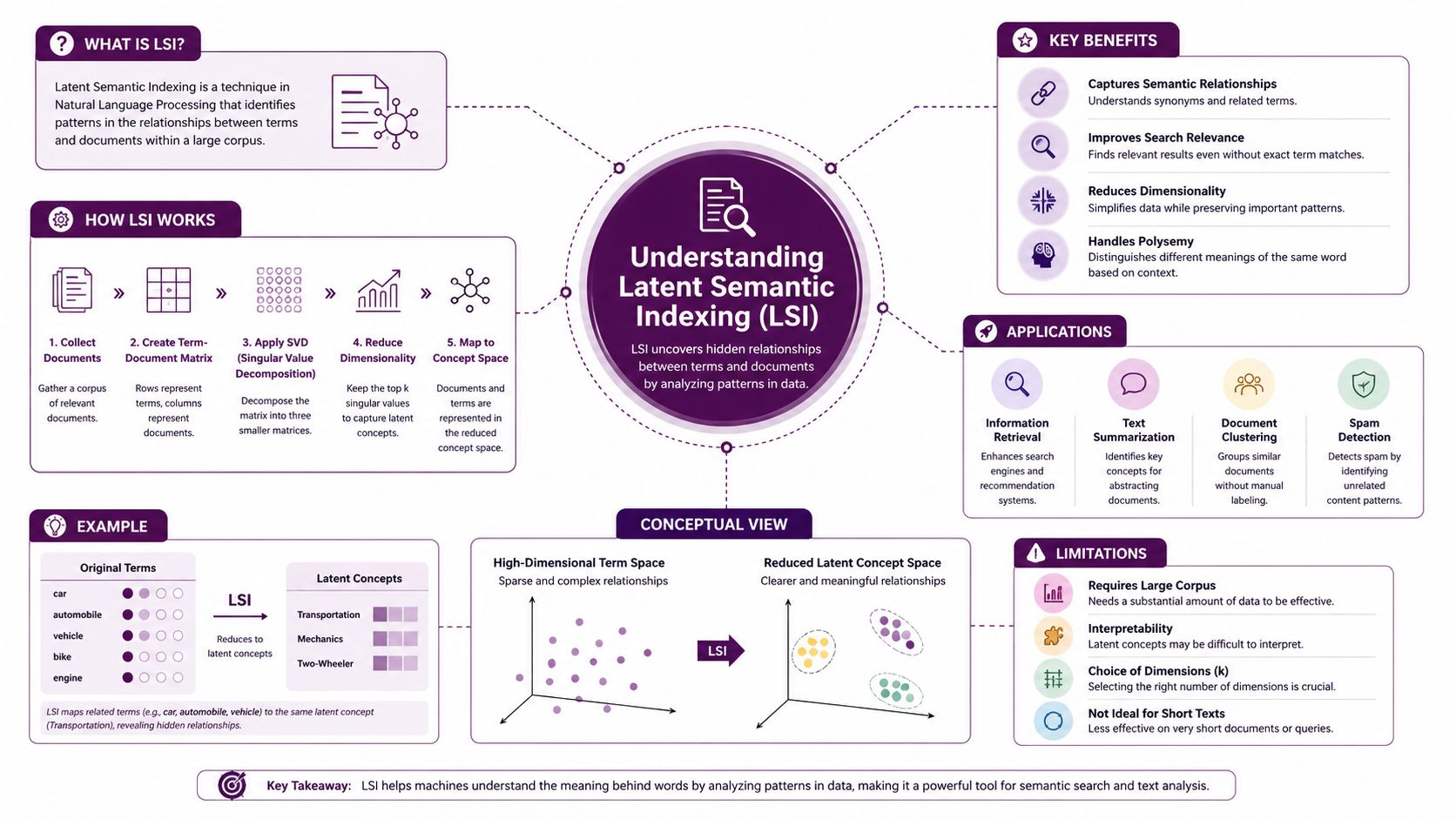
Think of a term-document matrix as a giant spreadsheet. Rows are words, columns are documents, and the numbers show where terms appear together. LSI applies singular value decomposition (SVD) to that matrix and compresses it into a lower-dimensional semantic space, typically around 100–300 orthogonal latent factors TREC.
That reduction matters because it doesn't just shrink data, it exposes structure. A query and a document can land close together in latent space even when they don't share the same surface words, which is why LSI helps with synonymy and vocabulary mismatch. The Stanford IR textbook describes this as a low-rank approximation of the term-document matrix, which keeps similarity high even when exact term overlap is low Stanford IR book.
Practical rule: if two pages use different wording but answer the same intent, semantic similarity can still make them related.
Why that matters for relevance
The simplest way to understand LSI is to compare it with a flashlight in a dark room. Raw term matching only lights up the words you can see directly. LSI tries to reveal the shape of the room itself, the hidden relationships that connect those words across many documents.
That's why the method became influential in retrieval research. A query about one term can still match a document that uses another term, as long as both participate in similar co-occurrence patterns across the corpus MSU paper. If you want a practical taxonomy for grouping those topic relationships in modern content planning, a useful companion is this topic cluster glossary.
The core confusion for many teams is thinking the method is about keywords themselves. It isn't. It's about the statistical geometry of language, and that's why it became a foundational idea in retrieval systems long before SEO people started talking about it.
History and Relation to LSA
Where LSI came from
LSI entered the field through a 1990 paper by Deerwester and colleagues, where the goal was to replace individual-word matching with concept indices using truncated SVD LSI paper. That origin matters because it shows the method was designed for retrieval and clustering problems, not for marketing copy.
The academic framing also makes the naming confusion easier to understand. In practice, people sometimes blur LSI and LSA, but the sources in this brief describe the same lineage from an information-retrieval perspective, focused on matrix approximation, hidden co-occurrence, and concept structure. The Stanford material emphasizes the low-rank matrix view, while other lecture notes frame the same approach as a rank-reduction technique grounded in the Eckart-Young theorem Stanford linguistics paper.
Why the history still matters now
This background matters because it blocks a common SEO mistake. When someone says “LSI keywords,” they're usually using a loose marketing label, not the original academic method. Core academic sources describe LSI as a classic SVD-based retrieval technique, not a keyword-stuffing tactic Stanford IR book.
That difference is more than academic nitpicking. It helps teams stop treating semantic depth like a synonym checklist and start thinking like information architects. If you need a practitioner-friendly overview of how that misunderstanding shows up in SEO workflows, this guide to LSI for SEO managers is a useful reference point.
The cleanest way to remember the history is this. LSI began as a mathematical solution to retrieval noise, not as a content marketing hack. Once that's clear, the rest of the SEO conversation becomes much easier to evaluate.
Debunking LSI Keyword Myths
The myths teams keep repeating
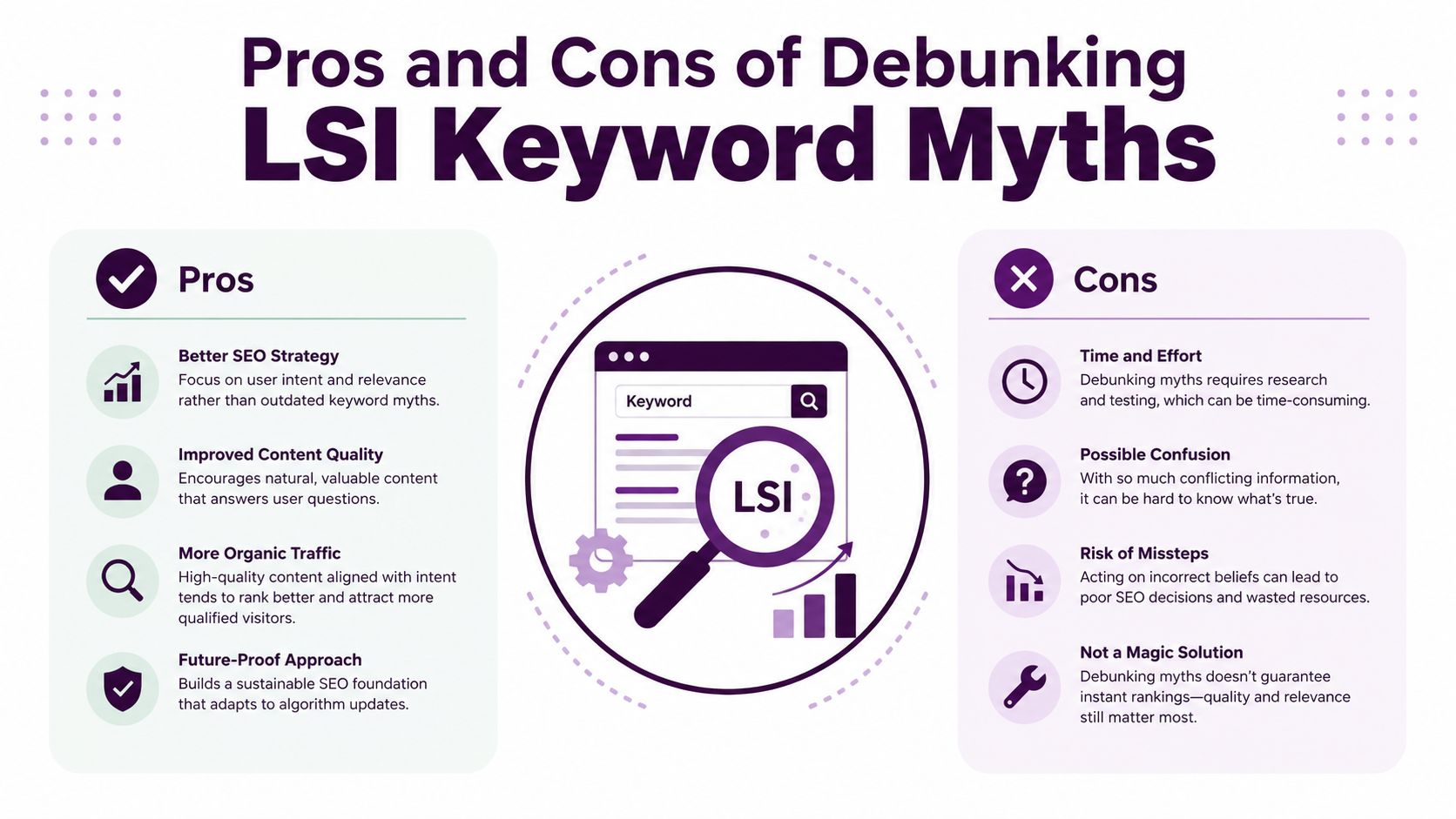
The first myth is that LSI keywords are a formal list of phrases you can extract and insert for better rankings. That framing collapses the academic method into a content gimmick, which is exactly what the Stanford IR book warns against by treating LSI as low-rank matrix approximation for retrieval, not a keyword formula Stanford IR book.
The second myth is that adding more related terms automatically makes a page stronger. In reality, forced synonym lists often weaken clarity, which is the opposite of what semantic retrieval is trying to achieve. LSI is about capturing relationships in a corpus, not about making every paragraph sound artificially broad.
The third myth is that the phrase itself still describes a live SEO ranking mechanism. That's why many articles call it a modern tactic when the core academic sources frame it as a classic IR method built on SVD Stanford IR book. If you want to compare this misconception with broader SEO language, the ranking content in AI answers discussion from MyMentions shows why semantic coverage matters more than outdated keyword labels.
What to stop doing
Stop building synonym dumps. If the wording isn't helping a reader understand the topic, it's padding.
Stop treating density as a proxy for depth. Semantic relevance comes from coverage, structure, and intent alignment.
Stop assuming “related terms” means random variations. Good semantic writing uses entities and concepts that are integral to the topic.
A page can mention more terms and still feel less useful if the writing loses focus.
A better model is to use LSI as a lens, not a checklist. The lens tells you that meaning is contextual, but it doesn't excuse sloppy copy. Semantic SEO works when the page answers the query clearly, then reinforces that answer with supporting concepts that fit naturally.
How Search Engines Interpret Semantics
From matrices to meaning
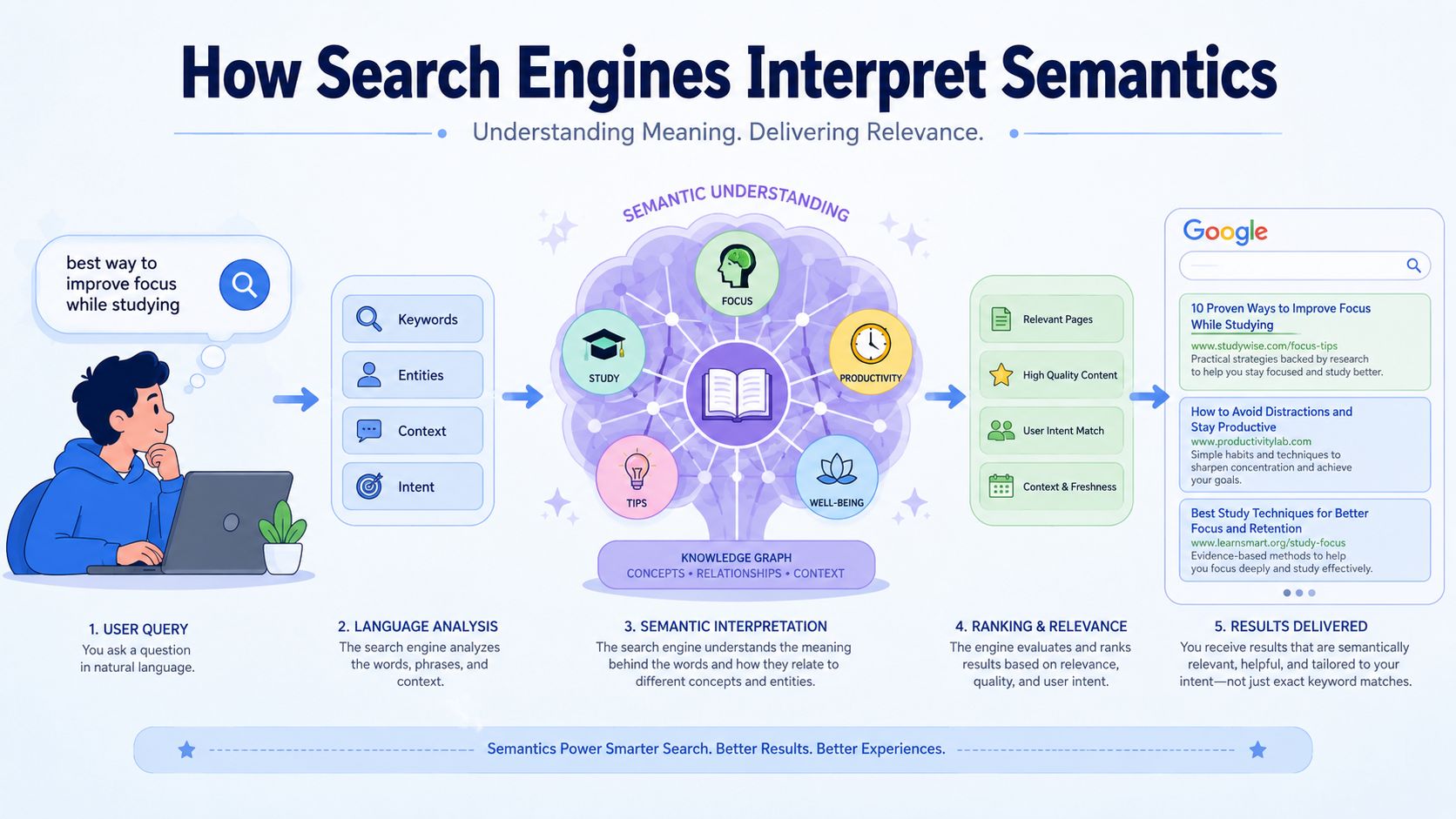
Modern search engines don't rely on the original LSI algorithm, but they do pursue the same broad goal, understanding meaning beyond exact word overlap. The historical LSI model used SVD on a term-document matrix to infer latent structure TREC. Search systems today use much more advanced semantic methods, but the principle is familiar, context matters.
That shift is why a query can be interpreted correctly even when the page doesn't echo it word for word. Engines now use context signals, entity recognition, and vector-based representations to decide whether a result matches user intent. The old matrix factorization approach is a useful mental model, but it's not the live ranking layer.
Why context beats exact matching
Marketers often overcorrect. They hear that search engines “understand semantics” and assume every page needs a pile of related words. What helps is writing that clearly establishes topic, subtopic, and intent, so the engine can place the page in the right conceptual neighborhood.
That's also why internal linking and topical organization matter so much. If a page consistently reinforces a concept across headings, body copy, and related pages, it gives search systems stronger evidence about what the page is for. For a practical look at how modern systems interpret and reuse topical signals, the RankBrain glossary entry is a helpful bridge between classic IR ideas and modern ranking behavior.
How to think about AI-era search
Search is now more conversational and more context-sensitive than the systems that made LSI famous. That doesn't make LSI obsolete as a concept, it makes it historically important. It gave marketers one of the earliest clean explanations for why exact-match thinking breaks down when language is messy.
If you're optimizing for AI answers or rich search experiences, the mindset is still the same. Cover the topic with precision, use terms that belong in the same conceptual field, and avoid forcing words just because they sound adjacent. For a deeper look at that shift in practical SERP environments, see ranking content in AI answers from MyMentions.
Optimizing Content with Semantic Techniques
Build around topic structure
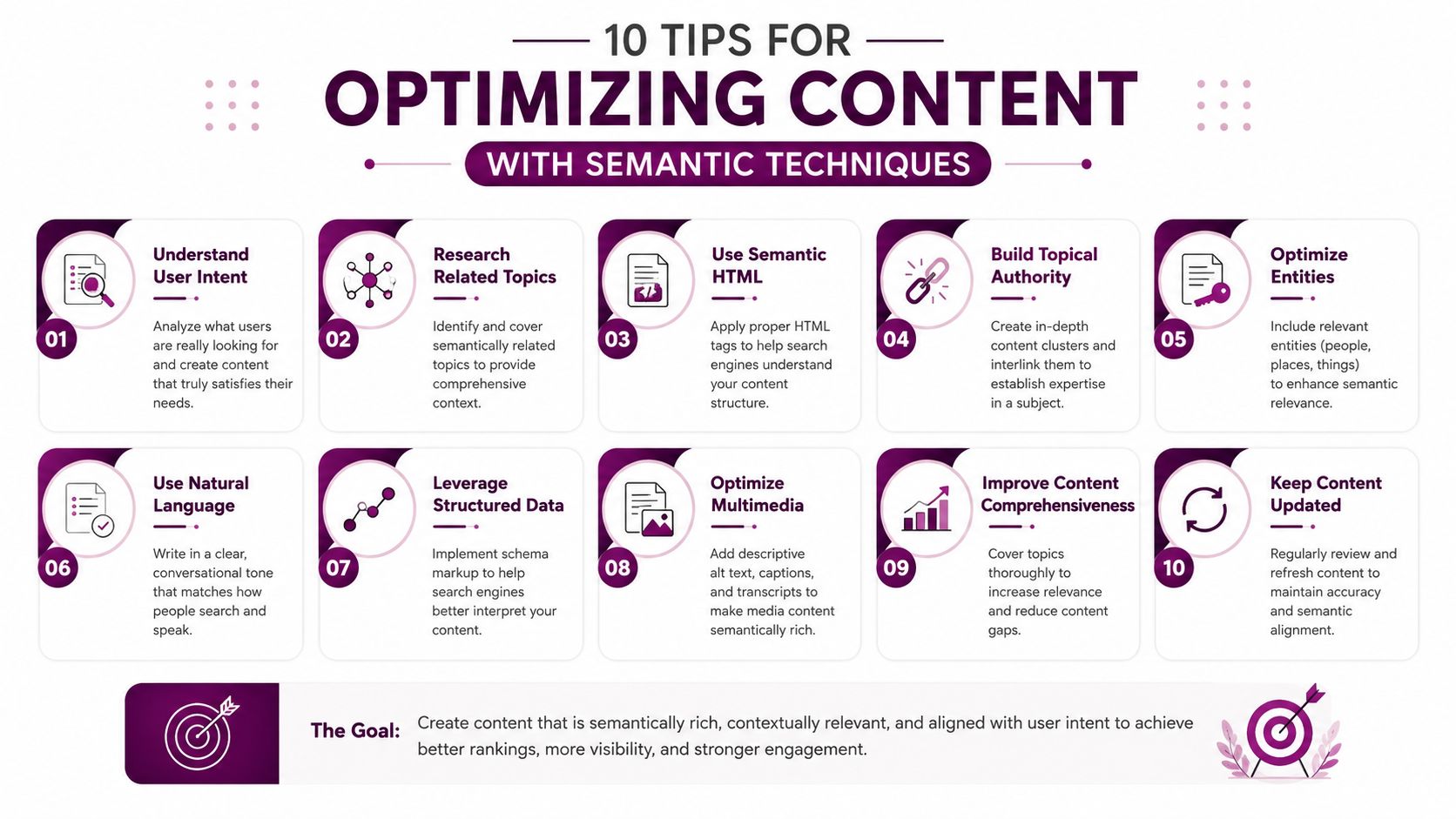
Start with a page that answers one core intent, then map the related entities that naturally belong beside it. A product page about running shoes should not just repeat the phrase “running shoes,” it should cover fit, cushioning, gait, terrain, and use case where relevant. That kind of semantic coverage signals topical completeness without sounding forced.
Useful test: if a term would look strange in a glossary next to the page topic, leave it out.
A second tactic is to use headings as semantic signposts. H2s and H3s should reflect the major conceptual branches of the topic, not just keyword variants. That helps readers scan the page and helps search systems understand the page's internal logic.
Use comparison, not repetition
The most effective semantic pages often read like careful comparisons. They distinguish related ideas, clarify edge cases, and answer the questions readers are likely to ask next. That's better than repeating one phrase in slightly different forms.
A simple workflow works well on existing pages:
Read the page as a newcomer. Mark any sections that repeat the same idea without adding context.
Check the competing pages. Note which subtopics they cover that your page misses.
Add missing entities naturally. Use them in explanations, examples, and supporting sections.
Trim filler language. Keep the page focused on the core task or question.
Review semantic coverage after editing. A semantic audit should show the topic is explained from several angles, not padded with synonyms.
For teams that want a structured content workflow, this content optimization guide is a useful starting point.
Balance breadth with restraint
Foundational LSI research also established that term-document matrices are commonly approximated using about 50–100 orthogonal factors, which shows the method is about balancing reduction with performance, not maximizing volume Stanford linguistics paper. That idea translates well into SEO writing. Broad coverage helps, but only when each added concept earns its place.
If you want a simple rule, use this one. Add concepts that deepen the answer, not words that merely decorate it. Semantic optimization works when the page becomes easier to classify and easier to trust.
Conclusion and Next Steps
Latent Semantic Indexing started as an information-retrieval method built on SVD, hidden co-occurrence patterns, and low-rank approximation. It's not a synonym-stuffing tactic, and it's not a magic SEO lever. It's a useful foundation for understanding why meaning, context, and topic structure matter so much in search.
That history leads to a practical conclusion. Modern engines use far more advanced semantic systems, but the core lesson is unchanged, pages win when they clearly cover a topic and support that topic with related concepts that make sense to humans. If your team has been treating “LSI keywords” like a formula, stop doing that and start auditing content for semantic completeness instead.
Pick one page that matters to your business, review the topic coverage, and tighten the structure around the underlying intent behind the query. Then measure whether the page reads better, answers more fully, and supports a clearer search purpose.
A CTA for Keyword Kick.