You're staring at a dashboard with too many signals, too many creatives, and not enough confidence in what to scale next. That's where AI in advertising examples become useful, not as shiny demos, but as proof that machines can help solve the same old problems, better relevance, faster production, cleaner bidding, and sharper measurement. The strongest campaigns aren't using AI because it sounds modern, they're using it because the work gets more precise and the waste gets smaller. One market estimate put the global AI in advertising industry at $16.3 billion in 2024 and projected it at $107.5 billion by 2032, with a 26.7% CAGR (Omneky's AI advertising statistics roundup). That scale matters, because AI is no longer just a creative toy. It's becoming part of the operating system for targeting, bidding, creative iteration, and optimization.
For teams comparing tools or trying to decide where AI belongs in the funnel, this is also where practical examples beat generic advice. A good starting point for creative workflows is the LunaBloom AI video generator, especially if your bottleneck is producing more ad variants without burning out the design team. The core question isn't whether AI can help. It's which advertising problem it should solve first.
1. Dynamic Creative Optimization for Personalization at Scale
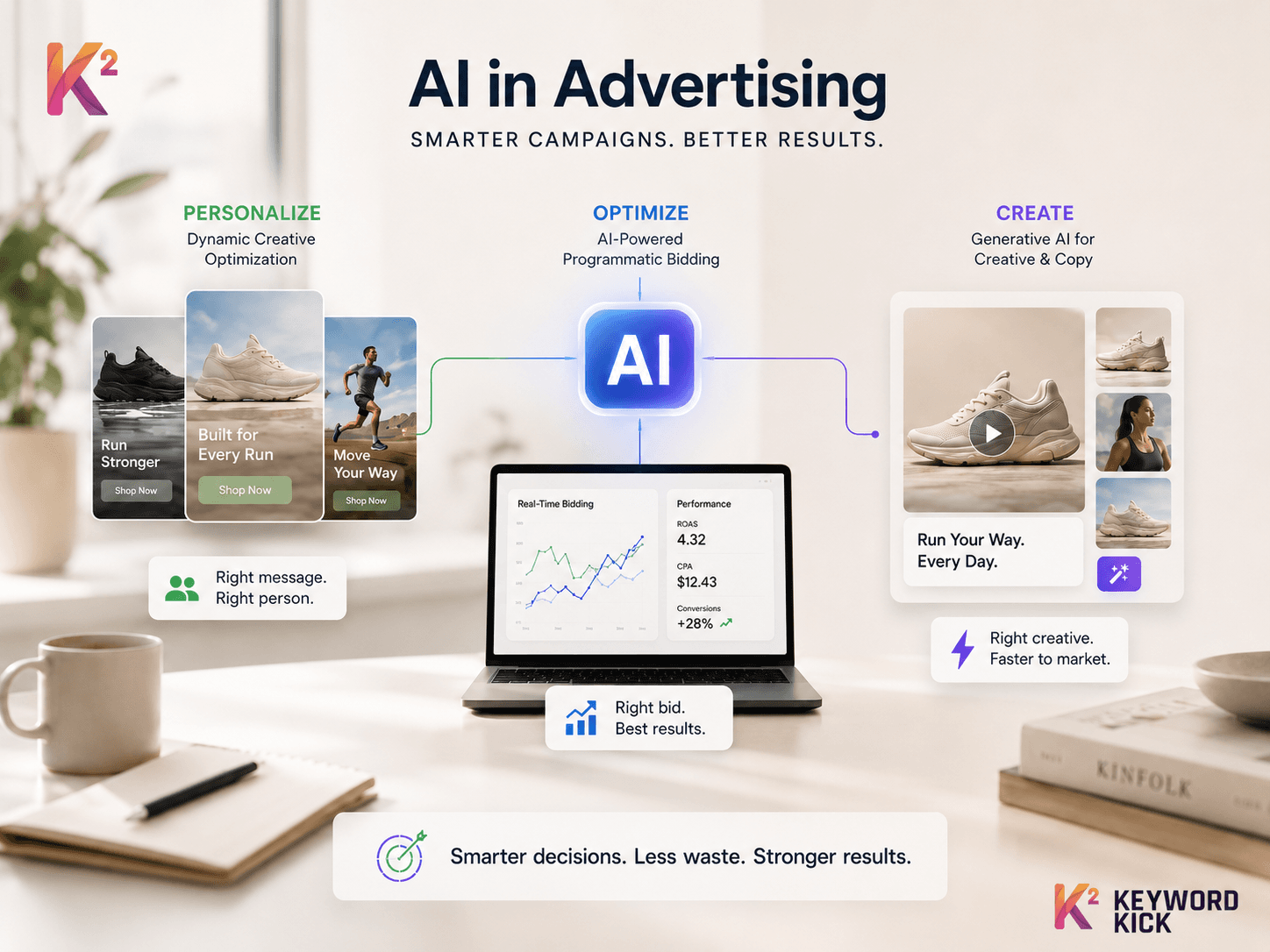
The fastest way to make ads feel stale is to show the same creative to everyone until performance drops. Dynamic Creative Optimization, or DCO, solves that by assembling and testing combinations of images, headlines, calls to action, and product feed data in real time. In practice, that means the ad system learns which mix works for which audience segment, then shifts delivery toward the combinations that keep people clicking and buying.
Why DCO works better than manual versioning
Manual creative testing usually dies under its own weight. A team can only build so many variants before the workflow turns into guesswork, and that's exactly where DCO helps. It gives media teams a structured way to run ongoing creative tests without rebuilding every asset from scratch.
Practical rule: Use DCO when you already have a decent asset library, clear product differences, and enough traffic to let the system learn. If your account is too small, the setup effort can outweigh the benefit.
The upside is relevance. The downside is control. DCO can be hard to manage if you don't define creative rules carefully, and it works best when your initial asset set is strong. In e-commerce, the smartest version connects directly to product feeds so pricing, availability, and imagery stay current.
If you want to see how optimization discipline supports broader content and campaign testing, the workflow logic is similar to the approach covered in this AI content optimization guide. The tool matters less than the process. Build fewer bad variants, and let the system do more of the repetitive learning.
2. AI-Powered Programmatic Bidding for Efficient Ad Spend
Programmatic bidding is where AI does some of its best work. Instead of relying on static rules, bidding systems evaluate context, behavior, device signals, and timing to decide how much an impression is worth in the moment. That's what turns buying media from a manual pacing exercise into a predictive decision engine.
What the AI is actually optimizing
The value here isn't just speed. It's the ability to stop overpaying for low-probability impressions while still competing for placements that matter. A strong bidding model learns where your conversion likelihood is highest and shifts spend toward those opportunities before the auction closes.
The Trade Desk is one of the best-known platforms in this space, and its core value proposition reflects that real-time optimization focus. The practical upside is clear, more efficient spend allocation, less manual bid management, and better use of high-intent inventory. The trade-off is equally clear. Bid decisions can feel like a black box, and if your input data is weak, the system can optimize around the wrong signals.
Where teams get programmatic wrong
Most wasted spend comes from overconfidence. Teams set a target, assume the machine will solve the rest, and never audit whether the model is learning from clean signals. That's dangerous because AI bidding only works well when your conversion data, audience definitions, and event tracking are stable.
Good bidding strategy starts with measurement hygiene, not with more automation.
A second mistake is expanding too fast. If you feed the system too many campaign goals at once, it may chase cheap traffic instead of profitable traffic. Better results usually come from clear conversion definitions and tight feedback loops, not from trying to automate every media decision on day one.
3. Generative AI for Rapid Ad Creative and Copy Development
If your team has ever waited a week for three headline options, you already know why generative AI matters. It shortens the gap between idea and testable asset. The best use case is not replacing creative strategy, it's accelerating the messy middle between concept and launch.
What it solves in real campaign work
Generative tools can draft headlines, visual concepts, short-form scripts, and rough storyboards in minutes. That helps smaller teams punch above their weight and helps larger teams break out of familiar patterns. The benefit is speed, but the strategic advantage is volume with intention. You can test more angles, more hooks, and more message framing without multiplying production cost in the same way traditional workflows do.
That said, AI-generated creative is not automatically better creative. Some outputs look off, some copy feels generic, and brand voice still needs human editing. There's also an ownership and IP question that legal teams should review before you make these assets central to a paid media program.
One useful way to think about it is this, use AI for idea generation and first drafts, then use human judgment for brand fit, compliance, and final polish.
For teams trying to bring AI into video-first campaigns, the best AI video creator software can help compress the storyboard stage and push more concepts into testing. If your production calendar is the bottleneck, that's where you'll feel the gain first. If your offer is weak, AI won't save it.
4. Predictive Audience Modeling to Find New Customers
Good prospecting used to depend heavily on broad demographics and a lot of media intuition. AI changed that by letting platforms model thousands of subtle behavior patterns from your existing customers, then look for similar signals in new users. The result is a smarter kind of lookalike targeting that goes deeper than age or interest buckets.
Why this is more useful than basic audience filters
Predictive audience modeling works best when your seed audience is high quality. If your best customers share meaningful behaviors, purchase patterns, or engagement habits, AI can detect those relationships and use them to score new prospects. That creates a more efficient top-of-funnel motion because the platform is no longer guessing based on a few declared attributes.
Pinterest's “shop the look” feature is a good visual example of this broader idea. By identifying products in images and connecting users to purchase links, it delivered a 9% increase in site conversions in preliminary testing, according to the example cited in the brief (Hellyeah AI's examples roundup). The underlying point is simple. When AI maps intent more accurately, it shortens the path from discovery to action.
The risk is filter bubble behavior. If you only ask the model to find more people like your current customers, it may miss adjacent audiences that could scale better. That matters especially for newer products where the best buyers haven't fully emerged yet.
If you're refining keyword and audience logic together, the same discipline applies in AI keyword research workflows. Start with signal quality, then let the machine widen the net.
5. AI-Powered Measurement and Marketing Mix Modeling
The cleanest measurement setups are the ones that admit what they can't see. As cookies weaken and channel journeys get messier, Marketing Mix Modeling, or MMM, has become more attractive because it uses aggregated, privacy-safe inputs to estimate the contribution of each channel. That gives media leaders a better top-down view of where budget is working.
Why MMM is back in the conversation
MMM is valuable because it looks beyond user-level attribution. It can combine spend, impressions, sales patterns, and seasonality to estimate incremental impact across channels that are hard to measure directly. That makes it useful for brands balancing TV, paid social, search, retail media, and offline activity.
The trade-off is that MMM is slower and less granular than click-level reporting. It needs enough historical data to be useful, and the models need ongoing maintenance. But for leadership teams making budget decisions across a full portfolio, that broader lens is often more useful than a single-platform attribution view.
What matters most: MMM is strongest when it informs budget strategy, not when it's treated like a daily reporting dashboard.
AI helps here by making the models more adaptive and easier to scenario-plan. Teams can test what happens when spend shifts between channels before they commit money in the market. That's especially valuable when the signal from one platform can't be trusted on its own.
This is one of the least glamorous AI use cases, but often one of the most valuable. Better measurement changes everything downstream, from bidding to creative allocation to executive confidence.
6. AI-Scripted Commercials for Novel Creative Angles
Some of the most memorable AI in advertising examples aren't about efficiency at all. They're about creative surprise. Brands have used AI to write full scripts or generate unusual campaign concepts that a human team might never have reached on its own. The result is often strange, occasionally brilliant, and always useful as a reminder that AI can be a brainstorming partner, not just an optimizer.
Why this works for brand distinction
When a category is crowded, sameness is the enemy. AI can help a team break pattern by surfacing combinations, themes, or narrative paths that don't come from the usual creative playbook. That can create a campaign people talk about, even if the ad isn't built for direct response first.
Kalshi's AI-produced nationally broadcast TV commercial is a strong real-world example of speed plus novelty. The company reportedly produced it for $2,000 in 48 hours using AI, which shows how quickly production timelines can collapse when the creative process is compressed (gethookd.ai case study collection). The lesson isn't just cost savings. It's that AI can move a campaign from idea to air far faster than a traditional agency workflow.
The limitation is obvious. AI-generated scripts can be off-brand, weird in the wrong way, or better suited to earned media than performance media. That's why curation matters. The strongest teams use AI to generate the unexpected, then decide what's worth keeping.
For content teams that want to extend that same logic into search and discoverability, autonomous SEO workflows are following a similar pattern, AI does the draft work, humans decide what's publishable.
7. AI-Powered Ad Fraud Detection to Protect Budgets
Not every AI advertising example is about growth. Some of the most valuable use cases are defensive. Ad fraud detection uses machine learning to spot patterns in impression and click data that signal bots, spoofed domains, or other invalid traffic. That matters because wasted spend hides inside reports that look healthy on the surface.
The hidden value of blocking bad traffic
Fraud systems work by comparing traffic patterns in real time, then flagging behavior that doesn't match human activity. That can protect brand safety, improve the integrity of campaign reporting, and reduce the amount of spend that disappears into low-quality inventory.
The biggest advantage is that the system runs continuously. Human analysts can spot anomalies, but they can't monitor every impression. AI can. The downside is that fraud detection tools add cost, and false positives can block legitimate users if the rules are too aggressive.
This is one of those categories where the win is often invisible until it isn't. A cleaner traffic mix improves not only media efficiency, but also the quality of every downstream decision. If the data is polluted, your optimization is too.
The best advertisers treat fraud protection as part of campaign infrastructure, not as a last-minute add-on. That mindset matters especially in open-web environments where inventory quality varies widely.
Clean traffic is a performance lever. If the system isn't seeing real people, the rest of your optimization stack is just decoration.
8. Conversational AI for Interactive Ad Experiences
Static ads are useful, but they're limited. Conversational AI turns an ad into a dialogue, which is a different kind of conversion path entirely. Instead of asking someone to click and hope they land on the right page, the brand can qualify interest, answer questions, and guide the next step inside the interaction itself.
Why interactive ads can outperform passive ones
The benefit here is friction reduction. If someone has a specific question about pricing, fit, availability, or next steps, a chatbot-style experience can answer it immediately. That makes the ad feel less like interruption and more like service.
ManyChat is a widely used platform in this category, and its appeal is obvious for teams that want automated conversation flows without building everything from scratch. The best setups collect first-party data, route qualified leads to sales, and hand off to a human when the conversation gets complex. The weak setups frustrate users by sounding scripted or failing on edge cases.
The skill is conversation design. A good bot doesn't try to answer everything. It handles the common objections cleanly, moves people forward, and knows when to stop talking.
If you're connecting conversational ads to broader search and customer journey work, the same thinking applies to AI SEO agent workflows. Good automation should remove friction, not create another layer of it.
Standout insight: Conversational AI works best when the goal is qualification, not just engagement. If you don't know what a qualified lead looks like, the bot will collect noise very efficiently.
AI in Advertising, 8-Point Comparison
Approach | Implementation Complexity 🔄 | Resource Requirements ⚡ | Expected Outcomes 📊⭐ | Ideal Use Cases 💡 | Key Advantages ⭐ |
|---|---|---|---|---|---|
Dynamic Creative Optimization (DCO) for Personalization at Scale | High, complex rules, asset tagging, platform setup 🔄 | High, many creative assets, clean segments, substantial traffic ⚡ | Higher relevance & engagement; improved CTR/CVR; lower long-term production cost 📊⭐ | E‑commerce with large catalogs, retargeting, high‑traffic display campaigns 💡 | Personalized creative at scale; continuous performance optimization ⭐ |
AI‑Powered Programmatic Bidding for Efficient Ad Spend | Medium–High, integration, algorithm tuning, monitoring 🔄 | High, extensive conversion data, platform access, budget for RTB ⚡ | Improved ROAS; lower CPA; more efficient budget allocation in auctions 📊⭐ | Performance campaigns, large budgets, real‑time bidding environments 💡 | Precise bid decisions; real‑time optimization; uncovers undervalued inventory ⭐ |
Generative AI for Rapid Ad Creative & Copy Development | Low–Medium, prompt engineering and human refinement 🔄 | Low, access to gen‑AI tools and design/review resources ⚡ | Rapid concept generation; high test velocity; lower production time/cost 📊⭐ | Creative ideation, small teams, A/B testing, prototype concepts 💡 | Fast, cost‑effective creative output; democratizes idea generation ⭐ |
Predictive Audience Modeling to Find New Customers | Medium, seed prep, model building, refresh cycles 🔄 | Medium, quality first‑party data and platform lookalike tools ⚡ | Expanded high‑intent prospect pools; improved prospecting ROAS 📊⭐ | Top‑of‑funnel acquisition, scaling customer base, lookalike targeting 💡 | Finds users beyond demographics; scales acquisition efficiently ⭐ |
AI‑Powered Measurement and Marketing Mix Modeling (MMM) | High, complex modeling, data integration, ongoing retraining 🔄 | High, 1–2 years of clean historical data, analytics expertise, compute ⚡ | Holistic channel impact insights; cookie‑less attribution; strategic budget guidance 📊⭐ | Strategic budget planning, cross‑channel measurement for brands & large advertisers 💡 | Privacy‑compliant, cross‑channel measurement; quantifies offline impact ⭐ |
AI‑Scripted Commercials for Novel Creative Angles | Medium, prompt design plus heavy creative curation 🔄 | Medium, LLM access plus production team and editorial oversight ⚡ | Highly original, attention‑grabbing creative; strong PR/awareness potential 📊⭐ | Brand awareness, experimental campaigns, PR‑focused work 💡 | Generates unexpected, buzzworthy concepts; breaks creative ruts ⭐ |
AI‑Powered Ad Fraud Detection to Protect Budgets | Low–Medium, integration and tuning with verification vendors 🔄 | Medium, third‑party fees, monitoring infrastructure, reporting ⚡ | Reduced wasted spend; cleaner metrics; improved brand safety 📊⭐ | Programmatic buys, high‑fraud environments, large media spends 💡 | Protects budget and reputation with continuous fraud detection ⭐ |
Conversational AI for Interactive Ad Experiences | Medium–High, conversation design, NLP tuning, handover flows 🔄 | Medium, chatbot platform, maintenance, CRM integration, human fallback ⚡ | Higher engagement; better qualified leads; first‑party data capture 📊⭐ | Lead generation, product discovery, automated customer interactions 💡 | Scalable personalized interactions; higher lead quality and data capture ⭐ |
Putting AI to Work in Your Ad Strategy
The best ai in advertising examples all share the same pattern. They solve a specific advertising problem, they use AI in a way that fits the workflow, and they produce a measurable business result that matters to the team using it. That can mean stronger conversion value, lower waste, faster production, better audience targeting, or cleaner measurement. It does not mean using AI everywhere just to prove you're keeping up.
The clearest examples also show a useful strategic divide. Some AI applications are built for scale, like DCO, programmatic bidding, and predictive audience modeling. Others are built for speed, like generative creative and scripted commercial concepts. A third group is about defense and control, including fraud detection and measurement modeling. That matters because a lot of teams ask the wrong first question. They ask, “What AI tool should we buy?” The better question is, “Which part of the advertising system is leaking value right now?”
The historical examples are especially useful because they show AI works when it's tied to a real business constraint. Facebook's AI recommendation engine increased Reels watch time by 15% by making content more relevant (Hellyeah AI). Pinterest's image-driven shopping feature lifted site conversions by 9% in early testing (same source). LinkedIn's AI-assisted recommendations were linked to a 25% increase in premium subscriptions in 2023, helping drive $1.7 billion in that year's revenue (same source). The point isn't to copy those platforms. It's to notice the pattern. AI works when it improves the decision path between attention and action.
The disclosure question matters too. Newer evidence suggests GenAI-created ads from scratch can outperform human-created ones, while AI-modified ads can underperform, and awareness that AI was involved can reduce CTR by 31.5% (Kevin Indig's post on AI-modified ads). That's a strong reminder that execution details matter as much as the label “AI.” How you use the tool, and whether you disclose it, can change the outcome.
The smartest next move is not a giant transformation project. Pick one problem, one campaign type, or one bottleneck, then test AI against it with a clean baseline. If creative is slowing you down, start there. If bidding is noisy, fix that first. If you can't trust measurement, solve that before scaling anything else. Start with the leak, measure the change, and only then expand the system.
A CTA for Keyword Kick.