You launch a new product line, the merchandising team is happy, paid search is live, and revenue starts moving. Then you check organic. The collection page that should be carrying long-term demand is buried. Google is indexing the wrong filtered URLs. Product variants are competing with each other. The blog is getting visits, but the pages that should sell are underperforming.
That's the actual operating environment for ecommerce SEO. It isn't a checklist problem. It's a systems problem. Teams have to decide which pages deserve authority, which URLs should exist at all, how crawl paths support revenue, and how to prove that SEO is contributing more than rankings.
Most stores don't fail because nobody wrote title tags. They fail because the site architecture, page strategy, and reporting model aren't built for scale.
The High Stakes of Ecommerce SEO
A lot of ecommerce teams still treat SEO like a supporting channel. That's usually a mistake.
On a healthy store, organic search doesn't just bring in traffic. It builds an asset. Rankings expand across thousands of queries, internal links strengthen key commercial pages over time, and the value compounds instead of resetting every time you stop spending. That's why the economics matter so much.
In a 2025 analysis of more than 20,000 ecommerce websites, the average ecommerce brand ranked for 1,783 organic keywords and received about 9,625 monthly organic visits. Reboot Online estimated that this traffic would cost about £11,790.58 per month if bought through paid search instead. The same analysis found ecommerce SEO conversion rates ranging from 2.99% to 4.4% between November 2023 and October 2024.
Those numbers explain why SEO belongs in the growth model, not in the leftovers bucket after paid media and email.
What this looks like in practice
A common pattern looks like this:
Merchandising launches first: New collections go live without a clear category strategy.
Paid search captures demand immediately: Traffic arrives, but only while budgets stay active.
SEO lags behind: Collection pages are thin, internal links are weak, and indexing gets diluted by filters, variants, or duplicate paths.
Reporting gets blurry: The team sees some non-brand growth, but can't tie it clearly to revenue-driving page types.
The result is predictable. The store can buy visibility, but it can't hold it organically.
Practical rule: If a revenue-critical category depends more on paid traffic than on crawlable, optimized collection pages, the SEO problem is structural, not tactical.
Why executives care once they see the right frame
SEO becomes easier to defend when you frame it around three questions:
Business question | SEO reality |
|---|---|
Why aren't we getting enough efficient acquisition? | Core category and product pages aren't capturing demand consistently. |
Why does traffic feel volatile? | The site is relying on a narrow keyword set instead of broad commercial coverage. |
Why is paid search carrying too much weight? | Organic visibility hasn't been built deeply enough across the catalog. |
The teams that win in ecommerce SEO rarely chase isolated ranking wins. They build coverage. They decide which collections deserve prominence, which templates need technical control, and which pages can realistically convert.
That's the shift. SEO is not about “more content” or “better metadata” in isolation. It's about designing a search acquisition system that can support revenue at catalog scale.
A Three-Pillar Strategic Framework
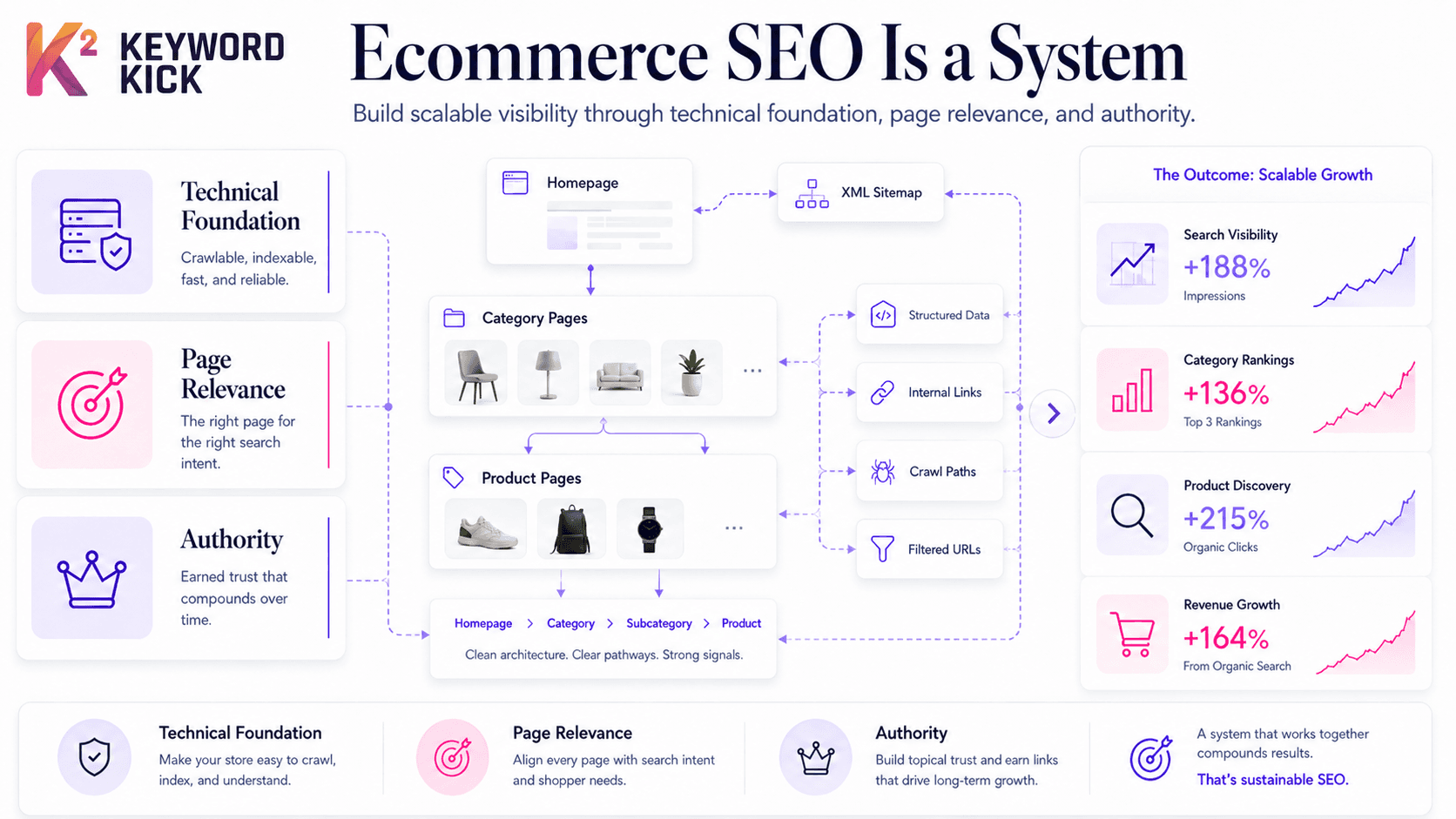
If a store's SEO program feels chaotic, it usually means the team is mixing tasks without a framework. The fix is simple. Treat ecommerce SEO like a three-part system: technical foundation, page-level relevance, and site-level authority.
Here's the visual model I use when aligning teams.
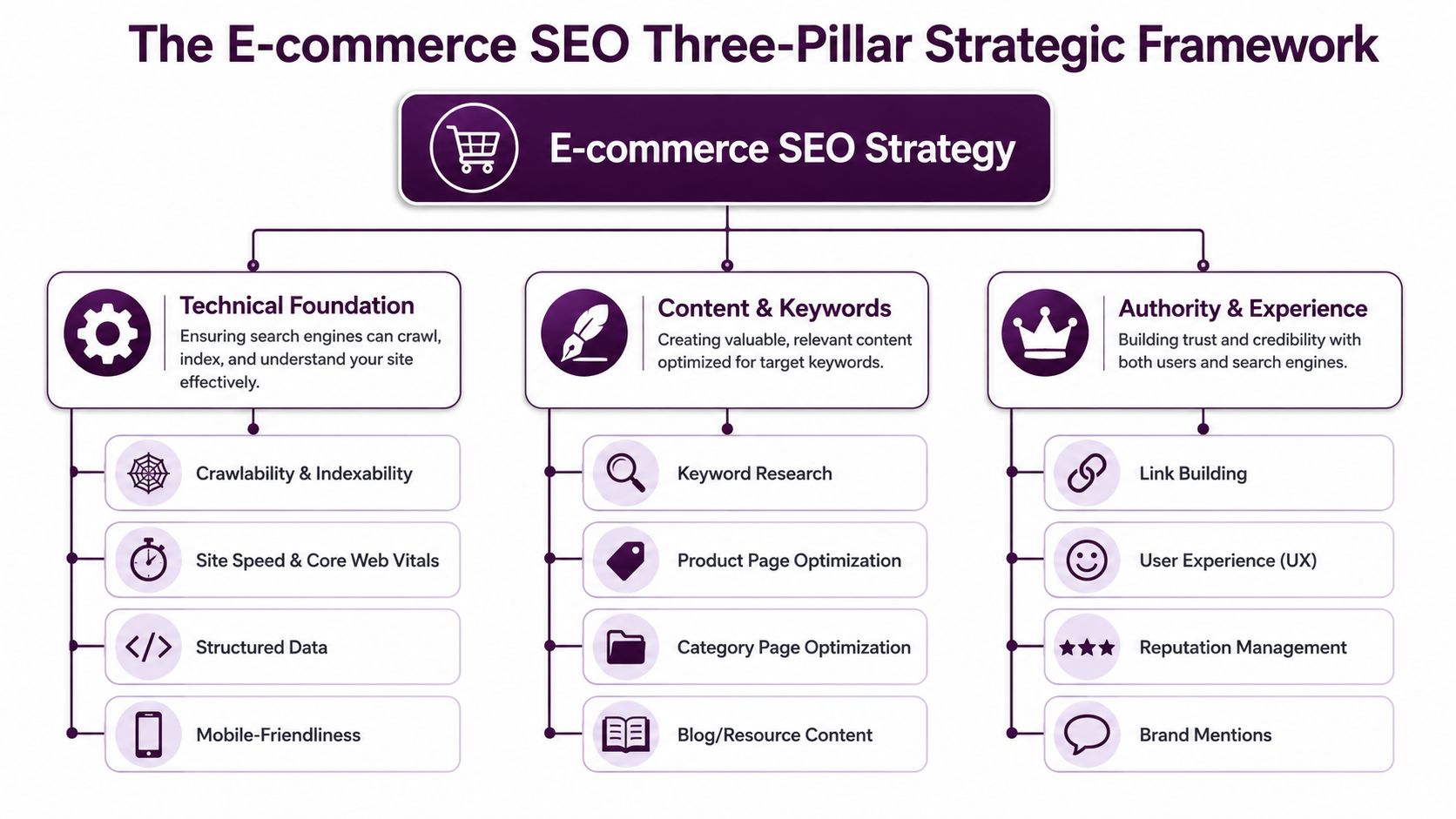
Pillar one is technical foundation
This is the part search engines depend on before they can reward anything else.
If crawlers can't consistently discover, render, and understand your key URLs, every downstream effort gets weaker. You can have excellent product copy and a strong brand, but if faceted URLs overwhelm discovery or your category hierarchy is unclear, Google won't prioritize the pages you want to rank.
The technical pillar includes:
Crawlability and indexability: Which URLs can bots reach, and which ones should they keep?
Site speed and mobile performance: Can commercial pages load cleanly on mobile devices with heavy image payloads?
Structured data: Can search engines interpret product, review, and listing details with less ambiguity?
Architecture signals: Do internal links and URL paths reinforce your actual hierarchy?
For teams working across different regional markets, I also like pointing them to broader strategy references such as this South Africa SEO guide, because market context changes how aggressively you localize architecture, category targeting, and SERP strategy.
Pillar two is page-level relevance
Search intent and merchandising converge.
Not every page type deserves the same SEO investment. Product pages solve highly specific demand. Category pages capture broader commercial intent. Editorial content can support discovery or links, but it should not distract from the pages closest to purchase.
A good relevance model answers four practical questions:
Which keyword sets map to categories, not products
Which products deserve standalone optimization
Where filters create useful landing pages versus thin clutter
Which content assets support shopping intent
This pillar is where titles, H1s, copy blocks, image alt text, product specs, FAQs, and schema work together. None of those elements win on their own. They win when they reinforce the right page type for the right query.
Collection pages often carry more long-term SEO leverage than teams expect, because they can target commercial demand at scale and pass authority deeper into the catalog.
Pillar three is site-level authority
Authority is what lets strong pages outrank equally optimized competitors.
This pillar includes link acquisition, digital PR, reputation signals, brand mentions, and the user experience signals that support trust once someone lands. In ecommerce, authority also comes from how clearly the site demonstrates expertise in a category. A specialist running focused category hubs usually has an easier time than a broad catalog with weak thematic depth.
How the pillars interact
Think of the framework like a retail build-out:
Pillar | What it does | What happens if it's weak |
|---|---|---|
Technical foundation | Makes pages discoverable and understandable | Important URLs get missed, duplicated, or devalued |
Page-level relevance | Aligns pages to buyer intent | The wrong templates rank, or rankings don't convert |
Site-level authority | Helps pages win competitive SERPs | You stay visible only where competition is light |
Most ecommerce SEO failures aren't caused by one missing tactic. They come from imbalance. Teams overinvest in blogging while technical debt grows. Or they clean up crawl issues but never build authority to core collections. The framework prevents that drift.
Mastering Foundational Technical SEO
The first technical question on any ecommerce site is simple. Can search engines find the pages that matter most, understand how they relate to each other, and get to them without wasting time on junk URLs?
If the answer is shaky, stop worrying about content velocity.
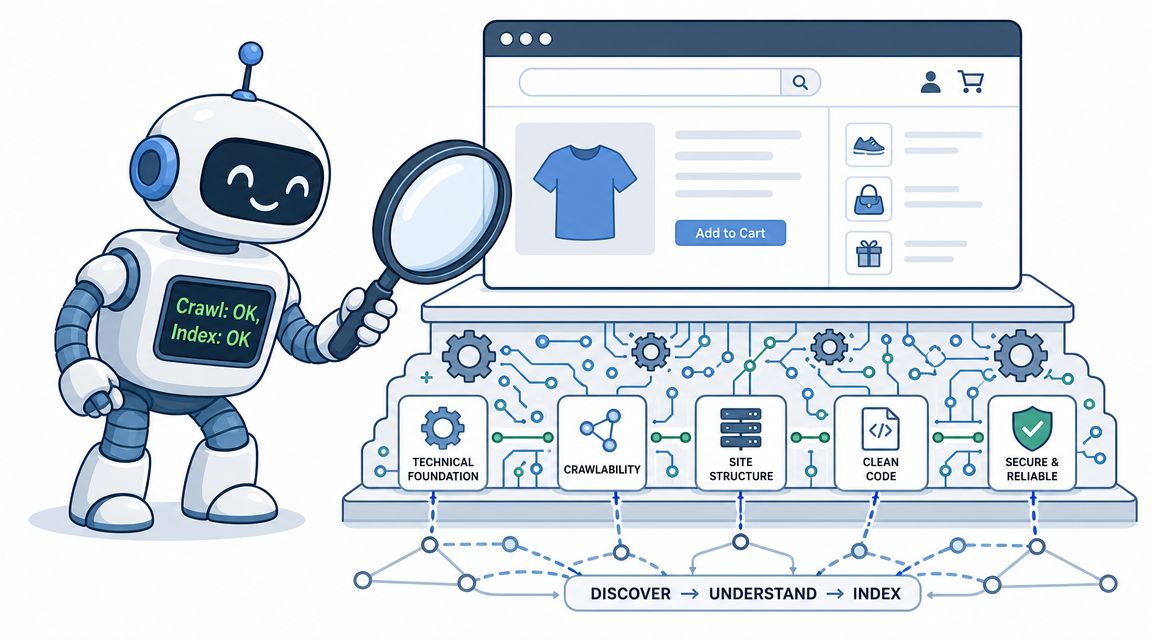
A strong starting point is the architecture itself. As noted in Victorious' technical SEO guidance for ecommerce, a strong technical architecture makes the hierarchy of categories, subcategories, and products explicit for crawlers. That matters because large stores generate huge numbers of URLs, and flat or inconsistent structures make important commercial pages harder for search engines to discover and grant authority.
Build hierarchy before you optimize templates
A healthy ecommerce hierarchy usually follows a clear path:
Homepage → primary category → subcategory or collection → product
That sounds obvious, but many stores break it in practice. They rely on search, faceted navigation, or promotional modules to surface products instead of reinforcing a stable commercial hierarchy.
Here's the standard I push for:
Categories represent real demand: If a category exists, it should have a business reason and a search reason.
Subcategories narrow intent cleanly: They should help both users and crawlers understand product grouping.
Products sit under logical parents: Avoid making a product reachable only through internal search or filtered combinations.
Breadcrumbs reinforce the structure: They're useful for users and for internal linking signals.
Internal linking is not secondary
On large stores, internal linking is authority distribution. That's not a metaphor. It determines which URLs repeatedly receive crawl attention and contextual relevance.
Use internal links intentionally:
Link down from top categories: Send users and crawlers into high-value subcategories and products.
Link laterally where relevant: Related categories, compatible products, and substitutes all help.
Link up with breadcrumbs: Products should point back to their category context.
Protect key pages from isolation: If a strategic collection only appears in XML sitemaps or seasonal banners, it's underlinked.
For teams tightening fundamentals, this guide on technical SEO basics and rankings is a useful companion to architecture work because it frames crawlability and indexing issues in operational terms.
A page that matters to revenue should never depend on deep crawling to be found.
Control indexation before it becomes bloat
Most ecommerce sites don't have an indexing problem because they lack pages. They have one because they have too many weak versions of the same intent.
The core controls are familiar, but execution matters:
Control | Best use |
|---|---|
Canonical tags | Consolidate product variants and duplicate URL paths |
Robots.txt | Reduce crawl waste on non-essential URL patterns |
Noindex | Keep thin or redundant pages out of the index when needed |
XML sitemaps | Surface priority URLs and segment important page types |
Canonicalization is especially important where color, size, or parameter-based product variants create alternate paths. If those variants are indexable without a clear signal, search engines can split attention across pages that should consolidate on one canonical version.
The foundational audit sequence
When a store is underperforming technically, I don't start with random issue lists. I start in order:
Map page types
Know exactly which URL classes exist. Categories, subcategories, products, filters, internal search, pagination, blog, account pages, duplicate protocol or parameter paths.Check crawl paths
Verify whether core commercial pages are linked from stable navigation, not just promotional placements.Review index control logic
Confirm canonicals, robots rules, and noindex directives align with the intended page strategy.Validate sitemap inclusion
Priority pages should be in the correct sitemaps. Junk URLs should not.Test mobile rendering and discovery
If the mobile version weakens navigation or hides content, rankings can suffer even when desktop looks fine.
Teams that get this layer right give every later SEO effort a chance to work. Teams that don't usually end up optimizing pages Google never wanted to prioritize in the first place.
Solving Advanced Ecommerce Technical Issues
Most ecommerce technical failures don't come from missing title tags or a forgotten sitemap. They come from scale features. Faceted navigation, pagination, and JavaScript-heavy interfaces create complexity faster than is often appreciated.
The trap is that each feature is useful for users. Filters help shoppers narrow inventory. Infinite product grids feel modern. JavaScript can make category pages more interactive. But each one can lead to distortion of crawling, indexation, and authority flow if nobody sets boundaries.
Faceted navigation needs rules, not hope
Facets are one of the biggest sources of index bloat on large stores. Size, color, material, brand, fit, price, availability, and promotional filters can produce an enormous number of URL combinations. Most of those combinations don't deserve indexation.
The decision framework is straightforward:
Keep SEO-facing facets limited: Only index filtered views with clear commercial demand and enough inventory to justify a landing page.
Canonicalize duplicates: If multiple filter combinations resolve to near-identical listings, they should consolidate.
Block or suppress low-value combinations: Sorting, session-based filters, and thin combinations shouldn't absorb crawl attention.
Write unique elements for indexable facet pages: If a filtered collection is meant to rank, it needs distinct metadata and useful copy.
A filter set is not automatically a page strategy. It becomes one only when there's real search intent behind it.
Pagination still affects discoverability
Pagination gets ignored until products buried deep in the catalog stop getting discovered. Then teams realize that category page one is carrying almost all of the authority while the rest of the listing architecture is weak.
The practical issue is not whether pagination exists. It's whether search engines can move through the product inventory cleanly.
Pagination pattern | Main SEO risk | Best practice |
|---|---|---|
Classic paginated URLs | Weak optimization across deeper pages | Keep URLs crawlable and linkable |
Load more | Products may depend on JavaScript interaction | Ensure equivalent crawlable URLs exist |
Infinite scroll | Deep products may be hard to discover | Pair with accessible paginated states |
If products only become visible after client-side actions and there's no crawlable alternative, discovery suffers. This usually shows up first on long-tail or lower-priority products that stop earning impressions.
JavaScript can hide what matters
JavaScript itself is not bad for SEO. The problem is dependency. If core category content, product details, internal links, or critical metadata rely on rendering that search engines process inconsistently, visibility becomes fragile.
The safest pattern is still to expose important content in the initial HTML whenever possible. That includes category copy, product details, breadcrumbs, and primary navigation links.
When reviewing JS-heavy templates, check for these failure modes:
Links rendered too late: Crawlers may miss navigational paths.
Core content injected after load: Important text can become less reliable for indexing.
Product galleries or descriptions hidden behind interactions: Search engines may not treat them consistently.
Filter states changing content without stable URLs: Useful for UX, poor for SEO governance.
Performance problems amplify every other issue
On ecommerce sites, technical debt often gets wrapped inside front-end weight. Large product images, script-heavy templates, and render-blocking assets slow both users and crawlers.
As outlined in Pixc's ecommerce optimization guidance, page speed optimization is critical because large product images and heavy front-end assets directly affect crawl efficiency and mobile rankings. Recommended controls include image compression, lazy-loading, and minimizing render-blocking resources.
For teams tuning this layer, the right reference is often performance-specific rather than general SEO. This overview of Core Web Vitals for SEOs is a good operational primer because it helps teams separate template issues from isolated URL issues.
Fast pages don't just improve UX. They reduce friction in crawling, rendering, and mobile evaluation.
A practical recovery approach for advanced issues
When technical complexity is suppressing performance, don't try to fix everything at once. Work in this order:
Identify URL explosion sources
Usually filters, parameters, or variant paths.Check whether deep products remain discoverable
Test pagination and scroll behavior without relying on full browser interaction.Review rendered HTML on key templates
Make sure essential content and links are present early.Reduce front-end weight on categories and PDPs
Images, unused scripts, and blocking resources usually drive the biggest wins.
On enterprise ecommerce sites, advanced technical SEO is mostly governance. The point is not to remove complexity. It's to stop complexity from generating low-value URLs and weak crawl signals at scale.
Optimizing Product and Category Pages
Product detail pages and category pages don't play the same role in ecommerce SEO, so they shouldn't be optimized the same way.
Product pages win on specificity. They match SKU-level or model-level demand, answer detailed questions, and convert buyers who already know what they want. Category pages win on breadth. They target broader commercial intent, consolidate internal linking, and often carry more ranking potential across non-brand terms.
The mistake is treating both templates like generic landing pages.
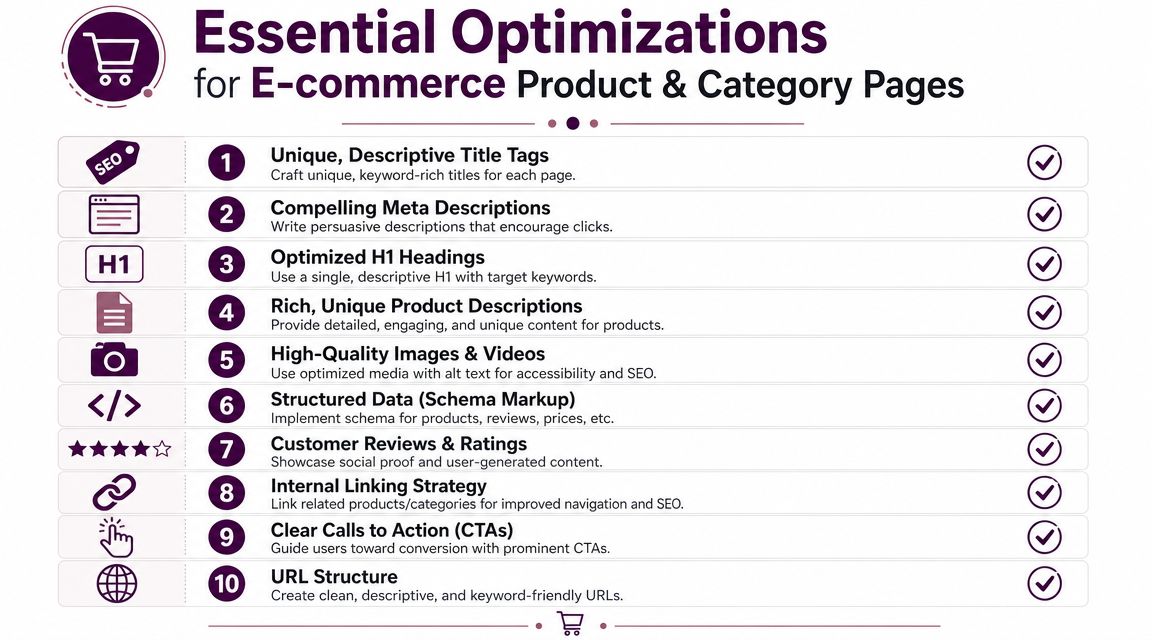
This checklist is a useful visual reference for what strong commercial pages need.
Product pages should remove buying friction
A strong PDP doesn't just repeat manufacturer copy and list specs. It helps a buyer make a decision.
The baseline elements are familiar, but the difference is in execution:
Title tags that identify the product clearly: Include the core product name and important qualifiers without stuffing.
One descriptive H1: Usually the product name, not a vague marketing slogan.
Original product descriptions: Explain what the item is, who it's for, and what matters before purchase.
Media that supports conversion: Clear images, variant clarity, and video where useful.
Structured data: Product-related schema helps search engines interpret the offer.
For teams improving PDP merchandising and conversion detail, this practical resource on product page optimization from Wand Websites is worth reviewing because it shows how SEO and product presentation should reinforce each other rather than compete.
Category pages carry more strategic weight than many teams realize
Category pages are often the strongest SEO asset on the site because they match broad commercial searches. They also act as hubs that send authority into the catalog.
A good category page needs more than a grid of products.
What category pages need to do well
Element | Why it matters |
|---|---|
Clear targeting | The page should match a distinct commercial intent, not a vague assortment |
Strong metadata | Titles and descriptions shape both relevance and click appeal |
Useful introductory or supporting copy | Helps clarify the collection without overwhelming the product grid |
Logical internal links | Related categories and subcategories help users and crawlers move through the topic |
Clean URL structure | Reinforces hierarchy and reduces duplicate path issues |
Category copy should support selection, not block it. Long, generic SEO text dumped above the fold usually hurts the page more than it helps.
Structured data should support visibility, not decorate the template
Structured data is one of the clearest ways to reduce ambiguity around product and listing pages. It won't rescue a weak page, but it helps search engines process the page more confidently.
For ecommerce templates, the usual priorities are:
Product schema on PDPs
Review-related markup where applicable
FAQ markup when visible, relevant content exists
List-related signals on collection pages where appropriate
What matters most is consistency. If price, availability, reviews, and page copy conflict, the markup won't save you.
The best commercial pages don't read like SEO templates. They read like well-merchandised category and product experiences that also send clean relevance signals.
The page audit standard I use
When reviewing high-value product and category pages, I check five things in order:
Intent match
Does this page deserve to rank for the query set being targeted?Template strength
Are titles, H1s, content blocks, images, and internal links working together?SERP differentiation
Does the snippet look distinctive enough to earn clicks?Conversion support
Are users getting the product details, trust signals, and navigation they need?Technical consistency
Are canonicals, schema, mobile rendering, and indexability aligned?
That last point matters. Plenty of well-written pages underperform because the wrong canonical is set, variants compete, or filters siphon relevance away from the intended URL.
Building Authority with Content and Links
The default ecommerce SEO advice is still “start a blog.” That's incomplete at best and expensive at worst.
Content only matters if it supports commercial visibility or authority. If your team publishes top-funnel articles that attract loose traffic but never strengthen the pages that sell, you're producing activity, not an advantage.
A more useful strategic question is this: which assets will help category and product pages rank better in competitive SERPs?
As noted in Socialed's ecommerce SEO guidance, practitioner commentary increasingly argues that category pages are the most scalable revenue assets because they target high-intent commercial keywords and consolidate internal authority, while blog content often fails to convert.
Start with commercial hubs, not content calendars
The strongest authority-building model in ecommerce usually looks like this:
Primary categories act as ranking hubs
Supporting guides help users choose within those categories
Internal links push authority into the most important commercial URLs
External promotion focuses on assets worth citing or linking to
That means your “content strategy” should often begin with collection pages and buying guides, not a random editorial calendar.
For example, a running store will usually get more SEO value from:
a well-built “men's trail running shoes” category
a shoe comparison guide
a fit or terrain selection resource
an expert-led buyer guide tied directly to the category set
than from generic lifestyle blog posts with weak commercial connection.
What earns links in ecommerce
Most product pages are poor link targets. That's normal. People don't often link to a SKU page unless it's newsworthy, exclusive, or uniquely useful.
Linkable ecommerce assets tend to be:
Asset type | Why it attracts links |
|---|---|
Buying guides | Useful for shoppers and publishers referencing recommendations |
Comparison content | Helps users evaluate options before purchase |
Original research or catalog insights | Gives media and bloggers something to cite |
Interactive tools | Solves a problem better than a static article |
Seasonal or trend-led resource pages | Useful during recurring demand windows |
If you need a broader perspective on how organic acquisition content can support growth without becoming fluff, this organic lead generation guide is a helpful contrast. The important ecommerce lesson is that traffic alone isn't enough. Content has to contribute to the revenue path.
Internal authority is still the multiplier
A surprising number of stores invest in content and outreach, then fail to route the value back into commercial pages.
That's why internal linking deserves to sit inside authority strategy, not just technical SEO.
Use content assets to strengthen ranking pages by linking intentionally to:
priority categories
key subcategories
relevant buying collections
substitute or comparison destinations
If your backlink profile is uneven, clean it up before you chase more links. A focused backlink audit process helps teams spot weak domains, overconcentration, and gaps around priority sections of the site.
A blog is not a strategy. A network of assets that strengthens commercial pages is a strategy.
The authority allocation decision
When resources are limited, I'd usually prioritize in this order:
Strengthen category hubs first
Build one or two useful linkable assets per core category
Promote those assets externally
Use internal linking to channel value into money pages
Publish blog content only when it supports a clear search and conversion role
That order keeps SEO tied to business outcomes. It also prevents teams from measuring success by article volume when the ranking bottleneck is really authority concentration around high-intent collections.
How to Measure, Prioritize, and Recover
Most ecommerce SEO reporting still overweights rankings and underweights operational decisions. That creates two problems. First, teams celebrate movement that doesn't change revenue. Second, they miss warning signs until traffic or conversions fall hard enough to trigger executive attention.
A stronger operating model tracks outcomes by page type, then prioritizes work based on business impact and implementation reality.
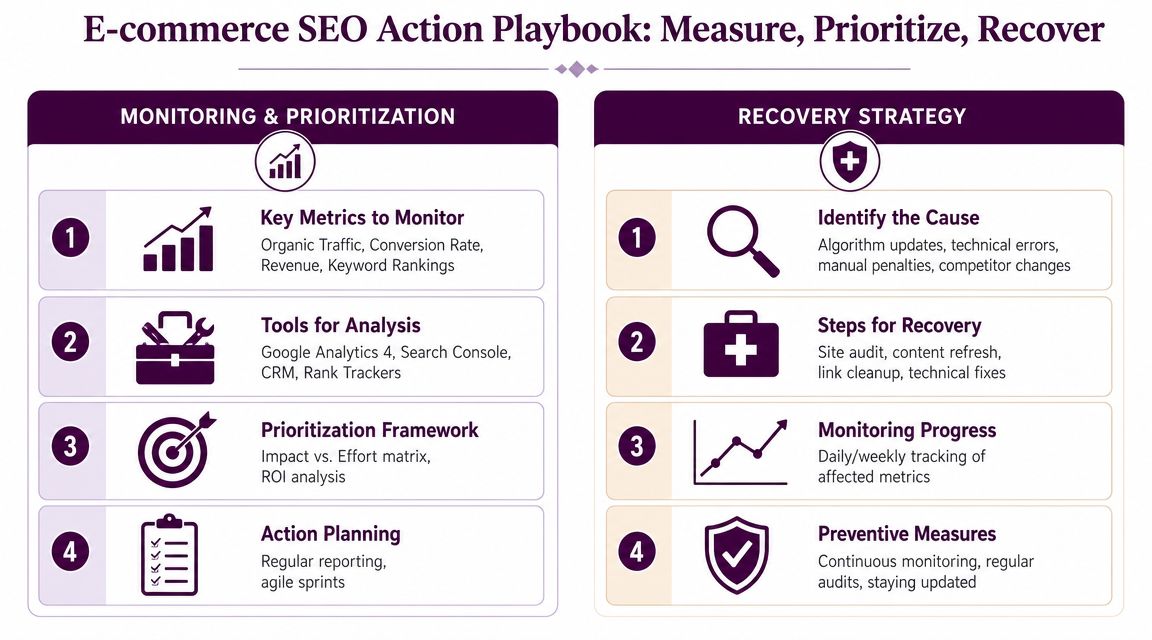
This is the framework I'd want every in-house lead and agency account team using.
Measure what the business actually feels
If organic traffic rises but category page revenue stalls, the program is not healthy. If rankings improve while crawl waste explodes, the program is not healthy. Metrics need to be segmented by page role.
The KPI stack I trust most is:
Organic revenue by page type: Categories, products, editorial, brand pages.
Conversion rate by page type: This surfaces whether traffic quality and page intent align.
Non-brand visibility on commercial terms: A better signal than broad average rankings.
Indexation quality: Are intended pages indexed, and are junk URLs suppressed?
Share of voice for priority categories: Useful for competitive planning.
A useful reporting view separates:
category pages that attract discovery demand
product pages that capture specific demand
supporting content that assists selection or links
That segmentation prevents a common mistake: blog traffic masking weak performance on money pages.
Prioritize with a simple scoring model
You don't need a complex forecasting system to decide what to do next. A lightweight scoring model works well if the inputs are honest.
I usually score work against three factors:
Factor | Question |
|---|---|
Impact | If this works, how much commercial upside is there? |
Confidence | How sure are we that this is the real bottleneck? |
Effort | How hard is it to implement across the site? |
This pushes teams toward changes like:
repairing indexation on priority category templates
cleaning canonical conflicts on high-value product sets
improving internal links to underperforming collections
fixing slow mobile category pages with heavy media
before they spend cycles on low-impact ideas.
The best prioritization model is the one your team will actually use every sprint.
Recovery starts with pattern recognition
When organic performance drops, teams often jump to the wrong diagnosis. They assume an algorithm hit when the issue is technical. Or they assume migration damage when the underlying problem is indexation drift after template changes.
The recovery playbook should begin with pattern questions:
Did the drop affect all page types or only some?
Was there a release, migration, CMS update, or merchandising change?
Did indexed page counts shift unexpectedly?
Did Google start surfacing the wrong canonical or URL pattern?
Did the decline hit rankings, clicks, conversions, or all three?
Common recovery scenarios
Post-migration decline
Check redirects, canonicals, internal links, lost category paths, and sitemap accuracy.Template rollout loss
Review metadata, rendered content, mobile layout changes, and hidden internal links.Sudden crawl inefficiency
Inspect robots logic, faceted URL exposure, and index bloat.Conversion drop without ranking loss
Usually a UX, stock, snippet, or intent mismatch problem rather than a pure SEO issue.
Build a weekly operating rhythm
The teams that recover fastest usually already have discipline in place.
A practical weekly workflow looks like this:
Monitor core KPIs
Review anomalies by page type
Score the next set of actions
Push fixes in small, controlled batches
Validate impact before expanding
That rhythm matters more than flashy dashboards. Ecommerce SEO is won by consistent diagnosis and disciplined prioritization, not by giant quarterly audits that sit untouched in a slide deck.
Adapting Ecommerce SEO for the AI Era
A lot of teams still assume SEO means ranking a blue link in the traditional results. That assumption is getting weaker.
Product discovery is spreading across AI summaries, product carousels, rich result formats, and more visually driven SERP features. That changes the job. The target is no longer just rank position. It's search visibility across the result set, including surfaces that may reduce direct clicks.
That shift matters for ecommerce because shopping queries are especially exposed to richer SERP treatments. If your product pages don't stand out visually, semantically, and structurally, you can lose attention even when you remain technically “ranked.”
According to recent practitioner commentary summarized in this discussion on AI-driven ecommerce search visibility, future success depends on optimizing for visibility within SERP features like product carousels and AI summaries, with a stronger focus on visual presentation, unique snippets, and rich structured data rather than classic keyword targeting alone.
What changes in practical terms
The page itself still matters. But now the snippet, product feed-like signals, and page uniqueness matter more.
Teams should pressure-test commercial pages against four questions:
Does the result look distinctive in the SERP
Is the product presentation visually strong
Is the page content specific enough to stand out from duplicates
Is structured data clean enough to support richer interpretation
A generic title and recycled manufacturer description used to be merely weak. In an AI-shaped SERP, it becomes easier to ignore entirely.
The operating shift teams need to make
The ecommerce teams adapting fastest are changing their optimization model in three ways:
They optimize for SERP real estate, not just rankings
That means caring about how listings appear, not only where they appear.They make commercial pages more unique
Better product descriptions, clearer differentiators, stronger imagery, and more useful supporting detail.They invest in brand strength
When clicks compress, branded demand and repeat visitation matter even more.
This doesn't replace classic ecommerce SEO. It sharpens it. Technical architecture, category strategy, and authority still matter. They just feed into a more competitive results environment where visibility can happen without a traditional click.
The teams that treat AI search as separate from SEO will lag. The teams that adapt their page strategy, snippet quality, and structured content to this new environment will hold more of the discovery journey.
If your team needs a clearer way to connect rankings, GA4, Search Console, backlinks, technical issues, and next-step prioritization, Keyword Kick is built for exactly that. It helps agencies and in-house teams see what changed, understand why it changed, and decide which ecommerce SEO actions are worth doing first.