While 43% of businesses pay between $101 and $750 for an SEO audit, professional manual audits typically cluster in the $2,501–$5,000 range, making scope and deliverables the true measure of cost. The popular advice to choose an audit by price tier misses the purchasing decision that matters: how much qualified analysis you're buying and what your team can implement afterward.
Don't start with the cheapest quote. Start with the business decision you need the audit to support, whether that's recovering lost organic leads, assessing a migration, or finding constraints on ecommerce growth. Then buy the depth of investigation needed to make that decision confidently.
The Real Price of an SEO Audit
An SEO audit isn't a standardized product. A provider can use that label for an automated crawl export, a narrowly focused investigation, or a strategic review involving technical specialists and content analysts. Comparing those offers by their headline price tells you very little.
In WebFX's survey of SEO audit spending, 250 U.S. businesses reported their costs: 43% paid $101–$750, approximately 23% paid $751–$2,500, and larger audits extended beyond $9,000. Those figures describe purchases with substantially different scopes, not interchangeable versions of the same service.
Separate inspection from interpretation
An inspection answers whether a crawler detected an issue. An investigation asks whether that issue affects important pages, why it exists, and whether fixing it deserves engineering time.
That distinction should shape your budget. A limited diagnostic can be appropriate when someone on your team already knows how to interpret the findings. It becomes a poor purchase when you're expecting strategic direction but receive a spreadsheet that requires your staff to perform the actual analysis.
Buying rule: Pay for the decisions you can't make internally, not for a longer list of things a tool can detect.
Before requesting proposals, define the job you're hiring the provider to do:
- Confirm technical health: Request a bounded inspection with clear coverage and exclusions.
- Explain underperformance: Require access to performance data and investigation of plausible causes.
- Prepare for a business change: Specify the platform, architecture, or migration decisions the provider must evaluate.
- Allocate implementation resources: Require recommendations that distinguish essential work from optional improvements.
Keep the audit separate from the broader engagement
Ask whether the quoted fee covers diagnosis alone or also includes execution and follow-up. Otherwise, a relatively inexpensive audit can become the opening payment for work you haven't budgeted.
If you're comparing standalone reviews with ongoing agency proposals, Growth 4 Trades provides a useful resource to compare SEO services costs. Use that broader purchasing context to distinguish audit deliverables from recurring service commitments.
My recommendation is straightforward: approve a defined investigation, not an ambiguous report. A modest, tightly scoped engagement can be a sensible investment. A low price attached to unclear coverage isn't evidence of value.
Pricing Tiers by Provider and Site Complexity
Price bands are useful for setting expectations, but they're not specifications. You still need to know which pages, systems, and business questions the provider will examine.
The provider pricing overview from Foundgrove draws on 439 SEO providers, with 21.2% reporting $2,501–$5,000 as the most common project-fee bracket; it also presents indicative ranges of $5,000–$15,000 for mid-market or ecommerce work, $12,001–$15,000 for enterprise audits, and $15,000–$30,000 or more for enterprise or migration engagements. These are budgeting references, not an audit-only price list with uniform deliverables.
SEO Audit Cost Ranges by Site Profile
The ranges below summarize that same pricing overview. Their overlap reflects differences in scope, not a clean boundary between business categories.
| Site Profile | Typical Scope | Estimated Cost Range |
|---|---|---|
| Business site requiring professional analysis | Manual technical and on-page assessment with strategic interpretation | $2,501–$5,000 |
| Mid-market or ecommerce site | Broader template, catalog, content, and technical investigation | $5,000–$15,000 |
| Enterprise site with bounded audit scope | Comprehensive analysis within an agreed architecture and coverage | $12,001–$15,000 |
| Enterprise or migration project with extensive requirements | Complex architecture, migration risk, and specialist investigation | $15,000–$30,000 or more |
Pay for complexity, not the company label
Enterprise branding alone doesn't justify enterprise pricing. Ask the provider to identify what makes the investigation harder.
Relevant scope drivers include international versions, JavaScript-rendered content, extensive product catalogs, complicated indexing behavior, and migration dependencies. These characteristics can require different testing methods and specialist involvement. A proposal should explain those requirements rather than hiding them behind a premium package name.
- Template diversity: Ask which distinct page types require manual review.
- Rendering requirements: Establish whether the provider will investigate rendered content, not just initial HTML.
- Catalog coverage: Agree how product, category, filter, and unavailable-item pages will be evaluated.
- Migration exposure: Define which existing and planned configurations fall within the engagement.
Use automated checks for routine inspection when your internal team can interpret the output. Commission deeper analysis when the question requires judgment across technical behavior, search performance, and commercial priorities.
Buy the appropriate method, not the largest package. If a provider can't connect the proposed scope to your site's actual characteristics, ask for a revised proposal before discussing discounts.
Calculating Labor Costs Across Provider Types
Ask what the analyst will do during the engagement. The answer is more useful than a polished description of the final presentation.
The Rankable audit labor benchmark reports average hourly rates of approximately $71.59 for freelancers, $98.90 for agencies, and $171.18 for independent consultants; a 20-hour audit therefore implies roughly $1,432, $1,978, or $3,424 in labor, respectively. That calculation excludes taxes, tools, project management, and revisions.
Compare the work behind the fixed fee
A fixed-price proposal doesn't need to expose every internal cost. It does need to explain how much qualified attention your website will receive and who will provide it.
Use the quoted fee and expected analyst hours to assess the implied rate. Then ask whether the staffing, specialist knowledge, and deliverables justify that rate. Don't assume an expensive independent consultant offers the same service as a freelancer, or that an agency's fee buys uninterrupted senior attention.
| Provider Type | What to Clarify Before Approval |
|---|---|
| Freelancer | Who handles specialist questions outside the core scope |
| Agency | How analysis, account management, and quality assurance are divided |
| Independent consultant | Which difficult decisions require their particular expertise |
| Internal team | What existing responsibilities must be deferred to complete the work |
A deeper engagement should also identify where additional labor goes. More time might support template validation, stakeholder interviews, analytics review, or implementation planning. It shouldn't disappear into an undefined promise of thoroughness.
Include your team's contribution
Internal analysis isn't free because it doesn't generate a vendor invoice. Your SEO lead, developer, and analytics specialist have other commitments.
For guidance on assigning those responsibilities, consult Keyword Kick on building SEO teams. Decide which work your staff can complete efficiently and which judgment you need to purchase externally.
The following checklist helps connect the labor you're buying to usable outputs.
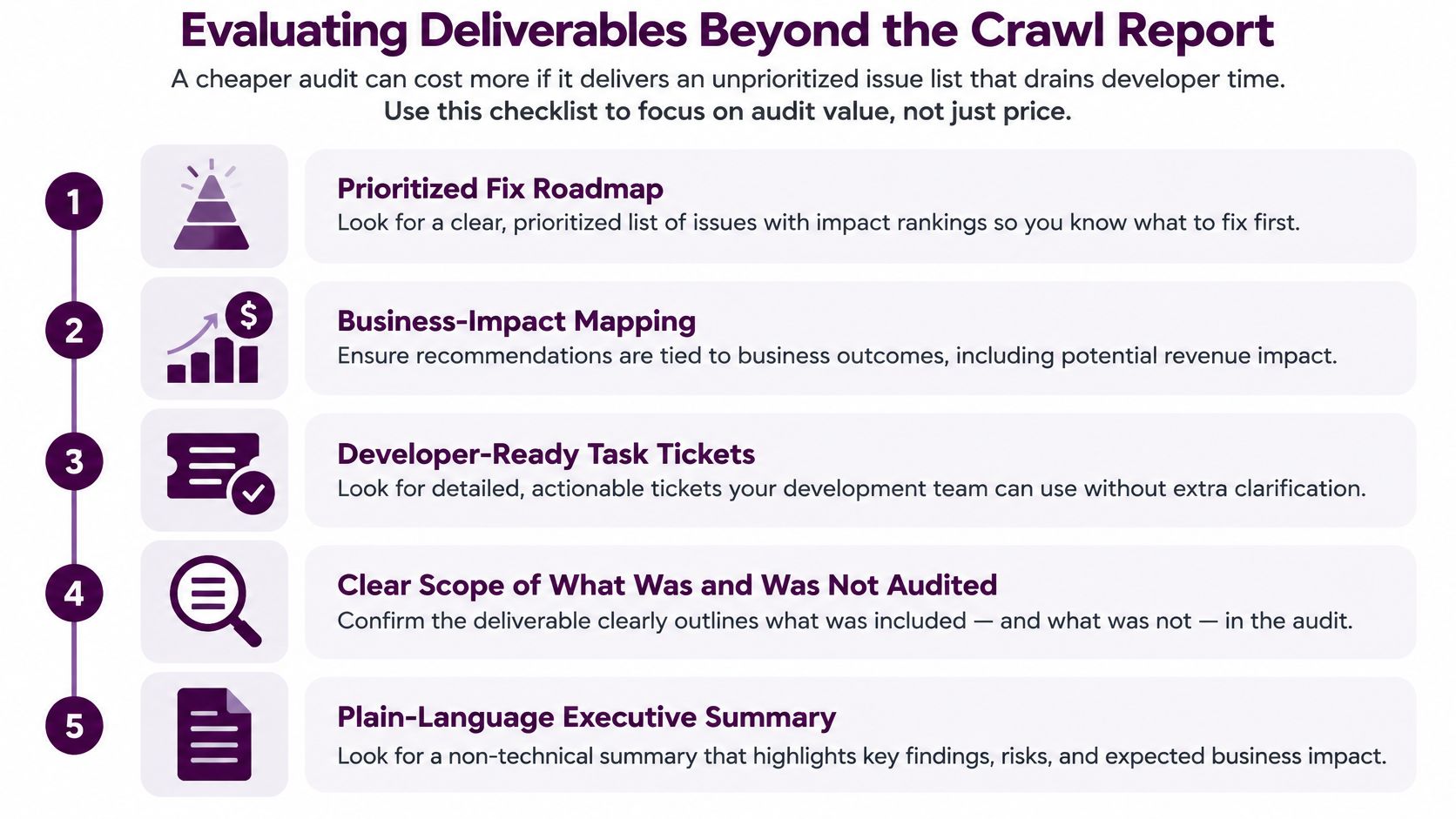
A specialist rate can be justified by a difficult decision. It isn't justified by attaching a senior name to work performed entirely by an automated export.
Evaluating Deliverables Beyond the Crawl Report
Request a sample deliverable before signing. Look for evidence that an analyst has moved from detection to diagnosis, then from diagnosis to an implementable recommendation.
The GoodFirms SEO pricing breakdown reports that 56% of surveyed companies spent $500–$1,500 annually on on-site audits, while nearly 21% spent $1,500–$3,000. Those are annual spending figures, not directly comparable standalone project quotes, which makes a deliverable-level comparison essential.
Require evidence and a clear boundary
Your statement of work should specify the data and methods the provider will use. Search Console, Analytics, crawl findings, rendered-page checks, and server logs shouldn't appear as an impressive list without an explanation of their purpose.
- Coverage statement: Identify included domains, page types, environments, and exclusions. Make sampling explicit.
- Validated findings: Require affected examples and evidence that the reported behavior occurs.
- Appropriate technical methods: Include JavaScript rendering or log analysis when the investigation calls for them, rather than automatically buying every available test.
- Performance context: Require the analyst to connect relevant findings with search and conversion data where access allows.
Not every detected issue deserves a development ticket. Ask the provider to distinguish a confirmed obstacle from a hypothesis, a cosmetic inconsistency, and an intentional configuration.
Demand a handoff your team can execute
A useful recommendation needs an owner, a proposed change, and an acceptance criterion. Developers shouldn't have to infer the intended behavior from a screenshot and a severity label.
Require prioritization based on business relevance, implementation effort, dependencies, and confidence in the diagnosis. Expected commercial impact can be described directionally when the evidence doesn't support a defensible revenue estimate.
For the reporting layer, use the scalable SEO reporting playbook to consider how findings will remain understandable to clients and internal stakeholders after the presentation.
Also specify how the team will revisit recommendations after changes go live. This lifecycle view is useful when defining the handoff.
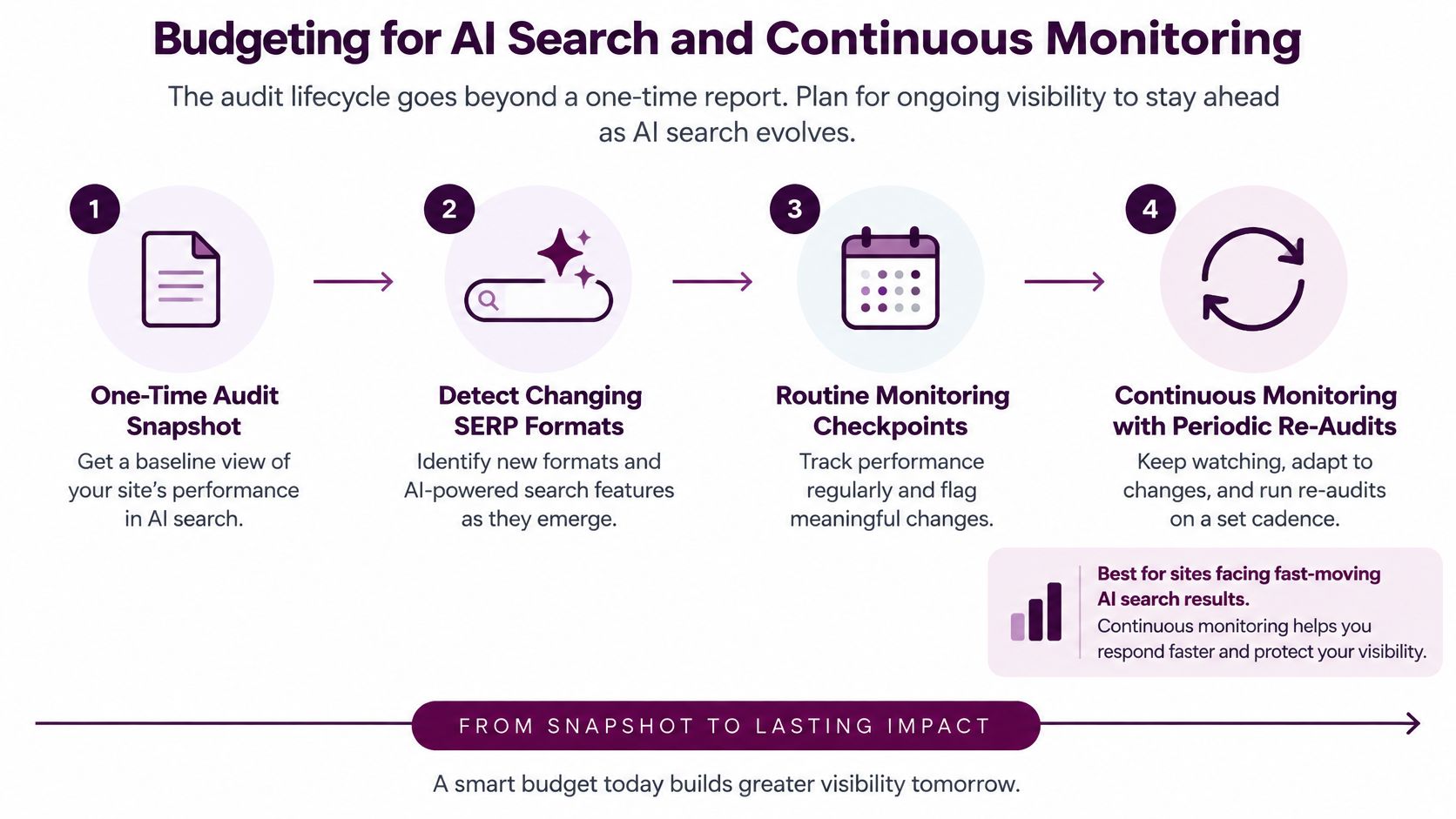
Reject invented precision. A vendor should explain why a recommendation matters without manufacturing a traffic forecast to make the report look more commercial.
Budgeting for AI Search and Continuous Monitoring
Don't approve an AI-search surcharge just because the proposal uses new terminology. Ask what additional investigation, measurement, or expertise you're purchasing.
Google's guidance on AI features and websites says the same foundational SEO practices and people-first content principles apply to its AI features. My budgeting conclusion is that a separate GEO premium needs a concrete scope justification, not a claim that established SEO suddenly requires replacement.
Match monitoring frequency to operational risk
Treat an investigation and ongoing monitoring as different budget lines. The former establishes causes and priorities. The latter helps your team identify changes that deserve attention.
I recommend monthly reviews for large ecommerce, international, JavaScript-heavy, or frequently deployed sites. For stable SMB websites, quarterly reviews are a reasonable starting point, with targeted checks after material releases or migrations. These are planning recommendations, not universal performance benchmarks.
| Operating Situation | Recommended Budget Emphasis |
|---|---|
| Frequent releases affecting important templates | Routine validation and a clear escalation process |
| Stable site with limited technical change | Periodic review and targeted investigation when needed |
| Migration or major redesign | Dedicated pre-release assessment and post-release validation |
| Changing search visibility without an obvious site change | Measurement review followed by a focused diagnostic |
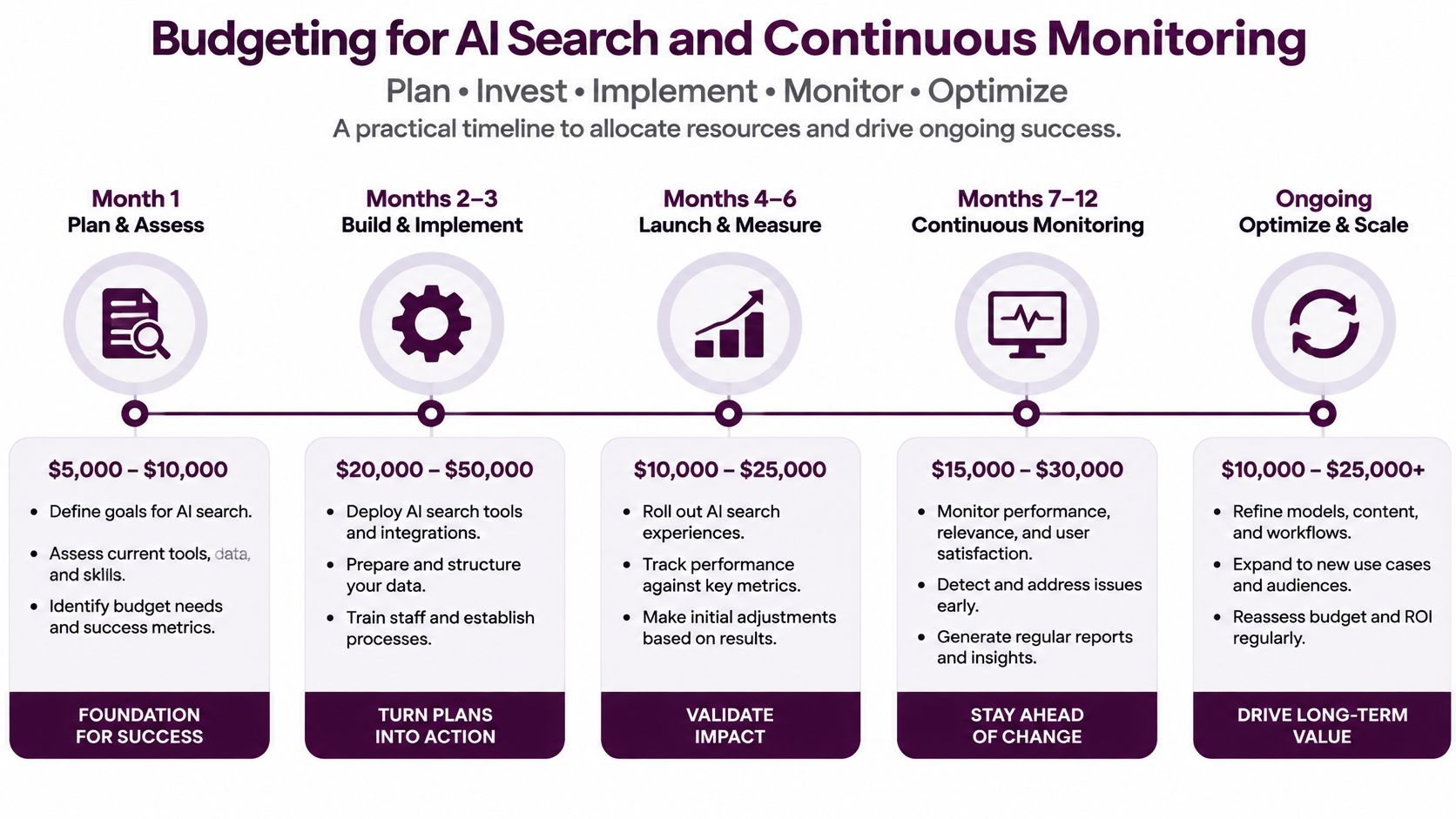
The budget should cover a response process, not just alerts. Assign someone to review changes, distinguish measurement problems from performance problems, and commission deeper analysis when necessary.
The timeline below provides a useful way to separate implementation, monitoring, and subsequent optimization.
Buy better measurement rather than vague promises
Ask how the provider will distinguish search appearances, visits, and business outcomes. A visibility observation isn't automatically evidence of commercial contribution.
For practical considerations around observation and reporting, consult the visibility tracking tips from Keyword Kick. Keep any additional measurement work connected to questions your marketing team can act on.
Budget boundary: Fund a defined monitoring method and an accountable response. Don't fund an undefined promise to make your brand visible everywhere.
Continuous monitoring is appropriate when the team can use it to catch and investigate meaningful changes. If nobody owns the response, adding more reports won't solve the management problem.
How to Compare Vendors and Reduce Wasted Spend
The strongest proposal isn't necessarily the broadest. It's the proposal that resolves your uncertainty without transferring avoidable interpretation work to your staff.
Consider a hypothetical procurement comparison. An agency offers an extensive report covering every available check, while a consultant proposes a narrower investigation of your most commercially important templates. If your immediate question concerns those templates, the narrower proposal may be the better purchase, provided it includes adequate evidence and a usable handoff.
Give every bidder the same purchasing brief
Write a shared brief before inviting quotes. Include the business problem, relevant site changes, available data, internal skills, and the decisions you need to make.
Then request consistent answers:
- Analysis ownership: Identify who performs the investigation and who reviews it.
- Scope boundaries: Ask bidders to explain exclusions and the consequences of those exclusions.
- Client dependencies: Specify required access, interviews, exports, and approvals.
- Commercial boundaries: Separate diagnosis, implementation, retesting, and additional support.
- Change control: Establish how unexpected findings affect scope and fees.
This prevents a vendor from appearing cheaper only because it excludes work another bidder includes. It also makes unnecessary scope easier to challenge.
Reduce preparation work, not analytical quality
Your team can prepare an architecture overview, recent release history, existing research, and a list of known issues. Supply clean access and identify the internal people who can answer technical questions.
That preparation lets you reserve external expertise for interpretation. Don't ask a specialist to spend the engagement reconstructing information your organization already has.
A phased engagement can also make sense. Commission an initial investigation to resolve the central uncertainty, then authorize additional content, competitor, or technical work only when the findings justify it.
| Vendor Behavior | Recommended Response |
|---|---|
| Refuses to show a redacted sample | Ask for a demonstration of the proposed output before approval |
| Describes only tool names and report length | Request the actual analysis method and decision criteria |
| Offers a broad discount without changing scope | Clarify whether staffing, review, or support will change |
| Pushes implementation before validating the diagnosis | Keep execution approval separate from discovery |
Don't negotiate away the part you need. Removing manual validation to hit a procurement target can leave your internal team paying the difference through rework.
Finalizing Your SEO Audit Investment Strategy
Suppose you're a marketing director facing declining organic leads and an upcoming platform change. Your first decision isn't which audit package to purchase. It's whether the provider must explain the current decline, assess the planned change, or handle both as distinct workstreams.
That distinction changes the required expertise, access, deliverables, and implementation ownership. Define it before asking leadership to approve the spend.
Build the approval around a business decision
Use a short investment memo rather than forwarding competing proposals without context. Explain the uncertainty you're trying to resolve, the consequence of leaving it unresolved, and why your internal team needs outside assistance.
| Decision Question | What the Approval Should Establish |
|---|---|
| Why buy an audit now? | A specific business problem or upcoming change |
| Why this scope? | Coverage proportionate to the uncertainty and risk |
| Why this provider? | Relevant expertise and credible example deliverables |
| Who will implement? | Named internal or external ownership |
| How will success be assessed? | Technical acceptance criteria and appropriate business measures |
On discovery calls, ask candidates what evidence would change their initial hypothesis. That question helps distinguish a genuine investigation from a provider working toward a predetermined recommendation.
Also ask what they would deliberately exclude. A credible scope has boundaries, and a capable advisor should be able to explain them.
Reserve capacity for implementation and verification
Don't exhaust the available budget on diagnosis. Secure the staff time needed to implement approved recommendations and confirm that the changes behave as intended.
Before work starts, document the relevant performance baseline and important measurement limitations. After implementation, review technical completion separately from commercial results, and record other changes that could affect interpretation. Don't attribute every subsequent movement to the audit.
Use this investment sequence to keep approval, execution, and review connected.
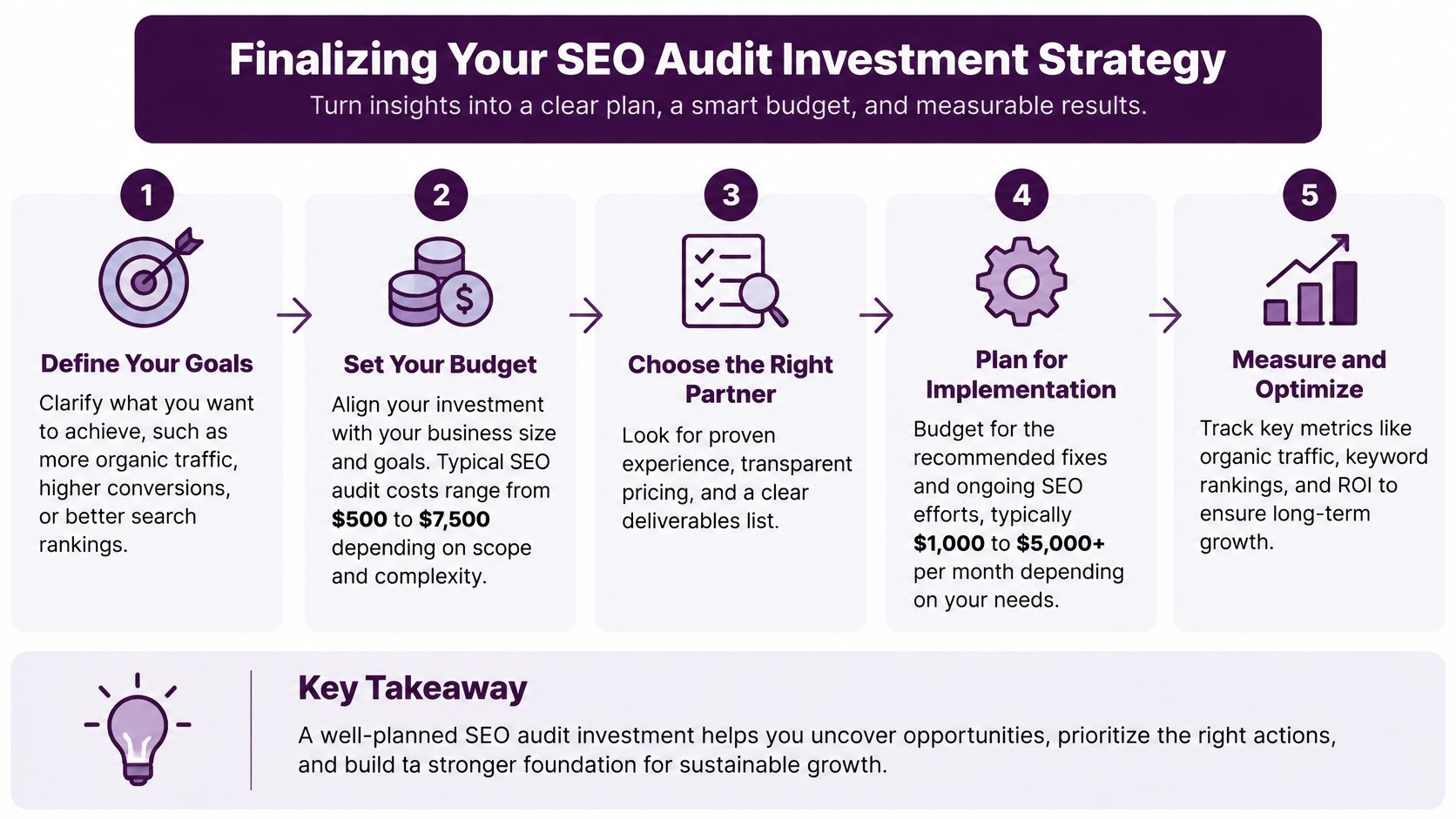
Approve the smallest scope that can answer the important question reliably. Expand it when evidence justifies further investigation, not because a vendor has a more expensive tier available.
The right SEO audit cost is the cost of enough qualified analysis to support sound action. Your final purchasing test is whether the people responsible for the website can explain what they'll do, why they'll do it, and how they'll verify the result.
Keyword Kick brings site audits, Search Console, Analytics, rankings, and backlink signals into a shared workspace, with AI-assisted recommendations to help teams prioritize action. Visit Keyword Kick to explore how ongoing diagnostics can support your audit budget and help your team decide what to investigate and implement next.