
You usually notice the problem at the worst possible time. A page that used to bring in strong editorial links starts slipping, a partner site subtly changes a dofollow mention to nofollow, or a high-value link vanishes after a redesign, and nobody spots it until traffic or rankings have already moved. That's the challenge with how to monitor backlinks in production, the work isn't collecting every link, it's deciding which changes matter enough to act on before they become expensive.
Backlink monitoring doesn't fail due to a lack of tools. It fails when teams monitor too much noise, too little signal, or both. If you've ever stared at an inbox full of backlink alerts and ignored half of them, or worse, found a lost link weeks after it disappeared, you already know why a triage-first workflow matters.
Why Most Backlink Monitoring Fails Before It Starts
A backlink check that starts after a ranking drop is already late. By that point, an editorial mention may be gone, a source page may redirect, or an anchor may have changed without anyone noticing until the impact shows up in traffic or rankings. The work that matters is triage, deciding which changes deserve action before they turn into real losses.
Reactive monitoring fails because the process is built around surprises instead of priorities. Teams export reports, scan a long list of changes, and spend time on low-value noise while the links that support authority, referral traffic, or conversions sit at the bottom of the queue. A site can lose an important placement, and if the workflow only reacts after a drop, recovery gets slower and more expensive.
That is why occasional manual checks stop working once a backlink profile gets any size. Search engines and SEO tools can surface new and lost links continuously, but a useful monitoring system still needs a review rhythm that fits the link profile and the team handling it. Practical guidance usually points to weekly checks for new and lost links, monthly reviews of anchor text, and quarterly reviews of referring domain authority, with manual spot-checks for the placements that would hurt most if they disappeared backlink monitoring cadence guidance.
Alert overload is the real issue
Many backlink monitoring setups are technically active, but they are still unusable in practice. They trigger on low-value link changes, temporary crawl glitches, and vague toxicity warnings, then send all of it into the same queue. Once the team sees too many false positives, the alerts lose credibility and the links that matter stop getting attention.
Practical rule: if an alert does not drive a decision, keep it out of the main queue.
A better workflow watches for changes first, then sorts those changes by value. A directory listing and a national press mention should never receive the same treatment, even if both appear in the same report. Editorial placements usually deserve tighter protection because they are part of a broader link earning benefits for PR approach, while routine mentions can sit in a lower-priority review bucket.
The tools themselves are not the problem. Google Search Console gives a free, first-party sample of linking domains, and platforms like SE Ranking and Moz can surface new and lost links, follow versus nofollow counts, anchor text, and linking-domain counts in one place. A separate crawl from a Keyword Kick backlink checker can help validate what is new, what has changed, and what is worth a manual look. The gain comes from setting the decision rules before the alerts start piling up.
Establishing Your Backlink Baseline and Tool Stack
A backlink monitor only works if the starting point is clean. I usually begin with a dated baseline export, one pull from Google Search Console and one pull from a dedicated crawler such as Ahrefs, Semrush, or SE Ranking, then I log referring domains, top linked pages, and anchor-text distribution in a simple sheet. That snapshot gives you something stable to compare against, so later changes are actual movement, not tool drift or a crawler catching up late.
Google Search Console is useful because it reflects what Google has on file, but it shows only a sample rather than a full backlink index GSC limits and workflow. For that reason, serious monitoring usually pairs Search Console with an independent crawler. GSC shows what Google sees, while the crawler adds status details, follow versus nofollow data, and a broader view of link context.
Track referring domains, not just backlink counts
Raw backlink counts can mislead you. One domain can link multiple times, so the count can climb even when your profile is not becoming more diverse or more resilient. Referring domains give the better health signal because domain diversity shows whether your authority base is spreading or just repeating itself.
The operational difference matters. If a single publisher adds five links, the backlink count may look healthy, but the profile has not become sturdier. If five new domains link once each, the profile is usually healthier even though the raw count is smaller.
If a metric cannot help you separate a real gain from tool noise, keep it out of the main decision queue.
Build the stack around the job, not the brand
Use Google Search Console as the first-party source, then add a crawler such as Ahrefs, Semrush, Moz, or SE Ranking for the monitoring layer with more detail. The setup I see hold up most often is a simple triad. GSC for Google's sampled view, a crawler for link detail, and a monitoring layer for alerts and trend tracking.
A workflow tool also helps once the volume of checks and decisions starts to grow. For example, a startup directory entry can be useful when you are comparing lighter-weight tools and want to see how different products describe their backlink coverage.
Set the baseline to document the fields that matter, then configure alerts for new and lost links, follow-to-nofollow changes, and status changes such as 200-to-404 transitions. If you want a compact way to inspect link profile changes alongside other SEO signals, the backlink checker tool is a practical reference point.
The point of the baseline is straightforward. When something disappears later, you should not have to guess whether the loss is real, important, or just one crawler being faster than another.
Key Metrics That Actually Signal Problems
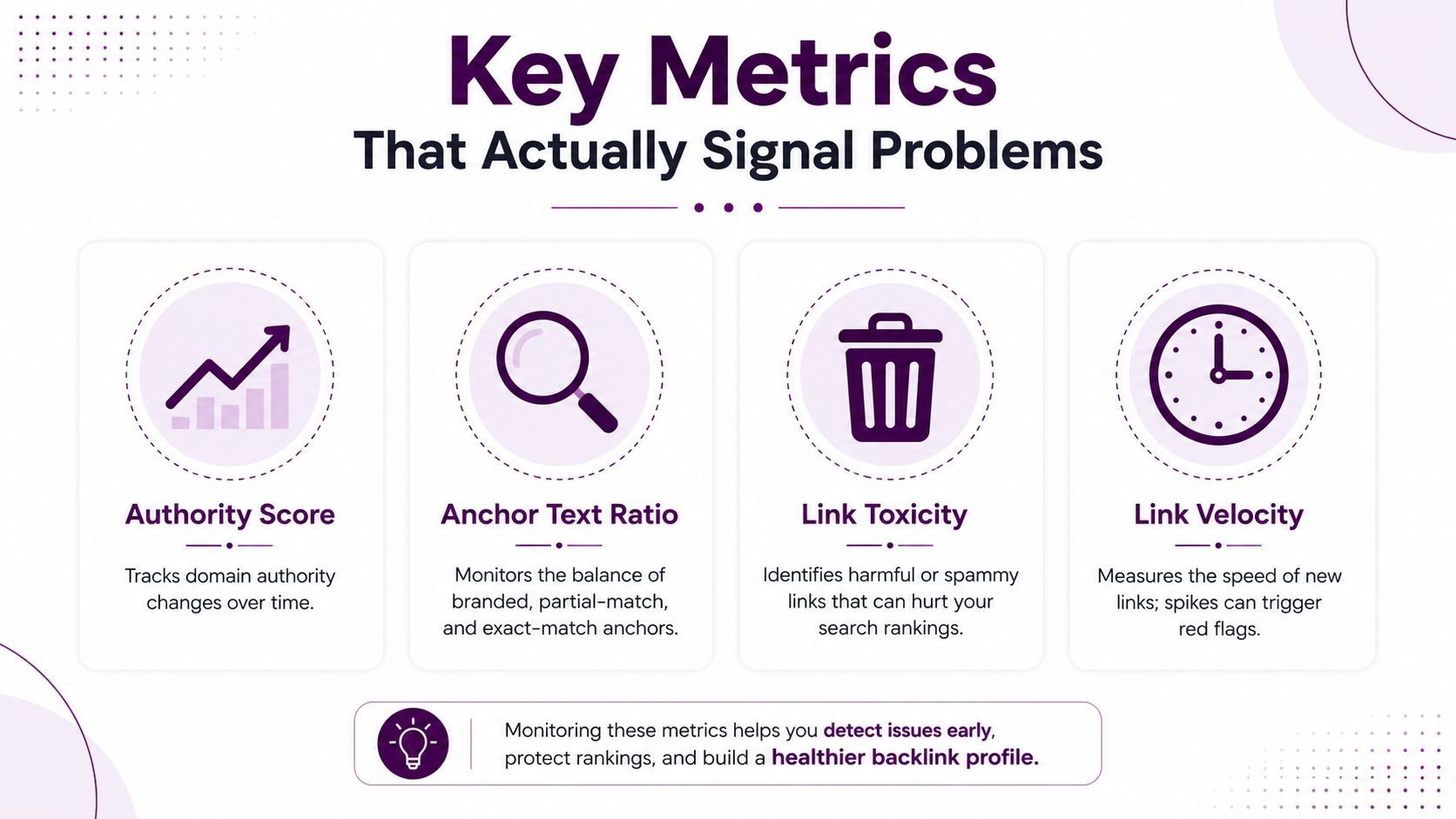
Most backlink dashboards drown people in metric confetti. The useful set is much smaller than vendors make it look, and once you separate signal from decoration, the workload gets easier. The metrics that matter most are the ones that show whether your authority base is stable, whether your anchor mix is natural, and whether the links you care about are still live.
Referring domains and authority changes
Start with referring domain count and the authority level of the domains that disappeared or appeared. Losing a link from a weak page is usually background churn. Losing a link from a trusted, high-authority publication is different, especially if that link helped discovery, earned referral traffic, or supported a key page.
The same logic applies to new wins. A new link from a respected domain is more meaningful than several low-value placements on thin pages. Treat those gains and losses as priority items, not generic trend data.
Anchor text and link attribute shifts
Anchor text deserves monthly attention because it's one of the cleanest places to spot unnatural patterns. A sudden skew toward exact-match anchors is a reason to look closely, especially if the new links came from unrelated pages or questionable placements. The problem isn't one anchor in isolation, it's the pattern across the profile.
Follow versus nofollow ratios also matter, but not because nofollow links are worthless. They matter because a sudden shift in link attributes can reveal edits, template changes, or policy updates on the linking site. A mention that changes from follow to nofollow may still send traffic, but it's no longer carrying the same authority signal.
Referral traffic and toxicity scores
Referral traffic tells you whether the link is doing more than passing a crawl signal. Some links are valuable because they support rankings, and some are valuable because they bring users who convert. If a link drives real visits, it deserves a higher recovery priority than a link that only exists in a crawler report.
Toxicity scores are useful as a screening layer, not as a final verdict. The score flags something worth inspecting, but it shouldn't trigger automatic panic. I'd rather review a handful of suspicious links with context than let a tool decide that a niche publication is “toxic” just because its footprint looks messy.
The useful signal is concentrated in a small part of the profile, so don't over-monitor everything equally. A clean dashboard should highlight the few links that affect authority, traffic, or revenue, then file the rest for trend review.
Building a Tiered Alert System and Monitoring Cadence
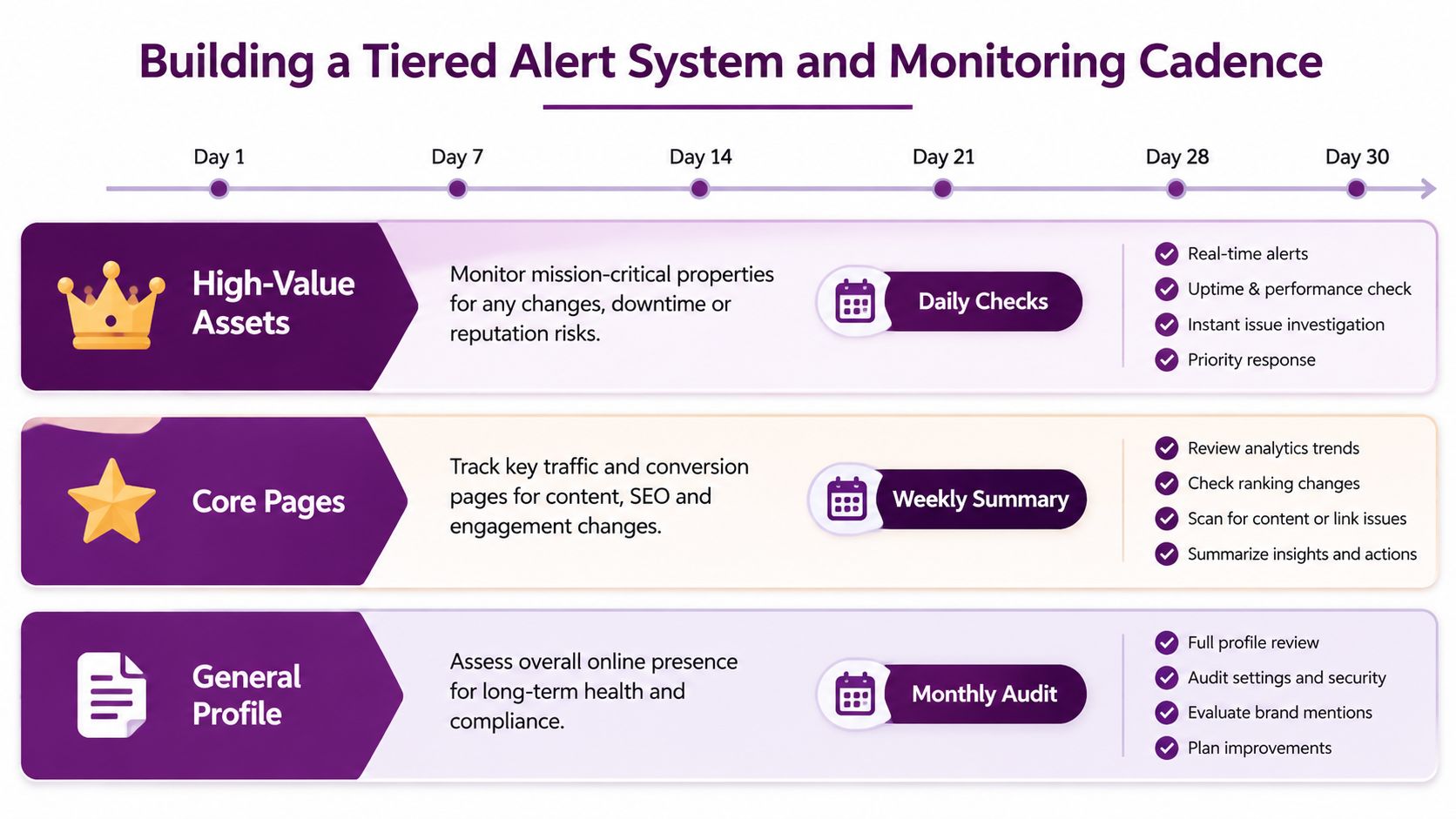
The fastest way to create alert fatigue is to give every link the same monitoring priority. The cleaner approach is to segment backlinks by value, then match alert frequency to the importance of the asset. That keeps the queue manageable and prevents important placements from getting buried under routine churn.
Daily, weekly, monthly, quarterly
A tiered cadence works because not every backlink deserves the same urgency. Daily checks belong on high-value assets, especially revenue-driving pages and placements from strong editorial domains. Weekly checks are enough for new and lost links across the broader profile. Monthly analysis should cover referring-domain growth and anchor mix. Quarterly audits are where you review the full profile and reassess any disavow file decisions.
That cadence aligns with how professionals work in production. Teams that use this structure usually watch for high-authority new links, lost links, toxic-score spikes, competitor backlink wins, and week-over-week referring-domain drops. Everything else is logged for trend analysis instead of being forced into a recovery queue.
What should trigger action
Not every alert needs outreach. A change should move from “note it” to “act on it” when the link comes from a high-authority domain, supports a critical page, or has a clear business tie to traffic or conversions. A weak directory loss rarely deserves the same attention as a missing editorial feature on a trusted site.
Practical rule: if you can't explain why a lost link matters in one sentence, it probably belongs in the monthly review, not the daily queue.
Filtering matters. If you're reviewing everything manually, you're doing too much. A well-configured system can cut weekly link review down to a short session, but only if low-value noise is suppressed and recovery effort is reserved for high-impact pages workflow and cadence guidance.
A clean alert system also makes it easier to spot patterns. If a competitor starts winning links from the same publications you target, that's a strategic signal. If a cluster of important links shifts status in a week, that's a maintenance signal. If one low-value domain starts throwing off spammy alerts, that's usually just noise.
Triage Workflow for Lost and Changed Backlinks
A lost link isn't automatically a problem, and a changed link isn't always worth recovering. The decision point is triage, not panic. Good teams log the event, assess the asset, and move quickly only when the loss is likely to affect authority, traffic, or visibility.
Log the facts before you decide
Use a standard record for every meaningful change. At minimum, capture the source URL, target URL, anchor text, acquisition date, monitor frequency, and priority level. That makes later outreach cleaner and stops the team from re-litigating the same decision every time the link changes again.
The next step is to ask whether the change looks intentional or accidental. A site redesign, template cleanup, or editorial refresh often removes links by accident. A deliberate policy shift is a different case, especially when the publisher keeps the page live but changes the attribute or moves the mention into a less visible part of the page.
Recoverable or not
Page-level change detection is more useful than waiting on periodic backlink exports because it catches edits and removals earlier. Bookmark the source URL, monitor the section of the page where the link lives, and set the check frequency based on the asset's value. High-value placements deserve daily checks, while lower-priority links can sit on weekly or monthly review.
I've found that teams make better decisions when they separate recoverable losses from normal churn. Editorial link removals, broken URLs after redesigns, and follow-to-nofollow changes often justify outreach if the domain matters. Low-authority mentions usually don't.
For a fast operational reference on this kind of review process, the backlink audit workflow is useful because it keeps the audit focused on action, not theory.
A lost link is a business decision only when the source page has business value.
Common scenarios that deserve different responses
An editorial link removed from a trusted publication usually deserves a polite recovery note. A broken link caused by a site migration often needs a direct URL fix or a replacement suggestion. A follow-to-nofollow change may be worth flagging, but it doesn't always justify outreach unless the placement is strategically important.
The point is to stop treating every alert as a fire. Some are just weather. Some need outreach. Some belong in the archive.
Remediation Strategies and Outreach Templates
Once a backlink is worth recovering, the work turns tactical. The right move depends on what changed, who controls the source page, and whether the placement still has value. In practice, there are three responses that matter most: restoration outreach, replacement offers, and disavow management for links that belong in the cleanup bucket.
Restoration, replacement, and cleanup
Direct outreach works best when the original mention was editorial and the page still exists. A short note that points out the missing link, the correct destination, or the updated resource usually does more than a long explanation. If the page owner doesn't want to restore the original link, offering a better replacement URL can sometimes solve the problem without friction.
If the issue is a toxic or spammy link, the question is different. Most sites do not need to disavow links unless they've received a manual action or have a clear, evidence-backed reason to do so. That's why the cleanup process should stay narrow and intentional, not preemptive.
Outreach that respects the publisher
A good email is specific, polite, and easy to act on. For a broken link, say which page is affected, what changed, and where the corrected URL should point. For an editorial mention, keep the request short and explain why the current version no longer serves the reader. For an unresponsive webmaster, a single follow-up is usually enough before you move on.
Keep the message about the reader and the page, not about your “SEO performance.”
That framing works because publishers care more about accuracy and maintenance than about your rankings. It also keeps the conversation grounded in utility rather than negotiation.
When disavow actually belongs in the workflow
Disavow file management should be part of quarterly review, not a reflexive response to every ugly domain in a report. If you're dealing with harmful links that can't be removed at the source, then format the file carefully and document why each domain is there. If you don't have that level of confidence, don't rush it.
A lot of teams also miss one practical opportunity, converting brand mentions that don't link yet. If the mention is real and relevant, this guide on turning unlinked brand mentions into backlinks is worth keeping in the workflow because it turns monitoring into reclamation.
The simplest rule is this. Recover what matters, ignore what doesn't, and don't waste recovery time on links that were never moving the needle.
Reporting and Stakeholder Communication Framework
Monitoring only matters when someone uses the output. That means reports should drive decisions, not just display counts. Different stakeholders need different views of the same backlink data, and the best reports are short enough to read, but specific enough to trigger action.
Three report styles that actually get read
An executive summary should focus on link profile health, notable gains, meaningful losses, and competitive positioning. It doesn't need every URL, it needs the story behind the changes. A tactical SEO report should be more specific, listing recovery opportunities, outreach status, and any pages that deserve protection. A client-facing dashboard should show progress without overwhelming non-specialists with raw exports.
The useful fields are usually the same, but the emphasis changes. Executives want direction. Operators want tasks. Clients want proof that monitoring is active and that issues are being handled before they become visible problems.
Present wins and losses together
A good report doesn't hide losses. It shows a new high-authority win alongside the links that were lost, then explains what was recovered and what's still open. That balance builds trust because it shows the monitoring system is doing real work, not just celebrating upside.
Tie the report back to outcomes whenever possible. If a page kept its important links intact, say so. If outreach restored a link on a strategic mention, note that the asset was recovered. If a lost link was low priority, mark it as churn and move on.
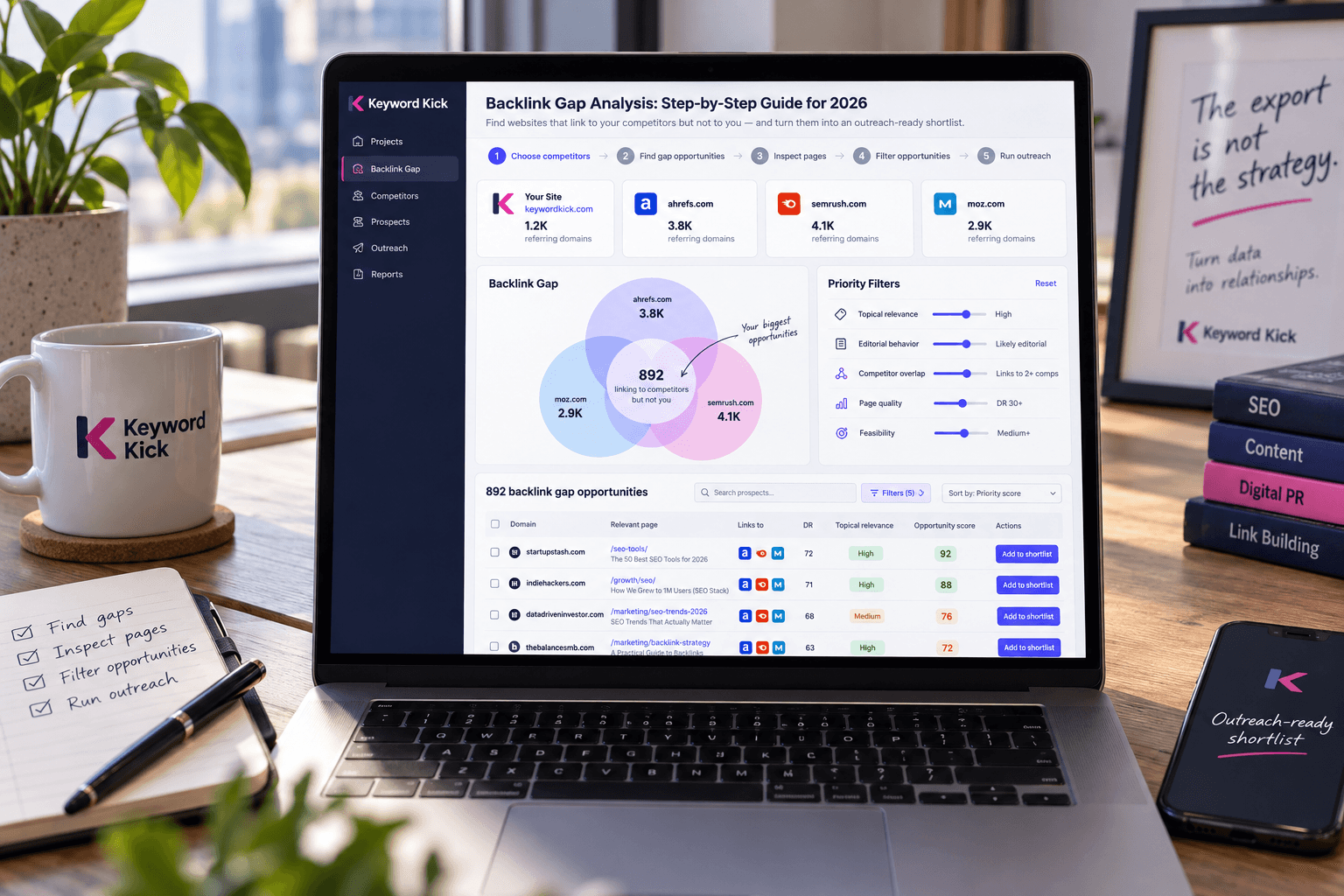
Keyword Kick fits into this kind of workflow as one option for teams that want backlink analysis, new and lost backlink monitoring, competitor link gap analysis, and toxic link detection in the same workspace, so the reporting layer can sit closer to the rest of the SEO stack without stitching separate tools together.
If backlink loss, anchor drift, and alert overload are eating too much of your team's time, Keyword Kick can help you centralize the monitoring work and turn the data into clear next steps. Visit Keyword Kick to see how its backlink analysis and monitoring workflows fit into a broader SEO process, then build a system that protects the links that matter.