You're staring at Search Console, typing your brand name, then the keyword you care about, and the result is the same, nothing useful. That's the point where most site owners start changing title tags, rewriting pages, and chasing backlinks at random. The better move is to treat my site ranking Google as a diagnosis problem, not a motivation problem.
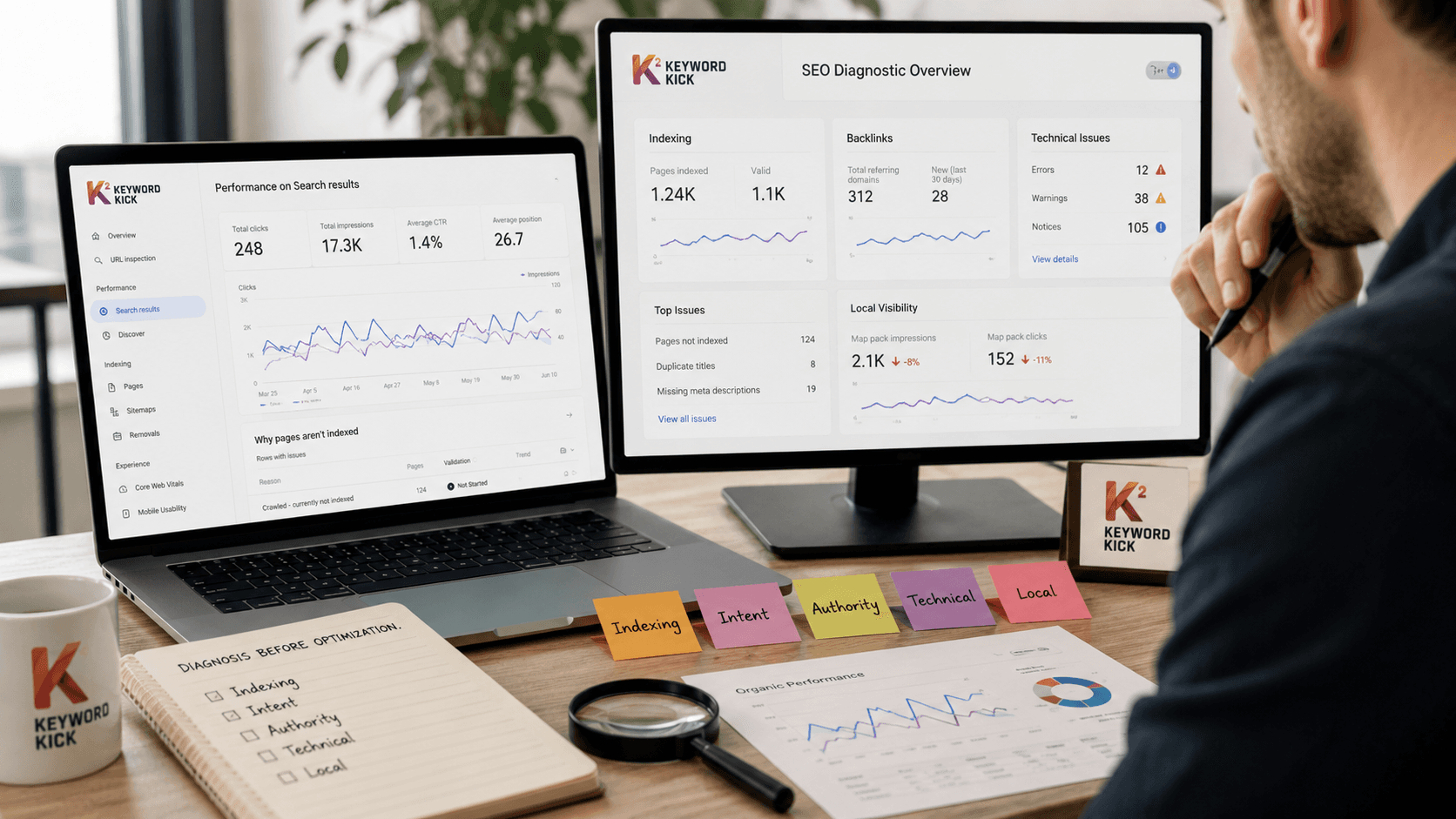
Google doesn't rank pages off a single signal. One widely cited SEO overview says Google uses over 200 confirmed ranking signals, and the strongest foundations keep showing up across industry guidance, helpful content, backlinks, internal linking, freshness, mobile usability, and technical accessibility (Google ranking factors overview). If your site isn't visible where you want it, the first job is to figure out whether you have an indexing issue, an intent mismatch, an authority gap, a technical blocker, or a local visibility problem.
First Confirm the Real Ranking Problem
The worst mistake is treating every ranking failure like the same failure. A page that never indexed, a page that dropped after a rewrite, and a page that ranks on page three are all different problems, even if the symptom feels identical. Search Engine Land makes the same point clearly, first determine whether a page is not ranking at all versus not ranking well before you touch anything (why a page isn't ranking in Google).
Start by separating three situations
If the page has never shown up, you may be dealing with discovery, crawl, or indexation issues. If the page used to rank and then faded, the issue could be content decay, lost links, technical changes, or stronger competitors. If the page ranks, but not for the terms you care about, the problem is usually intent mismatch rather than a pure SEO defect.
A simple way to stay sane is to classify the issue before you “fix” it:
Never appeared: Google may not have fully processed the page, or the page may not satisfy the query well enough to surface.
Dropped recently: Compare the current page against its earlier version, then look for content changes, link loss, or crawlability changes.
Visible but weak: The page may be indexed and relevant, but not strong enough in content depth, authority, or usability.
If you want a plain-English starting point for that first pass, a resource like troubleshoot why your business isn't on Google can help frame the question before you make changes.
Practical rule: don't optimize a page until you know whether Google can actually see it, trust it, and map it to the query you care about.
That distinction matters because broad ranking advice often skips the diagnosis step. A systematic process saves time, and it keeps you from “fixing” the wrong layer of the problem.
Your First Diagnostic with Google Search Console
Google Search Console is the fastest way to stop guessing. Anecdotal searches tell you what your browser sees. Search Console tells you whether Google is showing your pages, which queries trigger impressions, and where clicks stop happening. That's why it should be the first source of truth for my site ranking Google issues.

Read impressions before you read rankings
Open the Performance report and filter to the page or query you care about. If you see impressions but no meaningful clicks, the page is getting visibility, but the snippet, intent match, or position isn't strong enough to earn the visit. If you see no impressions, that's a different signal, because Google isn't surfacing the page for the search you expected.
That is why the query-level view matters more than a vague “the site is down” reaction. A page can rank for one cluster of terms and disappear for another, which means the problem is not always sitewide. Such a dynamic often leads many owners to waste weeks by optimizing pages that are already indexed but irrelevant to the target query.
Use URL Inspection to check Google's view of one page
The URL Inspection tool shows whether a specific page is indexed, whether Google has detected a canonical version, and whether the live URL appears accessible. If the tool says the page is not indexed, fix that first. If it's indexed but not getting traction, shift your attention to relevance, content quality, and supporting links.
A good workflow is simple:
Inspect the target URL to confirm index status.
Check the Performance report for impressions, clicks, and the exact queries involved.
Compare the page to the ranking result set to see whether your content matches the search intent.
If a page has impressions but no clicks, don't start with backlinks. Start with the title, snippet, and the answer the page actually gives.
If you want a deeper walkthrough of the interface, use how to use Google Search Console for SEO as a reference, then come back to the data with a clear hypothesis. The point is to replace hunches with proof.
Auditing Your Content and On-Page SEO Signals
Once a page is indexed and getting impressions, the next question is blunt, why isn't it winning. Most of the time, the answer is that the page doesn't match the searcher's intent as cleanly as the pages already ranking. The practical workflow starts with intent matching and topic clustering, then expands depth around the pages most aligned with your site's core focus (Google ranking factors and topic clustering).
Compare the page to what already ranks
Open the current top results and study what they have in common. Don't just look at keywords. Look at format, angle, depth, and subtopics. A how-to guide, a service page, and a product comparison can all target similar language while serving very different intent.
The pages that rank often answer a cluster of follow-up questions in one place. If your page only covers the obvious keyword and stops, it's usually too thin for the query environment Google is already rewarding. That's also where internal linking becomes strategic, because it helps Google see which pages carry the main topical load.
Tighten on-page signals without stuffing anything
A strong title tag should promise the same outcome the searcher expects. A good meta description won't force rankings on its own, but it can help the page earn clicks once it shows up. Headings should organize the content around real subtopics, not just repeat the same phrase in slightly different words.
Use this as a quick content audit:
Match search intent: confirm the page format fits the query, not just the keyword.
Cover supporting subtopics: include the practical questions people ask before they convert.
Improve internal links: point relevant pages toward the one you want to strengthen.
Refresh weak sections: update outdated references, steps, or examples.
For a hands-on review of those page-level signals, the on-page SEO checker can help you spot gaps faster than a manual skim alone.
Local visibility needs a separate lens. If you're trying to rank in a city or service area, generic SEO won't carry you very far. Local pages, natural location mentions, Google Business Profile work, reviews, and local directory links are distinct ranking levers for place-based searches (local SEO ranking factors). In practice, that means a strong national page can still fail locally if the page never signals where the service applies.
Analyzing Your Authority with Backlinks
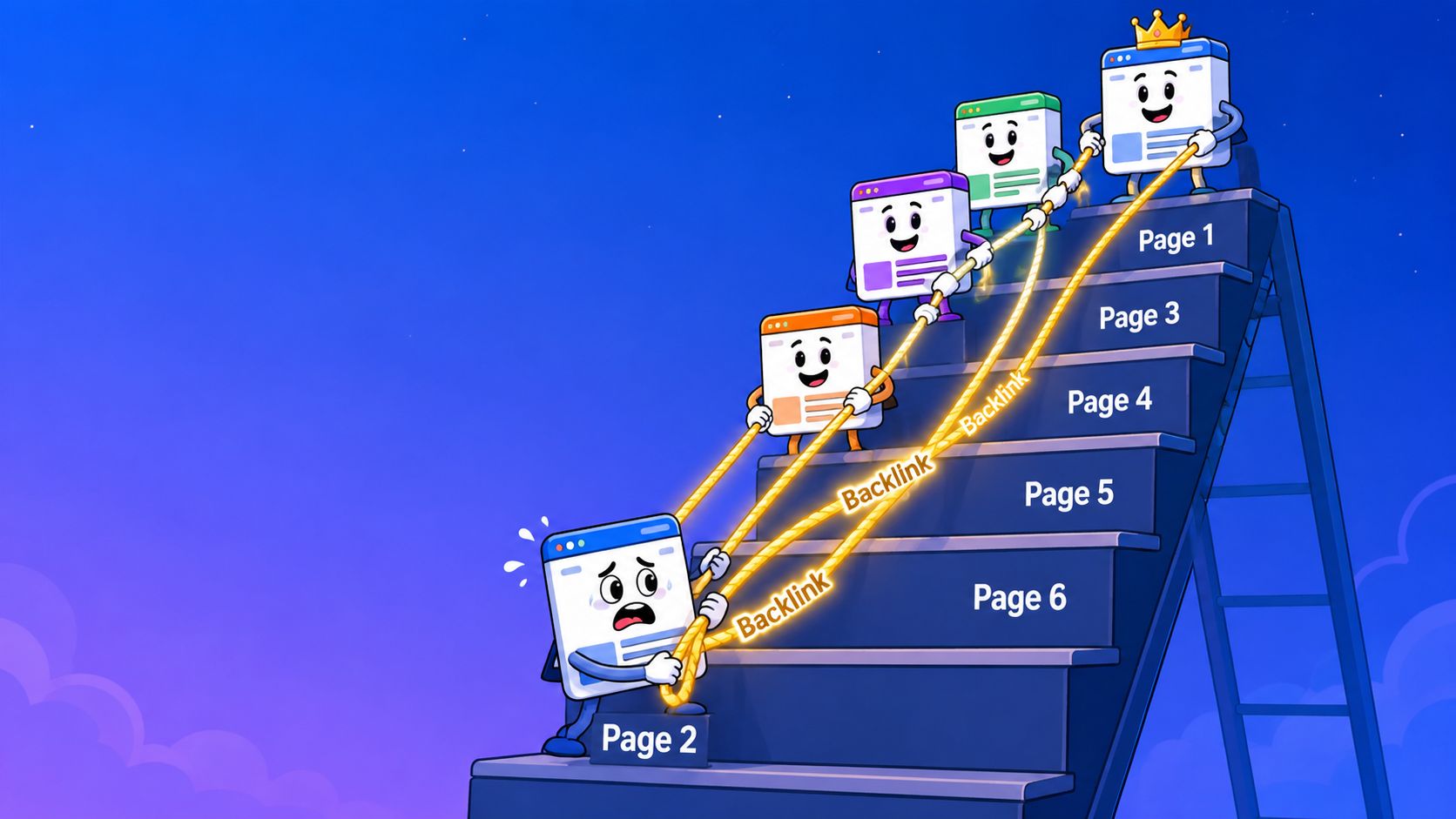
If the content matches intent and the page still lingers behind weaker-looking competitors, authority may be the bottleneck. Links still matter because they help Google judge whether other sites treat your page as a credible reference. The mistake is reducing that to raw quantity, because a pile of irrelevant links won't help much if the page itself doesn't look trustworthy.
Look at quality, relevance, and gaps
Start with the backlinks pointing to the page you care about, then compare them with the pages outranking you. You're not looking for a magic number. You're looking for whether the best-ranking pages have stronger editorial mentions, more relevant referring domains, or better topical alignment from the sites linking to them.
The safest lens is simple: which links look earned because the content deserved to be cited, and which links exist only because a site placed them somewhere? That distinction matters more than ever, especially when the page has enough on-page depth but still lacks outside validation.
Check for signals that support trust
Backlinks are one piece of trust, not the whole thing. Author bios, brand mentions, consistent company information, and coverage from relevant publications all contribute to the broader credibility picture. Searchers don't see those cues as a ranking system, but Google can use them as part of the trust evaluation around your content.
A focused audit should answer a few questions:
Do the linking sites fit the topic? Relevance usually matters more than volume.
Are the links pointing to the right pages? Home pages alone rarely solve a topical ranking issue.
Are there obvious spam patterns? Low-quality link neighborhoods can weaken confidence.
Are competitors earning editorial mentions? If yes, that often explains why they hold position better.
If you need a structured way to examine the profile, how to do a backlink audit in 30 minutes is a good operational reference.
Local intent deserves its own callout because generic authority advice often misses the specific challenge. Businesses trying to rank in a city often need location-specific pages, Google Business Profile optimization, reviews, and directory links to compete in proximity-based searches (local intent ranking guidance). A site can have decent general authority and still fail locally if those place signals are weak.
Uncovering Hidden Technical SEO Issues
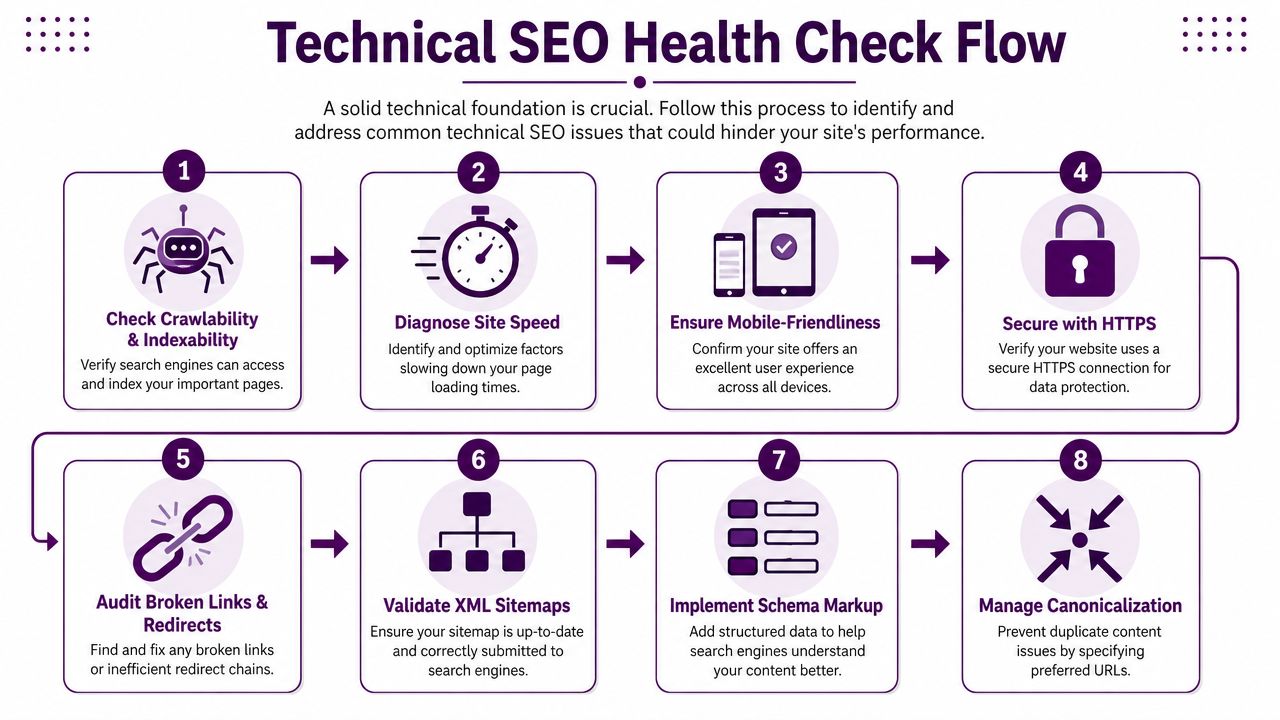
A page can be well written and well linked, then still underperform because Google can't crawl, render, or interpret it cleanly. Technical problems often stay invisible to non-specialists because the site looks fine in a browser. Google, however, reads the site through crawl paths, indexability rules, canonical signals, and mobile rendering.
Check the blockers first
Start with the issues that can prevent a page from appearing at all. Robots rules, noindex tags, broken canonicals, and accidental redirects are common culprits. If Google can't confidently access the page you want to rank, all the content work in the world won't move it.
Then check mobile usability and speed. Google's ranking guidance consistently points to mobile usability and technical accessibility as foundational signals, so pages that are awkward on a phone or hard to load are fighting uphill (Google ranking factors overview). You don't need a developer for the first pass. Use Search Console, a browser, and a page speed tool to look for obvious failures.
Review the site architecture
Keyword cannibalization is another quiet problem. If multiple pages target the same topic without a clear hierarchy, Google may split relevance across them instead of rewarding one strong URL. That is especially common on content-heavy sites where articles, category pages, and service pages overlap.
A quick technical checklist helps separate signal from noise:
Crawlability: verify that key pages are reachable through internal links.
Indexability: confirm the target URL is allowed to be indexed.
Mobile usability: test the page on a real phone, not just desktop preview.
Canonical clarity: make sure duplicates point to the right preferred URL.
Redirect sanity: avoid chains that slow down discovery and dilute clarity.
Technical SEO rarely creates the entire ranking problem, but it can make every other fix perform badly.
Use the current state of the site as the clue. If pages exist but aren't indexed, the fix is different from a page that is indexed but trapped behind poor architecture. If the site is mobile-friendly, fast enough, and cleanly crawlable, you've ruled out a major class of hidden blockers.
Creating Your Prioritized Action Plan
Diagnosis only matters if it leads to action. The easiest way to avoid overwhelm is to rank fixes by impact and effort, then work from the most impactful item downward. A broken noindex tag deserves attention before a cosmetic copy tweak, and a page with clear intent mismatch deserves attention before you obsess over a second backlink campaign.
Start with the issue that explains the most symptoms at once. If one problem is causing no impressions, indexing failures, and missing internal equity, that's the first move. If the page is indexed and visible but underperforming, content alignment usually beats everything else.
Use a simple priority order
Fix blockers first: indexation, crawlability, noindex errors, canonical confusion.
Strengthen relevance next: title, heading structure, subtopic coverage, internal links.
Build authority after that: relevant backlinks, mentions, and supporting citations.
Tune local signals where needed: location pages, profile data, reviews, and local links.
Then measure the outcome in Search Console, not in your memory. Watch impressions, clicks, and query coverage after each change. If a page starts surfacing for more relevant searches, you're moving in the right direction. If not, the diagnosis was wrong, and the next pass should focus on the layer you haven't solved yet.
This is the difference between reacting and operating. One approach creates noise. The other turns my site ranking Google into a repeatable process.
If you want a faster, more organized way to run this diagnosis on your own site, start with Keyword Kick and use it to turn scattered SEO signals into clear next steps. Keyword Kick can help you spot the highest-priority fixes, track what changes, and move from uncertainty to a plan you can execute.